The
Center for Food Safety is warning the public that the EPA is set to
approve the direct spraying of the herbicide 2,4-dichlorophenoxyacetic
acid (2,4-D) on Dow Chemical’s genetically engineered corn and soybeans.
That chemical is one-half of the compound called “Agent Orange” used in
Vietnam to destroy foliage; it caused cancer among Vietnam veterans.
EPA will render a decision after a 30 day comment period. Dow developed
the GE crops, known as “Enlist”, to withstand high doses of 2,4-D (which
it also sells) after its disastrous Roundup Ready crops created
glyphosate-resistant superweeds. You can sign a petition
opposing this action at CFS web site called “Dow Watch”. CFS opposes
this move by the EPA because they state, “wide scale use of herbicides
in tandem with GE crops has led to an epidemic of herbicide resistant
weeds, and the next step in the chemical arms race is Dow Chemical’s
2,4-D, a chemical linked to major health problems including cancer,
Parkinson’s disease, endocrine disruption, and reproductive problems.”
EPA advances approval of powerful weed killer for Dow’s ‘Agent Orange’ GMO crops
Published time: May 02, 2014 00:56 Edited time: May 03, 2014 14:35
The
US Environmental Protection Agency has revealed a proposal for mass use
of Dow Chemical’s herbicide 2,4-D on the company’s
genetically-engineered corn and soybeans. The GE crops were developed to
withstand several herbicides, including 2,4-D.
Dow would be allowed to sell the herbicide if the EPA approves it following a 30-day public comment period.
The
2,4-D chemical, combined with glyphosate, makes up the herbicide Enlist
Duo. 2,4-D also makes up half of the toxic mix in the now infamous 'Agent Orange,'
used by the United States during the Vietnam War, which is thought to
have resulted in the deaths of an estimated 400,000 people and birth
defects in 500,000 others.
Dow’s genetically-engineered corn and soybeans – known as Enlist – have received preliminary approval
from the US Department of Agriculture. Should Enlist crops win ultimate
authorization, the USDA said that would increase the annual use of
2,4-D (2,4-dichlorophenoxyacetic acid) in the United States from 26
million pounds per year to possibly 176 million pounds.
The crops are designed to withstand high doses of glyphosate – brought to market by biotech giant Monsanto as their Roundup weed killer – and 2,4-D. Dow’s corn and soybeans thus earned the derogatory name 'Agent Orange' crops by opponents of both the highly-toxic chemical mix and the controversial use of genetically-modified organisms (GMOs) in large-scale agriculture.
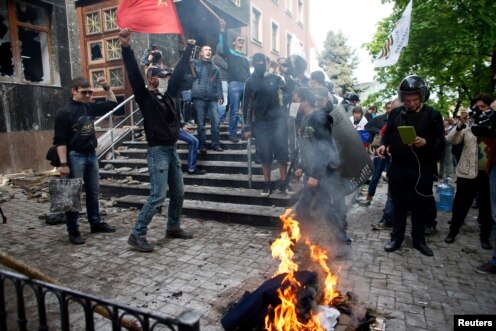
After
storming the office, Pro-Russian activists burn uniforms outside the
prosecutor's office in the separatist-held city of Donetsk, Ukraine, May
1, 2014.
VOA News
April 30, 2014 6:22 AM
Ukraine’s
acting president says that the Kyiv government has effectively lost
control over the situation in the country’s eastern Luhansk and Donetsk
regions where a number of government buildings have been taken over by
pro-Russia separatists.
Oleksandr Turchynov says that Russia is
now eyeing six more regions in the country’s east and south. A takeover
by Russia of two such regions, if it were to take full control of
Donetsk, would secure Russia’s land connection with Crimea, which it
annexed last month.
The takeover of two more regions along the
Black Sea coast would connect Russian mainland with Moldova’s
Russian-speaking Transdniestria enclave.
Speaking Wednesday at a
meeting of regional leaders in Kyiv, Turchynov operatives have received
instructions from Moscow to destabilize, via "acts of sabotage," the
regions of Kharkiv, Dnipropetrovsk, Kherson, Zaporizhzha, Mykolayiv and
Odesa.
Kyiv says that many such operatives have received training and are being financed by Russia, a charge Moscow denies. On full alert
Bracing
for a possible invasion by Russian troops massed on the border,
Turchynov says Ukraine’s military has been put "on full combat alert."
Speaking
at a ministerial meeting in Kyiv on Wednesday, he said there was a real
threat of Russia starting a war against Ukraine's mainland.
A
Ukrainian soldier stands guard in front of armored personnel carriers
at a check point near the village of Malynivka, southeast of Slovyansk,
in eastern Ukraine, April 29, 2014
Moscow, meanwhile, has voiced concern over Turchynov’s statement, criticizing it as “militaristic.”
“We
insist that Kyiv immediately cease its militaristic rhetoric aimed at
intimidating its own population,” said a Foreign Ministry statement
calling on Ukrainian authorities to start a dialogue toward national
reconciliation instead.
The criticism comes as pro-Russian gunmen
seized yet another administrative building in eastern Ukraine. Armed
insurgents took control of the local council building in Horlivka early
Wednesday, a town of more than 260,000 people. Police say the
pro-Russian rebels have also overtaken the town’s regional police
department.
Hundreds of pro-Russian separatists overran more
Ukrainian government buildings near the Russian border earlier this
week, taking control of several in the Donetsk and Luhansk regions.
The
pro-Moscow rebels in Donetsk have set a referendum on secession for May
11. A similar vote last month led to Russia's annexation of Ukraine’s
Crimean peninsula. Possible reshuffle
Ukrainian
Prime Minister Arseniy Yatsenyuk threatened his government on Wednesday
with a reshuffle if it failed to meet the demands of the people,
venting frustration with Kyiv's failure to restore law and order in the
country's east.
Some critics say the central government has become all but paralyzed by infighting.
“The
country demands action and results. If there is such action and results
that means the government is doing its job,” Yatsenyuk told a
government meeting.
“If in the near future such action and results fail to materialize, that means there will be personnel changes,” said Yatsenyuk.
He
said ministers would also pass to parliament a law on conducting a
nationwide poll on Ukrainian unity and territorial integrity, “those
issues which concern Ukraine today,” on May 25 when Ukraine is due to
hold a presidential election.
According to Tuesday's KPLC 7 News, a Sulphur, La., police officer
fatally shot a 14-month-old dog on Monday morning after being called
out to investigate a call about two suspicious men who were trespassing.
Though
the police officer has stated that the dog bit him, a witness to the
traumatic scene has a different version of what took place at the
parking lot of the Southwest Daily News. The young dog, named "Arzy
Kensington," had been tied to a fence near a box truck which Brandon
Carpenter, 28, and Logan Laliberte, 21, had taken shelter in when it
started to rain.
According to Eric Midkiff, circulation manager at
the Southwest Daily News, the officer who had been called out to the
scene to investigate a possible trespassing, interacted briefly with the
dog before firing the fatal shot. Midkiff described what he saw to the Huffington Post:
The dog was rubbing up against the cop,
He would rub the dog's back and then push him away. All of a sudden, he just jumped down and shot the dog in the head."
He added:
That dog did not bite that officer,"
"The dog was wagging his tail, his tongue was hanging out."
By Pam Martens and Russ Martens: April 28, 2014
It
doesn’t get any more Orwellian than this: Wall Street mega banks crash
the U.S. financial system in 2008. Hundreds of thousands of financial
industry workers lose their jobs. Then, beginning late last year, a rash
of suspicious deaths start to occur among current and former bank
employees. Next we learn that four of the Wall Street mega banks likely
hold over $680 billion face amount of life insurance on their workers,
payable to the banks, not the families. We ask their Federal regulator
for the details of this life insurance under a Freedom of Information
Act request and we’re told the information constitutes “trade secrets.”
According to the Centers for Disease Control and Prevention, the life expectancy of a 25 year old male
with a Bachelor’s degree or higher as of 2006 was 81 years of age. But
in the past five months, five highly educated JPMorgan male employees in
their 30s and one former employee aged 28, have died under suspicious
circumstances, including three of whom allegedly leaped off buildings – a
statistical rarity even during the height of the financial crisis in
2008.
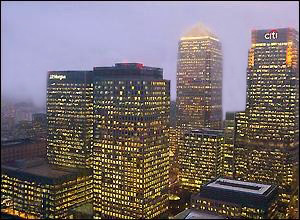
There is one other major obstacle to brushing away these
deaths as random occurrences – they are not happening at JPMorgan’s
closest peer bank – Citigroup. Both JPMorgan and Citigroup are global
financial institutions with both commercial banking and investment
banking operations. Their employee counts are similar – 260,000
employees for JPMorgan versus 251,000 for Citigroup.
Both JPMorgan
and Citigroup also own massive amounts of bank-owned life insurance
(BOLI), a controversial practice that pays the corporation when a
current or former employee dies. (In the case of former employees, the
banks conduct regular “death sweeps” of public records using former
employees’ Social Security numbers to learn if a former employee has
died and then submits a request for payment of the death benefit to the
insurance company.)
Wall Street On Parade carefully researched
public death announcements over the past 12 months which named the
decedent as a current or former employee of Citigroup or its commercial
banking unit, Citibank. We found no data suggesting Citigroup was
experiencing the same rash of deaths of young men in their 30s as
JPMorgan Chase. Nor did we discover any press reports of leaps from
buildings among Citigroup’s workers.
Given the above set of facts,
on March 21 of this year, we wrote to the regulator of national banks,
the Office of the Comptroller of the Currency (OCC), seeking the
following information under the Freedom of Information Act (See OCC Response to Wall Street On Parade’s Request for Banker Death Information):
The
number of deaths from 2008 through March 21, 2014 on which JPMorgan
Chase collected death benefits; the total face amount of BOLI life
insurance in force at JPMorgan; the total number of former and current
employees of JPMorgan Chase who are insured under these policies; any
peer studies showing the same data comparing JPMorgan Chase with Bank of
America, Wells Fargo and Citigroup.
The OCC responded politely by
letter dated April 18, after first calling a few days earlier to inform
us that we would be getting nothing under the sunshine law request. (On
Wall Street, sunshine routinely means dark curtain.) The OCC letter
advised that documents relevant to our request were being withheld on
the basis that they are “privileged or contains trade secrets, or
commercial or financial information, furnished in confidence, that
relates to the business, personal, or financial affairs of any person,”
or relate to “a record contained in or related to an examination.”
The
ironic reality is that the documents do not pertain to the personal
financial affairs of individuals who have a privacy right. Individuals
are not going to receive the proceeds of this life insurance for the
most part. In many cases, they do not even know that multi-million
dollar policies that pay upon their death have been taken out by their
employer or former employer. Equally important, JPMorgan is a publicly
traded company whose shareholders have a right under securities laws to
understand the quality of its earnings – are those earnings coming from
traditional banking and investment banking operations or is this
ghoulish practice of profiting from the death of workers now a major
contributor to profits on Wall Street?
As it turns out, one aspect
of the information cavalierly denied to us by the OCC is publicly
available to those willing to hunt for it. On March 24 of this year, we
reported that JPMorgan Chase held $10.4 billion in BOLI assets at its
insured depository bank as of December 31, 2013.
We reached out to
BOLI expert, Michael D. Myers, to understand what JPMorgan’s $10.4
billion in BOLI assets at its commercial bank might represent in terms
of face amount of life insurance on its workers. Myers said: “Without
knowing the length of the investment or its rate of return, it is
difficult to estimate the face amount of the insurance coverage.
However, a cash value of $10.4 billion could easily translate into more
than $100 billion in actual insurance coverage and possibly two or three
times that amount” said Myers, a partner in the Houston, Texas law firm
McClanahan Myers Espey, L.L.P.
Insurance policies pertaining to bankers’ suicides classified as containing ‘trade secrets’
Published time: April 29, 2014 19:09
After
a recent rash of mysterious apparent suicides shook the financial
world, researchers are scrambling to find answers about what really is
the reason behind these multiple deaths. Some observers have now come to
a rather shocking conclusion.
Wall Street on Parade bloggers Pam and Russ Martens wrote
this week that something seems awry regarding the bank-owned life
insurance (BOLI) policies held by JPMorgan Chase. Traditional life
insurance policies ensure that the loved ones of the deceased are
compensated fairly in the event of a death, but banks are investing
billions in policies that let them receive untaxed payment with the
passing of each employee. While it’s not unusual for major banks to take
out policies that compensate companies in the event of an employee
death, the Martens wrote, attempts to find out more about that practice
have been peculiarly hard and have raised a red flag among bloggers like
those at Wall Street on Parade.
Four of the biggest banks on Wall
Street combined hold over $680 billion in BOLI policies, the bloggers
reported, but JPMorgan held around $17.9 billion in BOLI assets at the
end of last year to Citigroup’s comparably meager $8.8 billion.
Both
banks are global financial institutions with commercial and investment
banking operations, the Martens wrote, and each employs close to a
quarter-of-a-million employees. Nevertheless, they say that JPMorgan has
experienced a far greater rate of suicide among employees in recent
months, particularly in the midst of a series of news reports
documenting unusual leaps off buildings and other bizarre deaths that
have taken the lives of JPMorgan staffers.
Hmmmm, alert the presses and let everyone know that in spite of the facts that :
Oil
spills are never properly cleaned up and the side effects of the
chemicals and toxins left behind linger for years.
Energy
Companies responsible for the spills are never truly held
accountable for all the damage done due to carelessness and cost
cutting to fatten their bottom line
Sea life , Coral
Reefs, and the food chain in oil spill damaged areas face death
at every turn. While the culprits shrug their shoulders and say
"Oh Well"
Coastlines are negatively impacted.
Damaging not only the ecology but the livelihood of those who
depend on a clean and healthy ocean to sustain themselves and their
families.
The Energy Companies walk away after
THEY feel they have done enough when in reality they fall
woefully short and the corrupt government taking corporate
kickbacks allows them to get away with their crimes with a slap
on the wrist.
In spite of all this destruction ........Oil Spills create jobs.
Would that also be the case for oil spills caused by,
oh
let's say, pipeline leaks and train derailments in populated areas
where not only people are affected, but their ground water and
lands are poisoned with chemicals and toxic oil that can never truly
be completely removed?
Yes indeed, that certainly is worth the jobs created alright......NOT!!
~Desert Rose~
.....
Kinder Morgan: Oil Spills' Economic Effects Are Both Good And Bad
The Huffington Post Canada | Posted: 05/01/2014 1:41 pm EDT | Updated: 05/01/2014 1:59 pm EDT
There is at least something of a bright side to oil spills, pipeline company Kinder Morgan says.
In a recent submission to the National Energy Board, the company says marine oil spills “can have both positive and negative effects on local and regional economies” thanks to the economic activity generated by cleanup operations.
“Spill
response and clean-up creates business and employment opportunities for
affected communities, regions, and clean-up service providers,” the
company says.
The comments appear in a 15,000-page application to the NEB to triple the capacity of its Trans Mountain Pipeline, which carries oil from Alberta to Port Metro Vancouver.
Environmentalists fear an increase in oil shipments through West Coast waters would increase the risk of oil tanker accidents.
Kinder
Morgan’s submission doesn’t ignore the negatives; it points out that
oil spills are devastating to fishing and tourism industries, and notes
the negative impacts on human health, damage to property and harm done
to “cultural resources.”
But it cites a 1990 research paper looking at the economic impacts of the Exxon Valdez oil spill to argue there are positive elements as well.
It's in the cards; spread of possible oil spill tracked by 'drift card' study
Apr 1, 2014 at 12:00PM updated at 2:33PM
Jennifer of Victoria and a friend show off a drift card that she found on Vancouver Island.
— image credit: Contributed photo/Friends of San Juans
Journal staff report
Conservation
groups from Washington and British Columbia commemorated the 25th
anniversary of the Exxon Valdez oil spill by launching 650 ‘drift cards’
along Salish Sea oil tanker routes.
The
cards were dropped at two locations: off Turn Point, Stuart Island,
where Haro Strait intersects with Boundary Pass, and near Bird Rocks in
Rosario Strait. They carry a simple message: This Could Be Oil.
This
research responds to a sharp increase in fossil fuel export projects
proposed in British Columbia and Washington state. The proposed Gateway Pacific coal terminal
at Cherry Point north of Bellingham and Kinder Morgan’s increase in
tar-sands shipping from Vancouver, and other projects, would add an
additional 2,620 ship transits per year to the waters of the Salish Sea,
making the region one of North America’s busiest fossil fuel shipping
corridors.
“The
increased risk of a major oil spill in the Salish Sea is real," said
Stephanie Buffum, executive director of Friends of the San
Juans. "Anyone with a cultural, environmental or economic interest in
our region should get engaged with Coast Guard rulemaking; familiarize
themselves with effects of cargo traveling through our waters; and ask
decision makers to ensure diluted bitumen (oil sand) is classified as a
petroleum product that is taxed to fund oil spill clean-up efforts.”
Here are some of those job opportunities Kinder Morgan was referring to :
.....
BP pipeline sprays ‘oily mist’ over 33 acres of Alaskan tundra
Published time: May 01, 2014 03:15
Alaska
state officials confirmed Wednesday that an oily mist sprung from a
compromised oil pipeline and sprayed into the wind without stopping for
at least two hours, covering 33 acres of the frozen snow field in the
oil well's vicinity.
The discovery was at the BP-owned Prudhoe oil
field on Alaska’s North Slope, the northernmost region of the state
where a number of profitable oil fields sit beneath the tundra. The
Alaska Department of Environmental Conservation (DEC) revealed that BP
officials found the mist during a routine inspection on Monday.
Initial
reports said that 27 acres had been covered, although that figure was
updated later on Wednesday. The cause is still under investigation,
according to the Associated Press,
but officials know that the mist was made up of a mixture of gas, crude
oil, and water. They also reported that while the noxious mist was
distributed over such a wide area by 30 mph winds, no wildlife was
impacted.
BP spokeswoman Dawn Patience said the company is “still assessing repairs” and will soon know what, if any, long-term effects the spill could have.
The
Prudhoe Bay region, like elsewhere in the North Slope, is home to a
great number of migratory birds and caribou, as well as other animals,
such as a massive porcupine herd. Clean-up efforts are expected to be
complete before birds pass through the region again in the coming weeks.
The
company was at fault in at least two oil spills in the same region
since 2006. That year, an estimated 267,000 gallons of oil seeped
through a quarter-inch sized hole in a corroded BP pipeline. That
accident went unnoticed for five days, until an oil worker smelled the
aroma of crude when driving through the area, according to Think Progress.
Lynchburg, Virginia Train Derailment Sparks Fire, Fills Air With Plumes Of Black Smoke
The Huffington Post
Posted: Updated:
A CSX train derailed near downtown Lynchburg, Virginia around 2:30 p.m. on Wednesday, prompting evacuations and calls to avoid part of the city as flames and a plume of black smoke rose into the air. There are no immediate reports of injuries.
The City Of Lynchburg announced that the train was carrying crude oil and three or four of its 13 to 14 cars were breached.
"There is some spillage in the river of crude oil,"
Lynchburg city spokeswoman LuAnn Hunt told the Richmond Times-Dispatch.
Richmond primarily draws its water from the James River, downstream
from Lynchburg. Another official said the city is making plans to tap an
"alternative water supply."
The train's tankers may be from a
class of rail cars deemed an "unacceptable public risk" by a member of
the National Transportation Safety Board in February. These black, pill-shaped cars, known as DOT-111s, have been involved in recent notable oil train derailments in North Dakota and Quebec.
"We are very clear that this issue needs to be acted on very quickly,"
National Transportation Safety Board Chairman Deborah Hersman told
reporters last week. The Transportation Department is currently working
on stricter standards for rail tank cars used to transport hazardous
materials. "They aren't moving fast enough," Hersman said.
In February, Plains CEO Greg Armstrong said on the company's quarter four earnings call that Yorktown is ideally situated geographically to become an oil export mecca if the ban is lifted.
When
asked by an analyst from Bank of America about the ongoing debate over
lifting the crude oil export ban, Armstrong discussed how Plains could
stand to profit from exports.
http://www.democracynow.org
- The oil giant BP is back in court for the April 2010 accident that
caused the worst offshore oil spill in U.S. history, killing 11 workers
and leaking almost five million barrels of crude oil into the Gulf of
Mexico. On Monday, the second phase of the trial began with lawyers
accusing the oil company of lying about how much oil was leaking,
failing to prepare for how to handle the disaster, and for not capping
the leak quick enough. We're joined in New Orleans by Monique Harden,
co-director of Advocates for Environmental Human Rights and an attorney
who specializes in environmental justice concerns in New Orleans. In the
aftermath of the BP spill, Harden's organization exposed how the oil
giant had contracted with a claims processing company that promoted its
record of reducing lost dollar pay-outs for injuries and damage caused
by its client companies. We are also joined by John Barry, vice
president of the Southeast Louisiana Flood Protection Authority -- East,
which has brought a lawsuit against 97 oil and gas companies for
destruction of the Gulf coastline, making the area more at risk from
flooding and storm surges.
Democracy Now!, is an independent
global news hour that airs weekdays on 1,200+ TV and radio stations
Monday through Friday. Watch it live 8-9am ET at http://www.democracynow.org.
BP oil spill redirects here. For the
2006 oil spill involving BP, see Prudhoe Bay oil spill. For other uses,
see The Deepwater Horizon oil spill (also refe.
BBC Stephen Fry
And The Great American Oil Spill BBC Documentary on BP Oil Spill
Disaster. The Deepwater Horizon oil spill (also referred to as the BP
oil sp.
documentary, documentaries, full documentary, history
documentary, documentary bbc, history channel documentary, documentary
history channel, national geogra.
documentary, documentaries,
full documentary, history documentary, documentary bbc, history channel
documentary, documentary history channel, national geogra.
TAGS:
Gulf Of Mexico (Body Of Water) Disaster (Quotation Subject) Oil Spill
(Disaster Type) Beach Flip Ocean May Cry Thomas Engine Storm Start Back
Front Tra.
Full documenary Channel.Please subscrible our channel
to watch more videos. Deepwater Disaster BP Oil Spill Documentary . All
our videos for just education.
Please Enjoy. Subscribe & Like
too. Thanks. Cheers! Stephen Fry loves Louisiana. Four months after the
BP oil spill, dubbed the worst ecological disaster in .
The
Deepwater Horizon oil spill, also called the BP Oil Spill, the Gulf of
Mexico oil spill or the Macondo blowout. I dont Own the Video Footage or
Images..
documentary, documentaries, full documentary, history
documentary, documentary bbc, history channel documentary, documentary
history channel, national geogra.
no description available
documentary, documentaries, full documentary, history documentary,
documentary bbc, history channel documentary, documentary history.
On
the three year memorial of the BP Oil Spill disaster I wanted to share
with you one very important fact. BP has been lying to you! Due to
decades of abuse.
Visit to find out how you can help! On April
20, 2010, the largest environmental disaster in US history began when
the Deepwater Horizo.
A documentary that examines the April 2010
oil spill in the Gulf of Mexico following the sinking of the Deepwater
Horizon oil rig. News Feeds on the issue ht.
BP Oil Spill Timeline.
The
Deepwater Horizon oil spill (also referred to as the BP oil spill, the
BP oil disaster, the Gulf of Mexico oil spill, and the Macondo blowout)
began on 2.
Please read the description! What really happened
with the cover-up of the Deep Water Horizon incident in the Gulf of
Mexico. Josh and Rebecca Tickell interv.
The Deepwater Horizon
oil spill (also referred to as the BP oil spill, the Gulf of Mexico oil
spill, the BP oil disaster or the Macondo blowout) is an oil sp.
This
video covers many environmental results of the BP Oil Spill, which
originated from a rig explosion on April 20, 2010 in the Gulf of Mexico,
placing an e.
Footage about the greatest oil disaster of all
times (2010 Gulf) Watch at our Planet like it would be your Child! dont
close your eyes! do your part!
.....
The 14,000 Oil Spills Nobody is Talking About | Brainwash Update
Abby Martin goes over updates to the
chemical spill in West Virginia and the coal-ash spill in North
Carolina, exposing the human and environmental impact as well as the
lack of accountability that accompanies tens of thousands of similar
ecological catastrophes that occur in the US every year due to the US'
addiction to fossil fuel. .....

 You can sign a petition
opposing this action at CFS web site called “Dow Watch”. CFS opposes
this move by the EPA because they state, “wide scale use of herbicides
in tandem with GE crops has led to an epidemic of herbicide resistant
weeds, and the next step in the chemical arms race is Dow Chemical’s
2,4-D, a chemical linked to major health problems including cancer,
Parkinson’s disease, endocrine disruption, and reproductive problems.”