Saturday, May 10, 2014

Numerous US agents are helping the coup-appointed government in Ukraine to “fight organized crime” in the south east of the country, the German newspaper Bild revealed.

Dozens of FBI, CIA agents in Kiev 'assisting Ukraine security'

Published time: May 04, 2014 09:32
Edited time: May 04, 2014 10:07


Reuters/Larry Downing

According to the daily, the CIA and FBI are advising the government in Kiev on how to deal with the ‘fight against organized crime’ and stop the violence in the country’s restive eastern regions.
The group also helps to investigate alleged financial crimes and is trying to trace the money, which was reportedly taken abroad during Viktor Yanokovich’s presidency, the newspaper said.
The head of the CIA, John Brennan, visited Kiev in mid-April and met with the acting Prime Minister Arseniy Yatsenyuk and first Vice-President Vitaly Yarema to discuss a safer way to transfer US information to Ukraine.

Read More Here
Enhanced by Zemanta

NATO Deputy Secretary General Alexander Vershbow now says that the allied group has been compelled to treat Russia “as more of an enemy than a partner,”

NATO’s second-in-command says Russia is now an enemy, not a partner

Published time: May 01, 2014 17:08
Edited time: May 02, 2014 06:51


 NATO Deputy Secretary General Alexander Vershbow (AFP Photo / Yuri Kadobnov)
NATO Deputy Secretary General Alexander Vershbow (AFP Photo / Yuri Kadobnov)
NATO Deputy Secretary General Alexander Vershbow now says that the allied group has been compelled to treat Russia “as more of an enemy than a partner,” according to an Associated Press report published Thursday.
The 61-year-old former United States ambassador to Russia reportedly told journalists this week that Moscow’s role in the ongoing crisis in Ukraine has forced NATO to reconsider the alliance’s opinion on Russia, and that additional troops may soon be mobilized to the region as tensions worsen.
AP journalist Robert Burns wrote on Thursday that Vershbow said the Kremlin’s perceived part in the recent events in Ukraine “marks a turning point in decades of effort by NATO to draw Moscow closer.”
NATO’s second-in-command reportedly told journalists that the alliance is now considering new measures meant to counter any future acts of aggression on the part of Russia aimed at partner nations, and soon could deploy a larger number of combat forces to Eastern Europe.
Journalists reporting for Civil.Ge wrote on Thursday that Vershbow told the audience at a panel discussion in Washington, DC one day earlier that NATO should deploy “defensive assets to the region.”
“We need to step up our support for defense reforms and military modernization of Russia’s neighbors, and not just of Ukraine, but also Moldova, Georgia, Armenia, Azerbaijan,” Vershbow said, according to the Civil Georgia site.

Read More Here
Enhanced by Zemanta

Apple, Microsoft, Facebook, and Google have updated their policies to routinely notify customers when law enforcement has requested information about them.

Defiant Apple, Facebook, other firms to inform public of govt surveillance requests

Published time: May 02, 2014 01:07
Edited time: May 02, 2014 06:42

Reuters / Eric Thayer

The same technology companies that the US intelligence community has relied upon to disclose email records are now refusing to keep surveillance requests secret and informing customers when they are the subject of such requests.
In the nearly ten months since former US National Security Agency contractor Edward Snowden revealed extensive surveillance efforts on everyday Americans’ online activity, the companies that were forced to facilitate that surveillance have come under harsh public scrutiny.
The embarrassment ignited a series of comments from executives at Google and Facebook, among others, calling on the NSA and other agencies to either stop forcing them to provide the communications that customers trust them with, or allow them to be more transparent.
Now, according to a Thursday report in the Washington Post, Apple, Microsoft, Facebook, and Google have updated their policies to routinely notify customers when law enforcement has requested information about them.
Yahoo enacted such a change in July, with the Post reporting Thursday that companies “have found that investigators often drop data demands to avoid having suspects learn of inquiries.”

Read More Here

.....

Apple, Facebook, others defy authorities, notify users of secret data demands


Major U.S. technology companies have largely ended the practice of quietly complying with investigators’ demands for e-mail records and other online data, saying that users have a right to know in advance when their information is targeted for government seizure.This increasingly defiant industry stand is giving some of the tens of thousands of Americans whose Internet data gets swept into criminal investigations each year the opportunity to fight in court to prevent disclosures. Prosecutors, however, warn that tech companies may undermine cases by tipping off criminals, giving them time to destroy vital electronic evidence before it can be gathered.
Graphic
How the NSA is infiltrating private networks
Click Here to View Full Graphic Story
How the NSA is infiltrating private networks

Fueling the shift is the industry’s eagerness to distance itself from the government after last year’s disclosures about National Security Agency surveillance of online services. Apple, Microsoft, Facebook and Google all are updating their policies to expand routine notification of users about government data seizures, unless specifically gagged by a judge or other legal authority, officials at all four companies said. Yahoo announced similar changes in July.As this position becomes uniform across the industry, U.S. tech companies will ignore the instructions stamped on the fronts of subpoenas urging them not to alert subjects about data requests, industry lawyers say. Companies that already routinely notify users have found that investigators often drop data demands to avoid having suspects learn of inquiries.
“It serves to chill the unbridled, cost-free collection of data,” said Albert Gidari Jr., a partner at Perkins Coie who represents several technology companies. “And I think that’s a good thing.”
The Justice Department disagrees, saying in a statement that new industry policies threaten investigations and put potential crime victims in greater peril.
“These risks of endangering life, risking destruction of evidence, or allowing suspects to flee or intimidate witnesses are not merely hypothetical, but unfortunately routine,” department spokesman Peter Carr said, citing a case in which early disclosure put at risk a cooperative witness in a case. He declined to offer details because the case was under seal.
The changing tech company policies do not affect data requests approved by the Foreign Intelligence Surveillance Court, which are automatically kept secret by law. National security letters, which are administrative subpoenas issued by the FBI for national security investigations, also carry binding gag orders.
The government traditionally has notified people directly affected by searches and seizures — though often not immediately — when investigators entered a home or tapped a phone line. But that practice has not survived the transition into the digital world. Cellular carriers such as AT&T and Verizon typically do not tell customers when investigators collect their call data.
Many tech companies once followed a similar model of quietly cooperating with law enforcement. Courts, meanwhile, ruled that it was sufficient for the government to notify the providers of Internet services of data requests, rather than the affected customers.
Twitter, founded in 2006, became perhaps the first major tech company to routinely notify users when investigators collected data, yet few others followed at first. When the Electronic Frontier Foundation began issuing its influential “Who Has Your Back?” report in 2011 — rating companies on their privacy and transparency policies — Twitter was the only company to get a star under the category “Tell users about data demands.” Google, the next mostly highly rated, got half a star from the civil liberties group.

Read More Here

.....
Enhanced by Zemanta

Another bad sign for America's middle class


Dees Illustration.com
.....
ByBruce Kennedy

Another bad sign for America's middle class

You don't have to be an economic victim of the Great Recession to know that America's middle class is being squeezed in an unprecedented manner. Not only is the U.S. middle class no longer the world's richest, according to recent research, but millions of families who were once financially secure are now living hand-to-mouth.
What's going on? A new report from the National Employment Law Project finds that, nearly five years after the recession officially ended, most of the jobs that have been created during the recovery offer lower wages. Such positions made up 22 percent of jobs lost in the recession, but have accounted for 44 percent of employment growth.

Play Video

Where is the middle class heading?


The labor research and advocacy group also found that, from the outset of the recession in late 2007 to its low point in February of 2010, "employment losses occurred throughout the economy, but were concentrated in mid-wage and higher-wage industries."
By contrast, mid-wage positions, which composed 37 percent of the jobs cut in the recession, have made up only 26 percent of those recovered. High-wage industries, which made up 41 percent of recession jobs lost, reportedly had a 30 percent recovery growth.
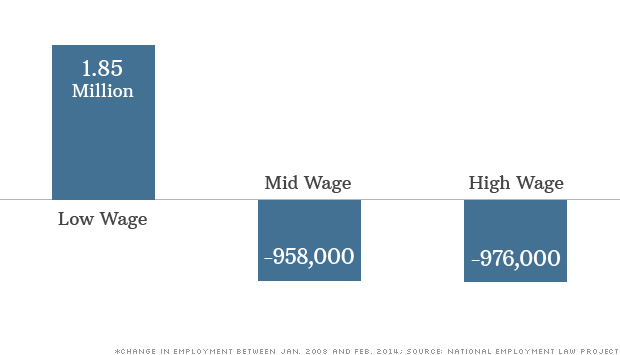
"Today, there are nearly 2 million fewer jobs in mid- and higher-wage industries than there were before the recession took hold, while there are 1.85 million more jobs in lower-wage industries," NELP said in a statement,

Read More Here

.....

The low wage jobs explosion

  @Luhby April 28, 2014: 4:57 PM ET
low wage explosionLow wage jobs are on the rise.
NEW YORK (CNNMoney)

Looking for a job? The ones you'll find will likely be low wage.

The labor market has been recovering since the Great Recession ended, but many of the jobs created have been in low-wage industries, according to a new report by the National Employment Law Project, a left-leaning group.
Among the fastest-growing jobs: Food services, home health care and retail -- all of which pay relatively little.
Better paying blue-collar industries, such as construction and manufacturing, have not recovered to their employment levels before the recession.
Lower wage industries accounted for 44% of employment growth since employment hit bottom in February 2010, the group found.
Going back to the start of the recession six years ago, the nation has added 1.85 million jobs in low-wage industries, but mid-wage and higher-wage industries have shed nearly 1 million positions each.

Read More Here

.....
Enhanced by Zemanta

Wednesday, May 7, 2014

Self-defense forces in the anti-Kiev stronghold of Slavyansk are Ukrainians, not Russians, say NYT reporters

No Russians among Slavyansk self-defense forces – NYT reporters

Published time: May 04, 2014 20:47


Kramatorsk, in eastern Ukraine May 2, 2014. (Reuters / Marko Djurica)
Self-defense forces in the anti-Kiev stronghold of Slavyansk are Ukrainians, not Russians, who distrust the new regime and the Western powers that support it, New York Times reporters have discovered. The forces also said they are not being paid to fight.
Two New York Times reporters have spent a week in the city of Slavyansk in eastern Ukraine, talking to members of the self-defense forces. The journalists visited self-defense checkpoints and observed the forces as they battled Ukrainian troops amid a military assault on the city on Friday.
The resistance fighters of the 12th Company, part of the People’s Self-Defense of the self-proclaimed Donetsk People’s Republic, deny claims made by Kiev and its Western sponsors that Russia or private tycoons are paying them to fight.
“This is not a job,” one of the activists, Dmitry told the NYT reporters. “It is a service.”
Armed with dated weapons, the self-defense activists said they would have bought new weapons if they had financial support. The NYT journalists reported seeing weapons from the 1980s and 1990s in checkpoints and warehouses.

The eastern Ukrainian city of Slavyansk on April 14, 2014. (AFP Photo / Anatoly Stepanov)
The activists explained that they purchased some of their weaponry from corrupt Ukrainian soldiers, while taking others from seized police buildings or confiscating them from captured Ukrainian armored vehicles.
“Much of their stock was identical to the weapons seen in the hands of Ukrainian soldiers and Interior Ministry Special Forces troops at government positions outside the city,” the NYT reporters said in an article published on Saturday.
“These included 9-millimeter Makarov pistols, Kalashnikov assault rifles, and a few Dragunov sniper rifles, RPK light machine guns and portable antitank rockets, including some with production stamps from the 1980s and early 1990s.”
The head of Slavyansk self-defense, Yury, also chuckled at claims made by Kiev authorities and the West that Russians are fighting side by side with them.
“We have no Muscovites here,” Yury told the journalists. “I have experience enough.”

Read More Here

Enhanced by Zemanta

Recovery for Whom? U.S. job growth jumps, number of people dropping out of the labor force, which pushed the unemployment rate to a 5-1/2-year low of 6.3 percent. Wage growth also was stagnant.

Reuters

People wait in line to meet a job recruiter at the UJA-Federation Connect to Care job fair in New York March 6, 2013. REUTERS/Shannon Stapleton
People wait in line to meet a job recruiter at the UJA-Federation Connect to Care job fair in New York March 6, 2013.
Credit: Reuters/Shannon Stapleton

 U.S. job growth jumps, but shrinking labor force a blemish

WASHINGTON Fri May 2, 2014 4:52pm EDT

(Reuters) - U.S. employers hired workers at the fastest clip in more than two years in April, pointing to a rebound in economic growth after a dreadful winter and keeping the Federal Reserve on track to end bond purchases this year.
The brightening outlook was, however, tempered somewhat by a sharp increase in the number of people dropping out of the labor force, which pushed the unemployment rate to a 5-1/2-year low of 6.3 percent. Wage growth also was stagnant.
Nonfarm payrolls surged 288,000 last month, the Labor Department said on Friday. That was largest gain since January 2012 and beat economists' expectations for only a 210,000 rise.
"It lends significant legitimacy to the positive tone in the wide array of post-February economic reports, which have all been consistently pointing to a significant pick-up in economic growth momentum this quarter," said Millan Mulraine, deputy chief economist at TD Securities in New York.
March and February's data was revised to show 36,000 more jobs than previously reported.
U.S. stocks briefly rallied on the report, which was later eclipsed by rising tensions in Ukraine. Stocks ended lower, while safe-haven bids pushed the yield in the 30-year U.S. government bond to its lowest level in more than 10 months.
The dollar was flat against a basket of currencies.
About 806,000 people dropped out of the labor force in April, unwinding the previous months' gains. That helped to push down the unemployment rate 0.4 percentage point to its lowest level since in September 2008.
The labor force participation rate, or the share of working-age Americans who are employed or unemployed but looking for a job, also fell four-tenths of a percentage point to 62.8 percent last month, slipping back to a 36-year low touched in December.
Overall, however, the data suggested the economy was gathering strength and led investors to pull forward their bets on when the Fed will start to raise interest rates.
The strong payrolls growth added to upbeat data such as consumer spending and industrial production in suggesting that sputtering growth in the first quarter was an aberration, weighed down by an unusually cold and disruptive winter.

Read More Here

Factbox

.....
Reuters

Discouraged job seekers behind shrinking labor force

WASHINGTON Fri Apr 5, 2013 6:58pm EDT

People wait in line to meet a job recruiter at the UJA-Federation Connect to Care job fair in New York March 6, 2013. REUTERS/Shannon Stapleton
People wait in line to meet a job recruiter at the UJA-Federation Connect to Care job fair in New York March 6, 2013.
Credit: Reuters/Shannon Stapleton

...
(Reuters) - Americans giving up the hunt for jobs were likely behind a sharp drop in the U.S. workforce last month, a bad sign for an economy that is struggling to achieve a faster growth pace.
The number of working-age Americans counted as part of the labor force -- either with a job or looking for one -- tumbled by 496,000 in March, the biggest fall since December 2009, the Labor Department said on Friday. That pushed the so-called workforce participation rate to a 34-year low of 63.3 percent.
March marked the second month in a row that the participation rate declined -- 626,000 people have dropped from the work force since January.
Friday's report showed a decline in the number of discouraged job seekers last month after a pop in February, which at first glance might suggest the drop in the workforce was mainly because of shifting demographics.
But a closer look at the underlying numbers raises questions about the notion that retiring baby boomers were the driving force behind the shrinking workforce.
"You have to think that it's a large part demographics, but demographics are not really going to have such a big effect on month-to-month changes," said Keith Hall, senior research fellow at George Mason University's Mercatus Center.
Of the nearly 500,000 people dropping out, just 118,000 were aged 55 and older, meaning more than three-quarters of the increase came from below-retirement-age adults.
Also, the number of people 65 and older counted as part of the workforce actually rose by 27,000, which followed a 72,000 increase in February.
Hall said the sluggish economy was forcing some older Americans to continue working to rebuild retirement nest-eggs that were shattered during the 2007-09 recession.
Indeed, the participation rate for Americans between 55 and 64 years old held steady at a relatively high 65 percent. On the other hand, participation by the 25-29 age group was the lowest since record-keeping started in 1982.
"People are just giving up the search for work. A lot of them would like to work and they aren't, that is a serious sickness in the economy," said Peter McHenry, assistant economics professor at the College of William & Mary in Williamsburg, Virginia.
The drop in participation helped to lower the unemployment rate by a tenth of a percentage point to 7.6 percent. If the workforce had not contracted, the jobless rate would have risen two-tenths of a percentage point to 7.9 percent in March.

Read More Here


.....


Enhanced by Zemanta