President Obama announced late Friday night that the U.S. will provide a $1 billion loan guarantee to Jordan, money meant to help the nation deal with the flood of refugees that have crossed over from Syria to escape a bloody civil war.
Mr. Obama made the announcement during a bilateral meeting with Jordan’s King Abdullah II
at a private retreat in Rancho Mirage, Calif. The president also said
he intends to renew a five-year memorandum of understanding with Jordan, worth about $360 million in direct economic support and another $300 million in military financing, according to the White House.
Mr.
Obama said both the agreement and the $1 billion loan are designed to
help Jordanian economic development overall, but also said the
deteriorating situation in Syria has placed a burden on Jordan that other countries must help bear.
“The people of Jordan
have been very generous in absorbing hundreds of thousands of
displaced persons from that war-ravaged country,” Mr. Obama said at
the outset of his meeting with the king. “It puts a great strain on
the resources of Jordan and it’s very important for us to make sure that we’re supportive of the kingdom in accommodating all these refugees.”
WASHINGTON — The Obama administration plans to suspend a substantial portion of American military aid to Egypt, several administration officials said Tuesday, after last summer’s deadly crackdown on the Muslim Brotherhood and the recent surge in violence there.
The
decision, which is expected to be announced in the coming days, will
hold up the delivery of several types of military hardware to the
Egyptian military, these officials said, including tanks, helicopters
and fighter jets. But it will not affect aid for counterterrorism
operations or for border security issues involving the Sinai Peninsula
and Gaza.
The administration’s move follows a lengthy review that
began in August after days of bloody attacks on supporters of Egypt’s
ousted president, Mohamed Morsi,
which left hundreds of people dead. The administration had already
frozen the shipment of four F-16 fighter jets and canceled joint
military exercises with the Egyptian Army.
The United States will
also suspend nonmilitary aid that flows directly to the government, but
not support for other activities like education or hospitals, the
officials said.
The decision, which was first reported Tuesday by
CNN, does not amount to an across-the-board cutoff of aid to the
Egyptian government, officials said. But they said Mr. Obama felt
compelled to take stronger action, especially after street clashes
erupted in several Egyptian cities on Sunday, killing more than 50
people.
Under the administration’s plan, officials said, the
military aid could be restored later if the Egyptian government showed
signs of restoring democratic institutions and a new government.
In
a statement on Tuesday evening, Caitlin Hayden, a spokeswoman for the
National Security Council, said: “Reports that we are halting all
military assistance to Egypt are false. We will announce the future of
our assistance program with Egypt in the coming days.”
Mr. Obama, she noted, said at the United Nations General Assembly last month that the “assistance relationship will continue.” In that speech,
however, Mr. Obama was critical of Egypt’s military-backed government
and warned that the delivery of American military hardware could be
affected if it did not take steps to put the country on the path to a
democratic transition.
While acknowledging that Mr. Morsi and his
Muslim Brotherhood-led government had lost the support of a large part
of the Egyptian public before the military ousted him in July, Mr. Obama
said the interim government “has made decisions inconsistent with
inclusive democracy.”
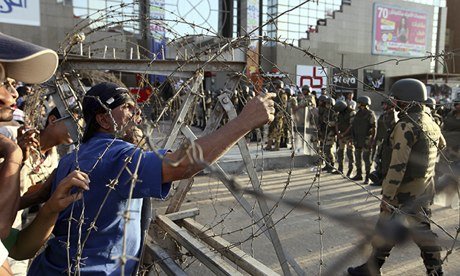
Egyptian supporters of
ousted president Mohamed Morsi confront troops during a protest in
Cairo last week. Photograph: Khaled Elfiqi/EPA
The Obama administration is poised to slash hundreds of millions of dollars in military and economic assistance to Egypt, US officials have said. An announcement is expected this week.
The
US has been considering such a move since the Egyptian military removed
the country's first democratically elected leader in June. It would be a
dramatic shift for the Obama administration, which has declined to
label President Mohamed Morsi's ousting a coup and has argued it is in US national security interests to keep aid flowing.
The
decision is likely to have profound implications for relations between
the US and Egypt after decades of close ties that have served as a
bulwark of security and stability in the Middle East.
The US
officials spoke on condition of anonymity because they were not
authorised to talk publicly before the administration's official
announcement.
President Obama's top national security aides recommended the aid cutoff in late August
– a policy shift Obama had been expected to announce last month. But
the announcement got sidetracked by the debate over whether to launch
military strikes against Syria. The US provides Egypt
with $1.5bn (£940m) a year in aid, $1.3bn of which is military
assistance; the rest is economic. Some of the aid goes to the government
and some to other groups but it is only the money that goes to the
government that would be suspended.
U.S. President Barack Obama delivers remarks at a business leaders' forum in Dar es Salaam, Tanzania, on Monday. (Reuters)
When U.S. President Barack Obama wraps up an African tour today, it
will mark the end of what some international development experts say is
an attempt to counter China’s growing influence throughout sub-Saharan
Africa and assert American economic dominance on the continent.
China surpassed the U.S. in total trade in sub-Saharan Africa in
2009, but its increasingly strong economic ties took root in 2000, when
then-Chinese president Hu Jintao hosted representatives from 44 African
nations in Beijing to establish the Forum on China-Africa Co-operation.
That meeting "set a mandate for China to become Africa's largest
trading partner," says Richard Poplak, a Johannesburg-based Canadian
author and journalist writing a book about China’s growing role in
Africa.
U.S. President Barack Obama speaks at the University of Cape Town on Sunday.(Reuters)
It
was also an early sign that the Chinese viewed economic opportunity in
Africa through a different lens than their American counterparts.
"What the Chinese did that no one else had done before was that they
considered Africa as a market — a market for Chinese goods, institutions
and services — when the rest of world viewed Africa as an economic
basket case and a place for aid programs,' says Poplak.
While the U.S. focused on global security following the attacks on
Sept. 11, 2001, Chinese firms began shoring up major contracts
throughout the continent that ensured access to Africa's vast resource
wealth in exchange for the funding and construction of infrastructure
projects like roads, railways and airports.
China also emphasized multilateral agreements with entire regions of
sub-Saharan Africa — agreements the U.S. has largely avoided in the
past, says Thomas Tieku, an assistant professor at the Munk School of
Global Affairs at the University of Toronto.
"The
U.S., in many senses, miscalculated their approach to Africa. It has
always been to focus on bilateral relationships— select a few countries
and deal solely with them," says Tieku. "Now they're playing a catch-up
game to try to establish equally strong relationships with multilateral
institutions like the African Union."
A new approach
Obama’s
three major announcements during the trip — a $7-billion project to
increase electrical infrastructure in sub-Saharan Africa; an investment
in trade with the East African Community (EAC); and a meeting in
Washington with leaders from throughout Africa next year, are signs of a
shifting U.S. approach to business in Africa, says Tieku.
“One area where China cannot compete with the U.S. is soft power.
Many Africans love American pop culture, and the best way to get a
pro-American message to Africans is through televisions, radios and the
internet.
“So the infrastructure investment will help Africans, but also the U.S. down the road.”
The
agreement with the five EAC nations signals that the U.S. is willing to
begin dealing on the regional level to increase intra-continental
trade, which accounts for only 10 per cent of all trade in Africa, says
Poplak.
'They're not doing this to
counter the U.S., they are doing it because it fits into their vision of
themselves as a major player. They need African resources, but moreso
they need African support and diplomatic partnerships.'—Deborah Brautigam
Included
in that deal is a commitment to renew and strengthen the Africa Growth
and Opportunity Act, a major initiative passed by the U.S. Congress and
signed by President Bill Clinton in 2000 to help open sub-Saharan
economies.
The act is largely considered a failure because the infrastructure
was not in place to get African products to global markets, says Tieku.
“With new infrastructure coming into place, being built every day, it's possible AGOA will realize its potential.”
Obama Unveils Plan to Boost Electric Power in Sub-Saharan Africa
By Julianna Goldman & Margaret Talev - Jun 30, 2013 5:00 PM CT
President Barack Obama, putting his mark on U.S. aid to Africa,
announced a plan to boost access to electric power in the sub-Sahara
and said America stands to benefit if the continent reaches its full
economic potential.
Obama unveiled the $7 billion initiative dubbed Power Africa at the University of Cape Town in a speech that his aides billed as the centerpiece of his three-country tour through Senegal, South Africa and Tanzania to promote trade and investment on the rapidly growing continent.
U.S.
President Barack Obama acknowledges the audience after delivering a
speech at the University of Cape Town on June 30, 2013. Photographer:
Saul Loeb/AFP via Getty Images
The president’s
goal is to double access to electricity across six countries that the
White House has singled out for promoting good governance -- Ethiopia, Ghana, Kenya, Liberia, Nigeria and Tanzania.
“I’m
calling for America to up our game when it comes to Africa,” he
said. “There’s no question Africa’s on the move, but it’s not moving
fast enough for the child still languishing in poverty in forgotten
townships.”
American companies see growing opportunity in Africa.
U.S. merchandise exports to the 49-country region were $21 billion in
2011, up 23 percent from 2010, according to the Office of the U.S. Trade
Representative. Imports from sub-Saharan Africa were worth $74 billion
in 2011, up 14 percent from 2010. Most of that, about $60 billion, was
crude oil.
Africa has 15 percent of the world’s population yet it
accounts for only 3 percent of energy consumption, according to a 2011
report by the African Union and other organizations.
Mandela’s Health
With Nelson Mandela’s
fragile health weighing heavily throughout the African trip, the U.S.
president has invoked the anti-apartheid icon’s legacy to draw the
connection between democratic values and economic growth.
Obama’s
speech included a tribute to Mandela and he and his family toured the
apartheid-era prison at Robben Island, finishing in a courtyard near
Mandela’s former prison cell. He then visited a community center that provides HIV education and treatment run by Archbishop Desmond Tutu’s foundation.
While
Africa is rising, progress is “fragile,” vulnerable to “the rot of
corruption” and “the undertow of conflict,” Obama said in his speech.
He will travel today to Tanzania for the last stop of the three-nation tour. In the country’s fast-growing metropolis of Dar es Salaam, he’ll convene a roundtable of company executives and promote investments in electrification projects.
Recognizing
Africa’s rapid growth -- as well as domestic budget constraints --
Obama said yesterday the U.S. is moving beyond the kind of direct
financial assistance its provided in the past. Instead, he said he
wanted to promote a new model that focuses on Africa’s “capacity to
solve problems.”




 U.S. President Barack Obama delivers remarks at a business leaders' forum in Dar es Salaam, Tanzania, on Monday. (Reuters)


