Showing posts with label UK government. Show all posts

Sunday, February 16, 2014

UK government admits failings over flood response


The Irish Times

Weather due to improve over coming days, forecasters predict

British prime minister David Cameron meets soldiers from the  Royal Gurkha Rifles, at a military command centre in Chertsey, southern England. Photograph: Paul Hackett/Reuters

British prime minister David Cameron meets soldiers from the Royal Gurkha Rifles, at a military command centre in Chertsey, southern England. Photograph: Paul Hackett/Reuters


Sun, Feb 16, 2014, 11:41

   
The military could have been brought in earlier to help deal with the winter storms that have been wracking Britain, a Government minister has admitted.
As the weather finally gave the country a respite, defence secretary Philip Hammond defended the government’s handling of the crisis. He said Royal Engineers were now being tasked to carry out a high-speed assessment of “serious” to damage the UK’s flood defence infrastructure.
But Mr Hammond conceded that in future the Government would involve the military earlier in the process, and be more “aggressive” in urging local authorities to use troops. Swathes of the UK remain on high alert as people battle to protect their homes and communities from the floodwaters, which are still expected to rise in places despite the break in the storms.
The Environment Agency (EA) has 16 severe flood warnings in place for the South West and the Thames Valley, with almost 150 flood warnings and 230


Enhanced by Zemanta

Sunday, September 22, 2013

More than 50,000 people affected by the so-called bedroom tax have fallen behind on rent and face eviction, figures given to The Independent show.


Exclusive: 50,000 people are now facing eviction after bedroom tax


One council tenant in three has been pushed into rent arrears since April, while tens of thousands in housing association properties are also affected


The statistics reveal the scale of debt created by the Government’s under-occupancy charge, as one council house tenant in three has been pushed into rent arrears since it was introduced in April.
Figures provided by 114 local authorities across Britain after Freedom of Information (FoI) requests by the campaign group False Economy show the impact of the bedroom tax over its first four months. The total number of affected council tenants across Britain is likely to be much higher than the 50,000 recorded in the sample of local authorities that responded to the FoI.
At least another 30,000 people living in housing association properties have also fallen behind on rent payments since the bedroom tax came in, with potentially tens of thousands more also affected, according to separate research by the National Housing Federation.
Barrow in Cumbria was the worst-affected area, where more than three-quarters of all council-house tenants have fallen into arrears since the bedroom tax started. In Clackmannanshire, Tamworth and South Kesteven more than half of all affected households have fallen behind on their rent since the charge was introduced.
The shadow Work and Pensions Secretary, Liam Byrne, said: “These appalling figures prove that while this government stands up for a privileged few, a debt bombshell is exploding for a generation of people.
“While the nation’s millionaires get a huge tax cut, thousands more now confront arrears and eviction from which they’ll never recover. This is final proof that the hated tax must be dropped now.”
Responding to the figures highlighted by The Independent, Mr Byrne told the BBC that "thousands and thousands of our neighbours are being pushed into foodbanks and into the hands of loan sharks because of this vicious policy”.
"The vast majority of people living in these homes are people with a disability. Hitting largely disabled people with this horrific tax and plunging them into debt - surely the message and the conclusion is very clear - we need to drop this tax, and drop it now," he said.
He asked where people should move to, highlighting research published by the Labour party earlier in the year that suggested there were not suitable alternative homes for 90 per cent of those affected by the bedroom tax.
The bedroom tax penalises tenants if they have a “spare” bedroom by reducing their housing benefit by up to 25 per cent. As emergency funds from councils dry up, experts warn the situation is expected to deteriorate further over the coming months. The latest revelations are a further blow for the policy after a judge ruled last week that those with a smaller extra room would be exempt from the charge.


Read More Here


Enhanced by Zemanta

Sunday, September 1, 2013

UK claims damage to National security as they reveal that Miranda had approximately 58,000 highly classified UK intelligence documents. : (Making Snowden's allegations true and very inconvenient for them.)

UK says Snowden leaks hurt its national security, could expose spies


Copies of the Guardian newspaper are displayed at a news agent in London August 21 2013. REUTERS/Suzanne Plunkett

LONDON | Fri Aug 30, 2013 10:46am EDT
(Reuters) - Leaks by a fugitive U.S. intelligence contractor have damaged Britain's national security, and the data he gave journalists includes information that might expose the identities of British spies, a government official told the High Court in London.
The official said Brazilian David Miranda, the partner of a Guardian newspaper journalist, was carrying a computer hard-drive containing 58,000 highly classified intelligence documents when he was detained at Heathrow airport earlier this month.
Miranda's partner Glenn Greenwald has led the Guardian's coverage of leaks from Edward Snowden, a former contractor at the U.S. National Security Agency (NSA), about U.S. and British surveillance of phone and Internet users.
In a written statement to the court at Friday's hearing, Oliver Robbins, Britain's Deputy National Security Adviser for Intelligence, Security and Resilience, said media stories about the documents seized from Miranda had already caused harm.
"It is worth reiterating the point that real damage has in fact already been done to UK national security by media revelations," he said.
"A particular concern for HMG (the British government) is the possibility that the identity of a UK intelligence officer might be revealed. It is known that contained in the seized material is personal information that would allow staff to be identified, including those deployed overseas."
He also said that Miranda and others had shown "very poor judgment in their security arrangements" by making passwords to the material easily accessible.
Miranda's lawyer, Gwendolen Morgan, accused UK authorities of making "sweeping and vague assertions about national security."


Read More Here


****************************************************

David Miranda was carrying password for secret files on piece of paper

A journalist’s partner who was detained carrying thousands of British intelligence documents through Heathrow airport was also holding the password to an encrypted file written on a piece of paper, the government has disclosed.

A senior Cabinet Office security adviser said Glenn Greenwald, left, and David Miranda had 'demonstrated very poor judgement in their security arrangements'
A senior Cabinet Office security adviser said Glenn Greenwald, left, and David Miranda had 'demonstrated very poor judgement in their security arrangements' Photo: RICARDO MORAES/REUTERS


In a written statement handed to the High Court in London, a senior Cabinet Office security adviser said it showed “very poor judgment” by David Miranda and other people associated with him.
Senior judges agreed to issue a court order which allows Scotland Yard to continue to examine data from nine electronic devices seized from Mr Miranda on August 18.
But the terms of the order were widened so police have specific permission to analyse whether Mr Miranda, and others, have breached the Official Secrets Acts or a section of the Terrorism Act 2000 which make it an offence to possess information which may be useful to terrorists.
Mr Miranda is the partner of Glenn Greenwald, a journalist with the Guardian newspaper who has made a series of controversial disclosures on US and British spying capabilities based on information from the former US intelligence employee Edward Snowden.
Scotland Yard announced last week they had launched a criminal investigation.
The government’s statement claims possession of the documents by Mr Miranda, Mr Greenwald and the Guardian posed a threat to national security, particularly because Mr Miranda was carrying a password alongside a range of electronic devices on which classified documents were stored.
Keeping passwords separate from the computer files or accounts to which they relate is a basic security step.
Oliver Robbins, the deputy national security adviser for intelligence, security and resilience in the Cabinet Office, said in his 13-page submission: “The information that has been accessed consists entirely of misappropriated material in the form of approximately 58,000 highly classified UK intelligence documents.
“I can confirm that the disclosure of this information would cause harm to UK national security.
“Much of the material is encrypted. However, among the unencrypted documents ... was a piece of paper that included the password for decrypting one of the encypted files on the external hard drive recovered from the claimant.
“The fact that ... the claimant was carrying on his person a handwritten piece of paper containing the password for one of the encrypted files ... is a sign of very poor information security practice.”
He added: “Even if the claimant were to undertake not to publish or disclose the information that has been detained, the claimant and his associates have demonstrated very poor judgement in their security arrangements with respect to the material rendering the appropriation of the material, or at least access to it by other, non-State actors, a real possibility.”


Read More Here


****************************************************
Enhanced by Zemanta

Sunday, August 25, 2013

'Snowden data destruction won't harm our reporting' - Guardian's Alan Rusbridger

NSA files: why the Guardian in London destroyed hard drives of leaked files

A threat of legal action by the government that could have stopped reporting on the files leaked by Edward Snowden led to a symbolic act at the Guardian's offices in London
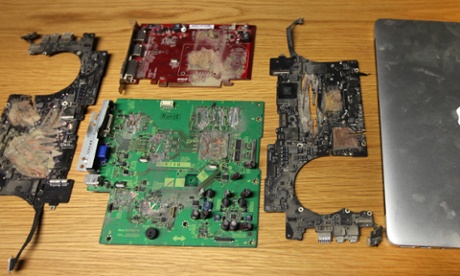
The remains of the hard disc and Macbook that held information leaked by Edward Snowden to the Guardian and was destroyed at the behest of the UK government. The remains of a computer that held files leaked by Edward Snowden to the Guardian and destroyed at the behest of the UK government. Photograph: Roger Tooth


Guardian editors on Tuesday revealed why and how the newspaper destroyed computer hard drives containing copies of some of the secret files leaked by Edward Snowden.
The decision was taken after a threat of legal action by the government that could have stopped reporting on the extent of American and British government surveillance revealed by the documents.
It resulted in one of the stranger episodes in the history of digital-age journalism. On Saturday 20 July, in a deserted basement of the Guardian's King's Cross offices, a senior editor and a Guardian computer expert used angle grinders and other tools to pulverise the hard drives and memory chips on which the encrypted files had been stored.
As they worked they were watched by technicians from Government Communications Headquarters (GCHQ) who took notes and photographs, but who left empty-handed.
The editor of the Guardian, Alan Rusbridger, had earlier informed government officials that other copies of the files existed outside the country and that the Guardian was neither the sole recipient nor steward of the files leaked by Snowden, a former National Security Agency (NSA) contractor. But the government insisted that the material be either destroyed or surrendered.
Twelve days after the destruction of the files the Guardian reported on US funding of GCHQ eavesdropping operations and published a portrait of working life in the British agency's huge "doughnut" building in Cheltenham. Guardian US, based and edited in New York, has also continued to report on evidence of NSA co-operation with US telecommunications corporations to maximise the collection of data on internet and phone users around the world.
The British government has attempted to step up its pressure on journalists, with the detention in Heathrow on Sunday of David Miranda, the partner of Glenn Greenwald, who has led the Guardian's US reporting on the files.
Miranda was detained for nine hours under a section of legislation enacted in 2000 aimed at terrorists. The use of this measure – which applies only to airports and ports – meant the normal protection for suspects in the UK, including journalists,  did not apply.
The initial UK attempts to stop reporting on the files came two weeks after the publication of the first story based on Snowden's leaks, about a secret US court order obliging the communications corporation Verizon to hand over data on its customers' phone usage. This was followed by a story detailing how GCHQ was making use of data collected by the NSA's internet monitoring programme, Prism.
Days later the paper published another story revealing how UK intelligence spied on British allies at two London summits.
Shortly afterwards two senior British officials arrived at the Guardian's offices to see Rusbridger and his deputy, Paul Johnson. They were cordial but made it clear they came on high authority to demand the immediate surrender of all the Snowden files in the Guardian's possession.
They argued that the material was stolen and that a newspaper had no business holding on to it. The Official Secrets Act was mentioned but not threatened. At this stage officials emphasised they preferred a low-key route rather than go to court.
The Guardian editors argued that there was a substantial public interest in the hitherto unknown scale of government surveillance and the collaboration with technology and telecoms companies, particularly given the apparent weakness of parliamentary and judicial oversight.
There was no written threat of any legal moves.
After three weeks which saw the publication of several more articles on both sides of the Atlantic about GCHQ and NSA internet and phone surveillance, British government officials got back in touch and took a sterner approach.
"You've had your fun. Now we want the stuff back," one of them said.


Read More  and Watch Video Here


*******************************************************
British government forces the Guardian to destroy Snowden files
RTAmerica RTAmerica


Published on Aug 20, 2013
The British government has given the Guardian newspaper an ultimatum: delete all data on Edward Snowden's leaks or risk getting shut down. A few months ago, Guardian reporter Glenn Greenwald revealed the NSA's massive surveillance program through the media outlet and now many see the government's move as retaliation for the leaks. Alan Rusbridger, editor for the Guardian, justified why they chose to comply with the government's request, and Josh Levy, Internet campaign director for Free Press, joins us with his take on the British government's request.
*******************************************************

Guardian editor on Miranda detention: ‘Terror and journalism being aligned’

Published time: August 21, 2013 03:02
Edited time: August 21, 2013 08:54

>Guardian editor Alan Rusbridger.(Reuters / Andrew Winning)
Guardian editor Alan Rusbridger.(Reuters / Andrew Winning)

The UK government created a “lawless bit of Britain” under the terror act which suspends all checks and balances, Guardian editor Alan Rusbridger said in an interview, adding that the paper is financing David Miranda's lawsuit against the Home Office.
Rusbridger called ports and airport transit lounges a “stateless bit of Britain,” where a government can use the word “terror” to “suspend all the normal rules.”
<i><i><br></i></i>
The comment was made in reference to UK authorities detaining and questioning David Miranda, the partner of Guardian journalist Glenn Greenwald, for nine hours in London’s Heathrow airport on Sunday under Schedule 7 of the UK’s anti-terrorism law.
Miranda told the BBC in an interview that he felt threatened during his 9-hour detention and as if “he were naked in front of a crowd.”
Greewald’s partner said that he was “forced to give passwords” to email and social media accounts to his interrogators. Authorities allegedly threatened him with prison if he did not comply.
Inside Britain, journalists and anyone else carrying material have more opportunities to stand their ground. “You can go before a judge, you can argue about public interest and the public interest of that work,” Rusbridger said.
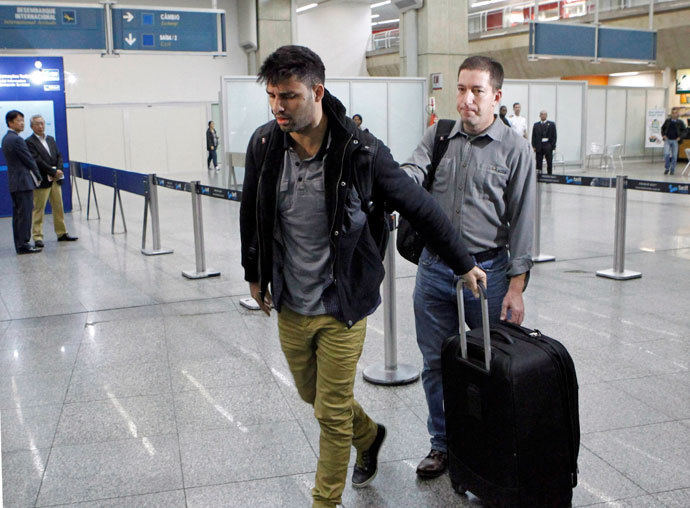
 David Miranda (L) -- the Brazilian partner of Glenn Greenwald, a US journalist with Britain's Guardian newspaper who worked with intelligence leaker Edward Snowden to expose US mass surveillance programmes -- is pictured at Rio de Janeiro's Tom Jobim international airport upon his arrival on August 19, 2013.(AFP Photo / Marcelo Piu)
David Miranda (L) -- the Brazilian partner of Glenn Greenwald, a US journalist with Britain's Guardian newspaper who worked with intelligence leaker Edward Snowden to expose US mass surveillance programmes -- is pictured at Rio de Janeiro's Tom Jobim international airport upon his arrival on August 19, 2013.(AFP Photo / Marcelo Piu)

“The disturbing thing about the way they treated Miranda was the use of this terror act, and there is a little noticed section there, Schedule 7, which effectively suspends all the normal checks and balances that you would have if you were arrested in the Heathrow car park,” he added.
Rusbridger believes there are “confusions in law” when it comes to where you are when you’re in a transit lounge and “whose laws you apply to.”
The UK created this “lawless bit of Britain” over a decade ago, according to the editor. It is a place “where anybody can be questioned for up to nine hours without access to a solicitor and where all your belongings can be confiscated and there’s nothing you can do about it,” he said.

Financing Miranda’s lawsuit

Rusbridger revealed that the Guardian is funding Miranda’s legal actions as he seeks a judicial review of the legal basis for his detention and assurances that the property seized from him by police will not be examined.
“The Guardian is supporting that action and we are supporting that in terms of financing it, because David Miranda was acting on behalf of Glenn Greenwald at the time that he was detained. I think it’s a good thing to challenge that law and see exactly why terror and journalism are being aligned in this disturbing way.”
U.S. journalist Glenn Greenwald (L) walks with his partner David Miranda in Rio de Janeiro's International Airport August 19, 2013. (Reuters / Ricardo Moraes)

“Miranda wasn’t really on assignment, he is Glenn Greenwald’s partner and Glenn Greenwald is a very busy man and he assists Glenn in his journalistic work. And he was acting as a messenger or intermediary in a way that is difficult for Glenn at the moment because he’s got a lot of work to be doing in Brazil and I think he’s also a bit nervous about traveling at the moment.”

'Snowden data destruction won't harm our reporting' - Guardian's Alan Rusbridger

RussiaToday RussiaToday


Published on Aug 20, 2013
The British government's attempts to stem the tide of articles on mass surveillance have gone beyond intimidating the journalist behind the publications. Just a day after Glenn Greenwald's partner was detained at Heathrow airport, The Guardian's editor, Alan Rusbridger, came forward describing how the authorities pressured the newspaper to destroy documents provided by NSA leaker Edward Snowden. Mr. Rusbridger has explained why he gave in to pressure from government agents, and destroyed hard-drives carrying information obtained from Edward Snowden.


RT LIVE http://rt.com/on-air


*******************************************************
Enhanced by Zemanta