Recently,
Saudi Arabia announced it was creating a coalition of Muslim countries
to fight terrorism. Such a plan was initiated by Riyadh's intention to
restore its position in the Middle East.
Saudi
Arabia’s call to arms has gained supporters. As of now, 34 nations have
expressed their interest in joining the anti-terrorist Muslim coalition
Riyadh is forming.Among them are countries with a majority of Shiite or
Sunni population, including Jordan, the UAE, Palestine, Tunisia, Libya,
Egypt, Qatar, Yemen, Turkey, a number of African Muslim nations as well
as Pakistan, Bangladesh and Malaysia. Another 10 nations said they
would be ready to join the coalition in the future.
Saudi
Arabia’s Defense Ministry Mohammad bin Salman did not elaborate on what
measures would be taken against terrorists. He only said that a
headquarters will be established in Riyadh to "coordinate military
operations."
Saudi Warplanes Drop Cluster Bombs on Own Soil to Prevent Yemeni Forces' Advances
TEHRAN
(FNA)- Saudi Arabia's warplanes are targeting the Southern parts of the
kingdom with cluster bombs in a bid to stop the Yemeni army and popular
forces' continued and rapid advance deep into their territories.
Saudi
Arabia has used cluster bombs many times before, but this is the first
time that it is using it against its own population in a desperate move
to stop the huge advances made by the Yemeni forces inside the kingdom
in recent days.
The Yemeni army and popular
forces have frequently crossed the border captured the Saudi military
bases and outpost, ruined the military sites and returned home in the
last few months and after the Riyadh-led coalition refrained from
stopping its air raids on residential areas in Yemen's cities.
But,
after months of coalition intensified air raids on civilian areas, the
Yemeni forces changed strategy and warned that they would start ground
assaults on Saudi territories to force Riyadh stop the massacre.
The
new strategy was put into effect on Sunday, when Yemen's army and
popular forces crossed the border and captured several key military
bases in three provinces in Southern Saudi Arabia near the border.
The
Yemeni forces seized Malhama, al-Radif and al-Mamoud military bases in
Jizan, al-Rabou'a military base in Asir and Nahouqa military base in
Najran provinces.
Then on Monday, the Yemeni forces took control of three more Saudi military bases in al-Shurfa region in Najran.
They also captured a military camp in Najran, and destroyed the military vehicles in there.
Sources inside the administration say they are struggling to keep in check the opposing sides in Yemen. | AP Photo
Obama officials at odds over Saudi airstrikes
Saudi Arabia’s airstrikes in Yemen, conducted with U.S. assistance, are
alleged to have killed at least 1,500 civilians, dividing members of
the Obama administration over whether the U.S. risks being accused of
abetting war crimes in a bombing campaign that could ultimately
strengthen Islamist militants.
Sources inside the administration say they are struggling to keep in check the
opposing sides in Yemen, one of the clearest examples of the
intensifying Saudi-Iran proxy war in the Middle East. But even as
reports of civilian suffering and terrorist gains pile up, U.S.
officials believe that reducing American support for the Saudis could
make the situation even worse.
The
White House does not want to anger Saudi Arabia, a vital, oil-rich ally
already unhappy with President Barack Obama’s decision to pursue a
nuclear deal with Iran. At the same time, what many hoped would be a
short Saudi-led campaign against the Iran-backed Houthi rebels who
overthrew Yemen’s government, is now entering its eighth month with no
end in sight.
“The White House is increasingly frustrated with the
Saudis, and they’re trying to figure out how to handle it,” said one
foreign policy expert familiar with the administration’s deliberations.
Private conversations seem to be having limited effect, the source said,
but "the U.S. is walking on such eggshells around Saudi when it comes
to the public domain that they’re not willing to ramp up their public
pressure."
It
was evident early on that the US bombing of alleged ISIS targets inside
Syria was, in reality, an attempt to support the terrorist organization
backed by NATO and the US as opposed to an attempt to defeat it. While
such a suggestion has been repeatedly labeled as a “conspiracy theory”
by the mainstream media and other gatekeepers in the “independent”
media, the fruits of America’s labor in terms of the bombing campaign
cannot be ignored. Likewise, neither can the world ignore the results of
Saudi Arabia’s bombing of Yemen.
The truth is that the United
States, NATO, and the GCC/Arab League are bombing in couched support of
ISIS, increasing its gains and hold on power with every sortie fired.
With this fact recognized, the NATO/GCC network of national governments
can now officially be labeled as the Air Force of Al-Qaeda.
For
instance, while the secular government of Bashar al-Assad remained the
only force inside Syria actually fighting al-Qaeda and ISIS – terrorist
organizations trained, funded, armed, and deployed by the United States,
NATO, and the GCC – the brutality of these death squads was used by the
Western propaganda machine to justify a bombing campaign that was
actually directed at Syrian military and civilian infrastructure.
IN THE ISLAMIC CONCEPT of qadar,
your divine destiny is inescapable. If you try to cheat death it will
find you. For two women on a dusty road in mid-June on the southwest
corner of the Arabian Peninsula, their repeated attempts to dodge fate
ended in tragic failure.
Leaving the war zone of Yemen’s southern
port city of Aden on June 10, the women headed north in a Toyota
Cressida driven by a male relative. The pair were escaping the violence
that had already turned entire streets in Aden to rubble, left hundreds
dead and thousands of civilians under siege, struggling to find food,
water and medical care.
Driving ahead of them was a family of four
in a Hilux pick-up truck, slowing at the numerous checkpoints along the
road and weaving around potholes in the asphalt. Between 4:30 and 5
p.m., seemingly from nowhere, the first missile struck. The Hilux
flipped into a cartwheeling fireball, killing the two children and their
parents inside.
Before the women in the Toyota had a chance to
compose themselves an ominous whistle preceded a second missile, which
smashed into the ground beside them and sent their car careering off the
road into the dusty scrubland. Twice in the space of just a few minutes
the women had stared death in the face.
Saudi air raids kill dozens of Yemeni civilians amid humanitarian crisis
1.6K293
The
latest Saudi-led airstrikes in Yemen have left dozens of civilians dead
and nearly 160 injured at a time that sees medical facilities
struggling to provide even the most basic services. The country is
suffering from a shortage of vital supplies due to the ongoing blockade.
The
coalition air raids against Houthi forces in Sanaa overnight on Friday
killed at least 40 civilians and injured at least another 130 people,
Yemen News Agency (SABA) reported.
One
strike leveled an apartment building in the center of the city killing a
family of nine, while another strike killed a man who had been
searching for his family in the rubble, AP reported. The coalition has
even managed to attack Yemen’s interior ministry in the capital,
launching about 10 strikes at the building as well as at a police camp
and a military building close to it.
The airstrikes also hit the residence of Oman’s ambassador in Sanaa.
The
particular cluster munition systems HRW said were used are CBU-105
Sensor Fuzed Weapons, which are guided bombs intended to take out tanks
and other armored vehicles with a flurry of explosions spread out over
an area.
If the cluster bombs fail to
detect their target, they are designed to self-destruct in the air, or
if that fails, to deactivate themselves after a short time. But
sometimes those mechanisms don't work, posing a lethal danger for those
who later encounter them.
UN condemns ‘virtual silence’ on civilian casualties in Yemeni conflict
248317.
UN
officials have openly criticized the “the virtual silence” with regards
to civilian suffering in the Yemeni conflict from the world community,
warning that unless violence on the ground is stopped via political
compromise more people will suffer.
Adama
Dieng, the Special Adviser on the Prevention of Genocide, and Jennifer
Welsh, the Special Adviser on the Responsibility to Protect, “expressed
concern at the ever increasing impact on civilians of the ongoing
conflict in Yemen, and the virtual silence of the international
community about the threat to populations.”
By Abu Bakr al-Yamani, Waleed Abu al-Khair and Mohammed al-Qaisi
The recent murder of doctors and nurses at al-Ordhi hospital inside
the Yemeni Ministry of Defence complex mirrors al-Qaeda’s previous
targeting of medical personnel in Syria and Iraq, security and medical
experts said.
While al-Qaeda’s kidnappings and murders aim to discourage medical
staffs from performing their duties and to demonstrate its power, these
attacks only help increase public resentment of al-Qaeda, they said.
Al-Qaeda in the Arabian Peninsula (AQAP) initially claimed
responsibility for the December 5th attack on al-Ordhi hospital in Sanaa
in which gunmen dressed in military uniforms opened fire on anyone in
their path, including women, children, doctors and nurses, killing 56
people.
But in a subsequent video message AQAP military commander Qassem
al-Rimi claimed the assailant acted alone and “did not follow
instructions”, in an attempt to distance the organisation from the
attack, which sparked outrage and condemnation.
“Doctors, nurses and other civilians have become a direct target for
al-Qaeda and were not targeted in error, as the organisation’s leaders’
claim,” said al-Jamhi Centre for Studies and Research head Saeed
al-Jamhi.
Al-Qaeda militants did target the hospital in their assault, and
“they did not stop there, for they spread throughout the building to
kill doctors and nurses and all who survived the blast”, al-Jamhi said.
Not a new phenomenon
While al-Qaeda’s targeting of doctors may be a new occurrence in
Yemen, it is not new in Iraq and Syria, where doctors are regularly
targeted by the organisation, al-Jamhi said.
“Terrorism is now eating away at al-Qaeda’s body and has driven it to
the stage of insanity in its killing of civilians,” he said.
“Al-Qaeda or its remaining scattered cells are operating without a
clear vision and with obvious confusion,” said strategic affairs
researcher Saeed Abdul Momen.
“The battle that took place at the Ministry of Defence was beyond its
capability and the crimes committed against the wounded and civilians
were horrific,” he said, adding that the broadcast images “showed the
hideousness of its actions and utter lack of compassion and humanity”.
“For that reason, the organisation claimed responsibility, then
backtracked, then once again claimed responsibility for it in an attempt
to claim victory and at the same time wash its hands clean of the crime
of killing civilians and doctors,” he said.
This proves al-Qaeda is lacking real leadership and is willing to
claim responsibility for any attack in order to demonstrate its
“strength, cruelty and tyranny”, Abdul Momen said.
It matters not to al-Qaeda how much killing and shedding of innocent
blood takes place as long as it succeeds in striking terror into
people’s hearts, he added.
Published on Thursday, December 26, 2013 by Common Dreams
UN Officials: We Demand Answers for US Wedding Massacres in Yemen
Special Rapporteur Juan Méndez: 'A deadly attack on illegitimate targets amounts to cruel, inhuman or degrading treatment'
- Sarah Lazare, staff writer
Children
gather near car destroyed in 2012 by a U.S. drone air strike in Azan,
in the southeastern Yemeni province of Shabwa. (Photo: Reuters / Khaled
Abdullah / Files)A suspected U.S. drone strike that killed
16 civilians attending a wedding in Yemen violates humanitarian law and
must be accounted for, declared UN experts on Thursday.
“A
deadly attack on illegitimate targets amounts to cruel, inhuman or
degrading treatment if, as in this case, it results in serious physical
or mental pain and suffering for the innocent victims,” said Special
Rapporteur on Torture Juan Méndez, according to a UN statement.
“If armed drones are to be used, States must adhere to international
humanitarian law, and should disclose the legal basis for their
operational responsibility and criteria for targeting,” said Christof
Heyns, UN Special Rapporteur on extrajudicial, summary or arbitrary
executions. “Yemen cannot consent to violations of the right to life of
people in its territory."
Local security officials report that 16 civilians were killed and over 10 injured when drone missiles struck two wedding processions on December 12.
Despite this mass civilian death, confirmed in numerous media
reports, the U.S. government has so far refused to disclose information
on the legality, targets, and victims of these strikes.
The Obama administration has been famously secretive about the covert
drone wars of the United States while claiming that their civilian
death count is low, despite reports from Bureau of Investigative Journalism researchers who have documented high numbers of civilian deaths in Pakistan and Yemen.
As Tom Engelhardt recently pointed out, while
much media reported that the wedding was an "unlikely target" that was
struck mistakenly, there is in fact nothing unlikely or unique about
this wedding tragedy. According to "the count of
TomDispatch, this is at least the eighth wedding party reported wiped
out, totally or in part, since the Afghan War began and it extends the
extermination of wedding celebrants from the air to a third country — six destroyed in Afghanistan, one in Iraq, and now the first in Yemen," writes Engelhardt.
"And in all those years, reporters covering these “incidents” never
seem to notice that similar events had occurred previously."
He adds, "The only thing that made the Yemeni incident unique was the
drone. The previous strikes were reportedly by piloted aircraft."
_____________________
This work is licensed under a Creative Commons Attribution-Share Alike 3.0 License.
U.S. Drone Strike Hits Convoy Headed To Wedding Party In Yemen, Killing At Least 13, Officials Say
Posted: 12/12/2013 1:47 pm EST | Updated: 12/13/2013 5:33 pm EST
The Associated Press reports Yemeni officials have said a U.S. drone strike hit a convoy headed to a wedding party:
BREAKING: Yemeni officials say U.S. drone strike hits convoy heading to wedding party, killing 13 people.
— The Associated Press (@AP) December 12, 2013
According to the report, at least 13 people were killed in the targeted strike.
Reuters quotes Yemeni security officials as saying the wedding party was targeted after it "was mistaken for an al-Qaeda convoy." Additionally, the news outlet cites 15 deaths, with another five people injured in the attack.
"An air strike missed its target and hit a wedding car convoy, ten
people were killed immediately and another five who were injured died
after being admitted to the hospital," one security official said. Al-Qaeda in the Arabian Peninsula,
or AQAP, is believed to be among the most active wings of the terrorist
organization. In response to the militant group's increased activity,
the U.S. has ramped up its use of drone strikes in Yemen since 2011. More from the Associated Press:
SANAA, Yemen (AP) — Missiles fired by a U.S. drone slammed
into a convoy of vehicles traveling to a wedding party in central Yemen
on Thursday, killing at least 13 people, Yemeni security officials said.
The officials said the attack took place in the city of Radda, the
capital of Bayda province, and left charred bodies and burnt out cars on
the road. The city, a stronghold of al-Qaida militants, witnessed
deadly clashes early last year between armed tribesmen backed by the
military and al-Qaida gunmen in an attempt to drive them out of the
city.
There were no immediate details on who was killed in the strike, and
there were conflicting reports about whether there were militants
traveling with the wedding convoy.
A military official said initial information indicated the drone
mistook the wedding party for an al-Qaida convoy. He said tribesmen
known to the villagers were among the dead.
One of the three security officials, however, said al-Qaida militants
were suspected to have been traveling with the wedding convoy.
While the U.S. acknowledges its drone program in Yemen, it does not usually talk about individual strikes.
If further investigations determine that the victims were all
civilians, the attack could fuel an outburst of anger against the United
States and the government in Sanaa among a Yemeni public already
opposed to the U.S. drone strikes.
Air strike kills 15 civilians in Yemen by mistake: officials
SANAAThu Dec 12, 2013 1:34pm EST
(Reuters) - Fifteen people on their way to a wedding in Yemen were killed in an air strike after their party was mistaken for an al Qaeda convoy, local security officials said on Thursday.
The officials did not
identify the plane in the strike in central al-Bayda province, but
tribal and local media sources said that it was a drone.
"An
air strike missed its target and hit a wedding car convoy, ten people
were killed immediately and another five who were injured died after
being admitted to the hospital," one security official said.
Five more people were injured, the officials said.
The
United States has stepped up drone strikes as part of a campaign
against Al Qaeda in the Arabian Peninsula (AQAP), regarded by Washington
as the most active wing of the militant network.
Officials report 15
wedding guests in the Yemen province of al-Bayda were hit by an air
strike, believed to be a US drone. Photograph: Malcolm Harris /
Alamy/Alamy
Fifteen people on their way to a wedding in Yemen were killed in an air strike after their party was mistaken for an al-Qaida convoy, local security officials said on Thursday.
The
officials did not identify the plane in the strike in central al-Bayda
province, but tribal and local media sources said that it was a drone.
"An
air strike missed its target and hit a wedding car convoy, 10 people
were killed immediately and another five who were injured died after
being admitted to the hospital," one security official said.
Five more people were injured, the officials said.
The United States
has stepped up drone strikes as part of a campaign against al-Qaida in
the Arabian Peninsula (AQAP), regarded by Washington as the most active
wing of the militant network.
Yemen, AQAP's main stronghold, is among a handful of countries where the United States acknowledges using drones, although it does not comment on the practice.
Human
Rights Watch said in a detailed report in August that US missile
strikes, including armed drone attacks, have killed dozens of civilians
in Yemen.
Saudi
militants were behind the massive car bombing and assault on Yemen's
military headquarters that killed more than 50 people, including
foreigners, investigators said in a preliminary report released Friday.
Al-Qaeda
claimed responsibility for the attack, saying it was retaliation for US
drone strikes that have killed dozens of the terror network's leaders.
The
attack - the deadliest in Sanaa since May 2012 - marked an escalation
in the terror network's battle to undermine the US-allied government and
destabilise the impoverished Arab nation despite the drone strikes and a
series of US-backed military offensive against it.
US forces also have been training and arming Yemeni special forces, and exchanging intelligence with the central government.
Military
investigators described a two-stage operation, saying heavily armed
militants wearing army uniforms first blew up a car packed with 500
kilograms of explosives near an entrance gate, then split into groups
that swept through a military hospital and a laboratory, shooting at
soldiers, doctors, nurses, doctors and patients.
Officials earlier
said 11 militants were killed, including the suicide bomber who drove
the car. It was not clear if the 12th attacker was captured or escaped.
The
investigative committee led by Yemen's Chief of Staff Gen. Ahmed
al-Ashwal, said militants shot the guards outside the gates of the
military hospital, allowing the suicide bomber to drive the car inside,
but a gunfight forced him to detonate his explosives before reaching his
target.
Al-Qaida said it
targeted the defense ministry because it 'accommodates drone control
rooms and US experts'. Photograph: YEMENI DEFENSE MINISTRY/HANDOUT/EPA
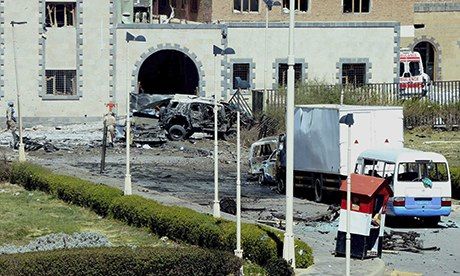
Al-Qaida has claimed responsibility for a brazen attack on the defence ministry in the heart of Yemen's capital, Sana'a, on Thursday, in which 52 people – including seven foreigners – were killed in a suicide car bombing and an assault by gunmen. The attack follows a rise in US drone strikes in this key American ally in the Middle East.
The two-stage operation came as the defence minister visited Washington for talks. The US military
increased its regional alert status after the attack and is "fully
prepared to support our Yemeni partners," a senior US defence official
said.
At least 167 people were wounded, nine seriously, in the
bombing and fierce firefight, which underscored the ability of
insurgents to exploit Yemen's instability and tenuous security – even at the headquarters of its military.
Among
the dead at the defence ministry complex, which also houses a military
hospital, were soldiers and civilians, including seven foreigners – two
aid workers from Germany, two doctors from Vietnam, two nurses from the
Philippines and a nurse from India – according to Yemen's supreme
security commission, which issued the casualty figures. Among the Yemeni
civilians killed were a doctor and a senior judge, it said.
Al-Qaida
in the Arabian Peninsula's media arm, al-Mallahem, claimed the attack
early Friday morning on its Twitter account, saying it targeted the
defence ministry building because it "accommodates drone control rooms
and American experts". It said security headquarters used by the
Americans in their war are "legitimate targets".
It was the deadliest attack in Sana'a since May 2012.
The
US considers the Yemeni branch of al-Qaida to be the most active in
the world. In recent months, Washington has sharply escalated drone
attacks against the militants. US forces also have been training and
arming Yemeni special forces, and exchanging intelligence with the
central government.
The terrorist network gained a major foothold
in the south, taking over several towns in the chaos that followed the
2011 uprising that ousted longtime president Ali Abdullah Saleh. The
drone strikes and a series of US-backed military offensives helped
uproot several key militant strongholds, but al-Qaida continues to fight
back.


 Children
gather near car destroyed in 2012 by a U.S. drone air strike in Azan,
in the southeastern Yemeni province of Shabwa. (Photo: Reuters / Khaled
Abdullah / Files)A suspected U.S. drone strike that killed
16 civilians attending a wedding in Yemen violates humanitarian law and
must be accounted for, declared UN experts on Thursday.