Tuesday, November 26, 2013

Authors of new report warn food donations not enough as six million threatened with worsened hunger


This Holiday Season, Charity No Match for Food Stamp Cuts


- Sarah Lazare, staff writer
(Photo: Everyday Feminism)'Tis the season to give, the saying goes.
Yet all of the charitable food donations in the United States this year combined would not make a dent in proposed cuts to food subsidy programs that threaten at least six million people with worsened hunger.
So said researchers with the Bread for the World Institute in an interview with The Guardian published Monday.
“Virtually every church, synagogue and mosque in the country is now gathering up food and distributing, and all of that work that food banks do comes to 5% of the food that needy people get,” Bread for the World president Reverend David Beckmann told The Guardian, referencing the organization's recent report Ending Hunger in America. “95% comes from school breakfasts, lunches, food stamps and WIC, so Congress can say 'We can cut this programme 5% per cent – no big deal.' But if you cut the national nutrition programmes 5%, you cancel out everything that the charitable system is doing.”
The comments come as further slashes to the Supplemental Nutrition Assistance Program are considered in the House, where $39 billion in cuts over the next ten years is up for debate, and the Senate, where a $4 billion slash could be approved. This is in addition to cuts that took effect on November 1 and will amount to $5 billion by the end of the year and $11 billion by 2016. Critics charge that these slashes, which constitute a fraction of the federal budget, will make little difference to tax payers yet devastate the millions who depend on food aid for survival.
Almost half of all people who receive food stamps are children, Forbes reports.
The cuts are under consideration despite 2012 census data, analyzed by the Department of Agriculture, that shows hunger in the United States is stuck at high levels for the fifth year in a row, with 14.5 percent of all U.S. households facing food insecurity in 2012. Poor households, "households with children headed by single women or single men," and African American and Hispanic households hardest hit, according to the USDA.
_____________________


File:Helping the homeless.jpg
Helping The Homeless  Wikimedia . Org
Author Ed Yourdon from New York City, USA

File:Homeless woman.jpg
Homeless woman with dogs ,Haight Street, San Francisco, CA    Wikimedia . Org
Enhanced by Zemanta

Wallstreet's Unchecked Greed and Corruption : The next Housing Bubble?

 The mortgage crisis, fueled by racially discriminatory lending practices, destroyed 53% of African American wealth and 66% of Hispanic wealth.    Wall Street hedge funds and private equity firms have quietly amassed an unprecedented rental empire on the backs of those who fell victim the first time around.   Where is the justice?


~Desert Rose~
..........


The Empire Strikes Back: How Wall Street Has Turned Housing Into a Dangerous Get-Rich-Quick Scheme -- Again

You can hardly turn on the television or open a newspaper without hearing about the nation’s impressive, much celebrated housing recovery. Home prices are rising! New construction has started! The crisis is over! Yet beneath the fanfare, a whole new get-rich-quick scheme is brewing.(Cover for the book of the same title by Bryan M. Chavis)
Over the last year and a half, Wall Street hedge funds and private equity firms have quietly amassed an unprecedented rental empire, snapping up Queen Anne Victorians in Atlanta, brick-faced bungalows in Chicago, Spanish revivals in Phoenix. In total, these deep-pocketed investors have bought more than 200,000 cheap, mostly foreclosed houses in cities hardest hit by the economic meltdown.
Wall Street’s foreclosure crisis, which began in late 2007 and forced more than 10 million people from their homes, has created a paradoxical problem. Millions of evicted Americans need a safe place to live, even as millions of vacant, bank-owned houses are blighting neighborhoods and spurring a rise in crime. Lucky for us, Wall Street has devised a solution: It’s going to rent these foreclosed houses back to us. In the process, it’s devised a new form of securitization that could cause this whole plan to blow up -- again.
Since the buying frenzy began, no company has picked up more houses than the Blackstone Group, the largest private equity firm in the world. Using a subsidiary company, Invitation Homes, Blackstone has grabbed houses at foreclosure auctions, through local brokers, and in bulk purchases directly from banks the same way a regular person might stock up on toilet paper from Costco.
In one move, it bought 1,400 houses in Atlanta in a single day. As of November, Blackstone had spent $7.5 billion to buy 40,000 mostly foreclosed houses across the country. That’s a spending rate of $100 million a week since October 2012. It recently announced plans to take the business international, beginning in foreclosure-ravaged Spain.
Few outside the finance industry have heard of Blackstone. Yet today, it’s the largest owner of single-family rental homes in the nation -- and of a whole lot of other things, too. It owns part or all of the Hilton Hotel chain, Southern Cross Healthcare, Houghton Mifflin publishing house, the Weather Channel, Sea World, the arts and crafts chain Michael’s, Orangina, and dozens of other companies.
"In other words, if Blackstone makes money by capitalizing on the housing crisis, all these other Wall Street banks -- generally regarded as the main culprits in creating the conditions that led to the foreclosure crisis in the first place -- make money too."
Blackstone manages more than $210 billion in assets, according to its 2012 Securities and Exchange Commission annual filing. It’s also a public company with a list of institutional owners that reads like a who’s who of companies recently implicated in lawsuits over the mortgage crisis, including Morgan Stanley, Citigroup, Deutsche Bank, UBS, Bank of America, Goldman Sachs, and of course JP Morgan Chase, which just settled a lawsuit with the Department of Justice over its risky and often illegal mortgage practices, agreeing to pay an unprecedented $13 billion fine.
In other words, if Blackstone makes money by capitalizing on the housing crisis, all these other Wall Street banks -- generally regarded as the main culprits in creating the conditions that led to the foreclosure crisis in the first place -- make money too.
An All-Cash Goliath
In neighborhoods across the country, many residents didn’t have to know what Blackstone was to realize that things were going seriously wrong.
Last year, Mark Alston, a real estate broker in Los Angeles, began noticing something strange happening. Home prices were rising. And they were rising fast -- up 20% between October 2012 and the same month this year. In a normal market, rising home prices would mean increased demand from homebuyers. But here was the unnerving thing: the homeownership rate was dropping, the first sign for Alston that the market was somehow out of whack.
The second sign was the buyers themselves.
Click here to see a larger version

“I went two years without selling to a black family, and that wasn’t for lack of trying,” says Alston, whose business is concentrated in inner-city neighborhoods where the majority of residents are African American and Hispanic. Instead, all his buyers -- every last one of them -- were besuited businessmen. And weirder yet, they were all paying in cash.
Between 2005 and 2009, the mortgage crisis, fueled by racially discriminatory lending practices, destroyed 53% of African American wealth and 66% of Hispanic wealth, figures that stagger the imagination. As a result, it’s safe to say that few blacks or Hispanics today are buying homes outright, in cash. Blackstone, on the other hand, doesn’t have a problem fronting the money, given its $3.6 billion credit line arranged by Deutsche Bank. This money has allowed it to outbid families who have to secure traditional financing. It’s also paved the way for the company to purchase a lot of homes very quickly, shocking local markets and driving prices up in a way that pushes even more families out of the game.
“You can’t compete with a company that’s betting on speculative future value when they’re playing with cash,” says Alston. “It’s almost like they planned this.”
In hindsight, it’s clear that the Great Recession fueled a terrific wealth and asset transfer away from ordinary Americans and to financial institutions. During that crisis, Americans lost trillions of dollars of household wealth when housing prices crashed, while banks seized about five million homes. But what’s just beginning to emerge is how, as in the recession years, the recovery itself continues to drive the process of transferring wealth and power from the bottom to the top.
From 2009-2012, the top 1% of Americans captured 95% of income gains. Now, as the housing market rebounds, billions of dollars in recovered housing wealth are flowing straight to Wall Street instead of to families and communities. Since spring 2012, just at the time when Blackstone began buying foreclosed homes in bulk, an estimated $88 billion of housing wealth accumulation has gone straight to banks or institutional investors as a result of their residential property holdings, according to an analysis by TomDispatch. And it’s a number that’s likely to just keep growing.
“Institutional investors are siphoning the wealth and the ability for wealth accumulation out of underserved communities,” says Henry Wade, founder of the Arizona Association of Real Estate Brokers.
But buying homes cheap and then waiting for them to appreciate in value isn’t the only way Blackstone is making money on this deal. It wants your rental payment, too.
Securitizing Rentals
Wall Street’s rental empire is entirely new. The single-family rental industry used to be the bailiwick of small-time mom-and-pop operations. But what makes this moment unprecedented is the financial alchemy that Blackstone added. In November, after many months of hype, Blackstone released history’s first rated bond backed by securitized rental payments. And once investors tripped over themselves in a rush to get it, Blackstone’s competitors announced that they, too, would develop similar securities as soon as possible.
Depending on whom you ask, the idea of bundling rental payments and selling them off to investors is either a natural evolution of the finance industry or a fire-breathing chimera.
“This is a new frontier,” comments Ted Weinstein, a consultant in the real-estate-owned homes industry for 30 years. “It’s something I never really would have dreamt of.”

Read More Here
Enhanced by Zemanta

Monday, November 25, 2013

The inability of European bureaucrats to keep up with the Kremlin's manipulations -- or Kiev's political calculations -- has cost the EU a trade deal with Ukraine, and severely damaged its foreign policy.

Putin's Gambit: How the EU Lost Ukraine

By SPIEGEL Staff
Photo Gallery: Russia's Ukraine Power Play Photos
AP/dpa
The inability of European bureaucrats to keep up with the Kremlin's manipulations -- or Kiev's political calculations -- has cost the EU a trade deal with Ukraine, and severely damaged its foreign policy.
Russian President Vladimir Putin's decisive move came on Nov. 9. That day, after years of courtship, and several months of promises and threats, he met with Ukrainian President Viktor Yanukovich at a military airport near Moscow. The meeting was so clandestine the Russians initially denied that it had taken place at all.
ANZEIGE
Before that point, the plan had been for Yanukovich to sign a 900-page association agreement, a sort of engagement contract, with the European Union in the Lithuanian capital of Vilnius on Nov. 29. But in early November near Moscow, Putin seems to have sealed an alliance with Ukraine, preempting his rivals in Brussels. And last Thursday Yanukovich postponed the signing of the EU agreement indefinitely. After giving temporary asylum to whistleblower Edward Snowden and brokering a deal to have Syria give up its chemical weapons, it was Putin's third recent victory over the West, albeit probably not a permanent one. After all, Yanukovich's agreement with Putin is a marriage of convenience, not a marriage of love.
Europe's 'Eastern Partnership' Dream
This tug-of-war began four years ago, when the EU proposed an "eastern partnership" with Ukraine as well as Armenia, Azerbaijan, Georgia, Moldova and Belarus. The EU offered cooperation, free trade and financial contributions in exchange for democratic reforms. Officials in Brussels spoke enthusiastically about the emergence of an historic Eastern European policy not unlike former German Chancellor Willy Brandt's rapprochement with the Warsaw Pact countries in the 1970s. The planned partnership agreements were intended to facilitate visa-free travel, reduce tariffs and introduce European norms. The only thing that not offered was EU membership.
The EU's other goal, even though it was not as openly expressed, was to limit Russia's influence and define how far Europe extends into the east. For Russia, the struggle to win over Ukraine is not only about maintaining its geopolitical influence, but about having control over a region that was the nucleus of the Russian empire a millennium ago. The word Ukraine translates as "border country," and many feel the capital Kiev is the mother of all Russian cities.
This helped create Cold War-style grappling between Moscow and Brussels. The Russian president, hardened by his fights in the Kremlin, is more adept than EU bureaucrats at manipulating people with venality and affections. None of the top European politicians made a serious effort to win over Ukraine, with neither German Chancellor Angela Merkel nor European Commission President José Manuel Barroso flying to Kiev to convince its wavering president.
'Unprecendented Pressure' from Russia
"I believe the unprecedented pressure from the Russians was the decisive factor," says former Polish Prime Minister and intermediary Aleksander Kwaniewski. "The Russians used everything in their arsenal." Elmar Brok, chairman of the foreign affairs committee in the European Parliament, says: "Yanukovich kept all options open until the end, so as to get the best possible deal."
The official reason for the agreement's failure is Yulia Tymoshenko, the opposition politician who has been in prison for the last two years. The EU had made her release a condition of the agreement. Yanukovich was unwilling to release his former rival, and last week the parliament in Kiev failed to approve a bill that would have secured her release.
But then there are the financial incentives. In the end, the Russian president seems to have promised his Ukrainian counterpart several billion euros in the form of subsidies, debt forgiveness and duty-free imports. The EU, for its part, had offered Ukraine loans worth €610 million ($827 million), which it had increased at the last moment, along with the vague prospect of a €1 billion loan from the International Monetary Fund (IMF). Yanukovich chose Putin's billions instead.
The EU had been banking on its radiant appeal, and on its great promise of prosperity, freedom and democracy, but now Brussels must confront the fact that, for the first time, an attempt at rapprochement was rebuffed because the price was wrong. "If Yanukovich doesn't want to make a deal, then he simply doesn't want to," says Brok.
Battle of the Unions
The EU's eastern partnership had gotten off to a rocky start even before the Ukrainian incident. Belarus dashed the EU's hopes it would join when protesters were violently suppressed after the reelection of President Alexander Lukashenko in 2010. Armenia called off an association agreement with the EU this September.
In the case of Ukraine, it initially seemed as if the Europeans' rational arguments would prevail over Russia's threatening gestures. According to an internal EU analysis, joining the "Eurasian Union" -- a Russia-backed proposed political and economic union including Russia, Tajikistan, Kayahkstan, Belarus and others -- would severely limit Ukraine's sovereignty. Once such a union had been formed, Kiev would no longer be able to enter into any other free trade agreements without Moscow's approval. An alliance with Moscow would thus have the exclusive nature of a marriage. The EU's eastern partnership, in contrast, would still allow Ukraine to enter into other alliances.

Read More Here

..........

Aborted EU Deal: Massive Protests Rock Ukraine After Pull-Back

Photo Gallery: Kiev's Day of Protest Photos
REUTERS
In the wake of Ukraine's withdrawal from EU trade deal discussions, Kiev was rocked by the biggest protests since the Orange Revolution while the daughter of imprisoned former Ukrainian leader Yulia Tymoshenko pled for Germany's help.
On Sunday, tens of thousands of people took to the streets of Kiev to protest the Ukrainian government's decision to call off plans for a trade deal with the European Union. The protests were the largest to take place in the country since 2004's Orange Revolution, when accusations of corruption and electoral fraud during that year's presidential election brought thousands of people to the streets and helped overturn the election of Viktor Yanukovych. According to police estimates, Sunday's protest attracted 23,000 people while organizers estimated the number at over 100,000.
ANZEIGE
The protests were set off by the announcement on Thursday that the Ukrainian government would no longer pursue preparations for the Association Agreement between Ukraine and the European Union in order to "ensure the national security of Ukraine" and "restore lost trade volumes with the Russian Federation." The deal would have created a new framework for trade between the former Soviet republic and the EU, but was seen as worrisome by Russia, which had threatened economic sanctions and travel restrictions should the deal go through. The Ukrainian parliament had also voted down bills last week which would have allowed imprisoned former prime minister Yulia Tymoshenko -- a key figure in the Orange Revolution -- to go to Germany for medical treatment. The release of Tymoshenko, whose jail term for abuse of power and embezzlement is widely seen as politically motivated, was one of the conditions for the EU deal. Kiev has instead announced intentions to create a joint commission to discuss relations between Ukraine, Russia and the EU.

Read More Here

..........


Russia 'blackmailed Ukraine to ditch EU pact'

Yulia Tymoshenko calls for Ukrainians to take to the streets as President Yanukovych comes under pressure from Kremlin
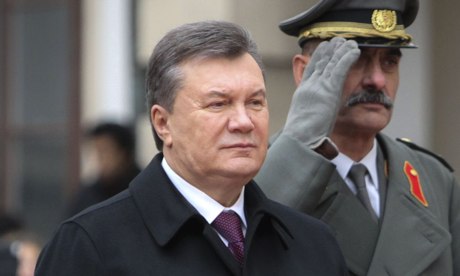
Ukrainian president Viktor Yanukovich
The Ukrainian president, Viktor Yanukovych, abruptly pulled out of the deal on Thursday, leaving EU policy in shreds. Photograph: Reuters
 
 
The European Union and Russia traded charges of blackmail on Friday over the future of Ukraine.
The Kremlin threatened the country with trade losses worth billions and costing hundreds of thousands of jobs if it signed up to a strategic pact with the European Union, senior Lithuanian officials said.
President Vladimir Putin of Russia said the EU was putting pressure on Kiev and organising mass protests against President Viktor Yanukovych.
A week before a critical EU summit in Vilnius, the Lithuanian capital, that was to be capped by the Brussels-Kiev pact, Yanukovych abruptly pulled out of the deal on Thursday, leaving EU policy in shreds and Putin relishing victory in the contest for Ukraine's future.
The volte face was a result of Russian blackmail, the Lithuanian president's office said as senior officials in Brussels said Yanukovych was sacrificing the hopes and wishes of most of his countrymen on the altar of Russian money and contracts.
Yulia Tymoshenko, the imprisoned former prime minister and arch-rival of Yanukovych, whose release and transfer to Germany has been the central condition for the EU pact, pleaded with the president to reverse his decision.
In a letter to Yanukovych from prison, she renounced the release condition and pledged she would stay in jail in Ukraine if Yanukovych relented. Fear of facing Tymoshenko in a 2015 presidential battle is believed to be one of the main reasons for the president's rebuff of the EU.
"I give you my word that, if you make a decision to sign the [EU] agreement, on the same day I will appeal to European leaders asking them to sign the agreement without fulfilling all criteria including the part regarding my release. I don't know if they will listen to my appeal but I will do everything possible for the signing of the agreement even as I continue to sit in prison," said Tymoshenko. "This is the only chance for you to survive as a politician," she told Yanukovych. "Because now, when you are killing the agreement you are making the biggest mistake of your life."
The thunderbolt from Yanukovych brought pro-European protesters on to the streets of central Kiev before what promises to be a weekend of campaigning climaxing in a large rally on Sunday. Around 1,500 took to the streets waving EU flags on Thursday evening. Organisers expect tens of thousands to join protests on Sunday. Jovita Neliupšiene, foreign policy aide to President Dalia Grybauskaite of Lithuania, said Yanukovych had called her before announcing he was ditching the EU pact, arguing that the pressure from Moscow was irresistible.
Yanukovych and Putin had a secret meeting last week. The Ukrainian and Russian prime ministers then met in Saint Petersburg on Wednesday.


Read More Here
..........
Enhanced by Zemanta

No need for Euro-missile defense if Iran deal success - Lavrov

RT 


Published on Nov 25, 2013
The Russian Foreign Minister's comment that the Iran nuclear deal quashes the reasons for America to build a missile defence shield in Eastern Europe. Russia's long-regarded the radar as a national security threat, but the US thinks it necessary to protect against so-called 'rogue states' - like Iran. Anoush Ehteshami, a Professor of International Relations and Head of the School of Government and International Affairs at Durham University, joins RT to discuss this issue.

RT LIVE http://rt.com/on-air


Enhanced by Zemanta

CrossTalk: Barack H. Bush

RT


Published on Nov 25, 2013
 
Is there a difference between George W. Bush and Barack Obama? If there is no difference, why is this the case? What is it about American politics that changes politicians once they are in high office? And, in light of the Obama presidency, will history now look more kindly upon Bush Jr.? CrossTalking with Daniel Faraci, Austin Petersen and Kimberly Amadeo.


Enhanced by Zemanta