Monday, April 28, 2014

U.S. Said to Sanction Seven Russians of Putin's Inner Circle , 17 of their Companies

Bloomberg


U.S. Strikes at Putin’s Inner Circle With Sanctions as Fight Over Ukraine Intensifies


The Obama administration today imposed sanctions on seven Russian officials and 17 companies linked to President Vladimir Putin’s inner circle over the crisis in Ukraine.
The list includes Igor Sechin, OAO Rosneft (ROSN) chief executive officer, and Sergei Chemezov, director of State Corporation for Promoting Development, Manufacturing and Export of Russian Technologies High-Tech Industrial Products, also known as Rostec, and banks such as InvestCapitalBank and SMP Bank.
The travel bans and asset freezes announced by the White House were levied in coordination with the European Union, which said today it’s adding 15 more names to the list of 55 individuals previously sanctioned. The identities of those targeted by the EU weren’t immediately disclosed.
The U.S. and EU say Russia hasn’t lived up to an accord signed April 17 in Geneva intended to defuse the confrontation between the Ukrainian government and pro-Russian separatists. The U.S. warned it’s prepared to levy additional penalties to hit the broader Russian economy if Putin escalates by sending troops into Ukraine.
“The goal here is not to go after Mr. Putin, personally,” President Barack Obama said earlier today at a news conference in the Philippines. “The goal is to change his calculus with respect to how the current actions that he’s engaging in in Ukraine could have an adverse impact on the Russian economy over the long haul.”

Photographer: Scott Olson/Getty Images
Pro-Russian activists break through the gate in front of TRK Donbass television station... Read More

Export Restrictions

The U.S. also expanded export restrictions on defense technologies and services and revoked previously approved export licenses.
The new sanctions list includes Oleg Belavantsev, Putin’s presidential envoy to Crimea; Dmitry Kozak, deputy prime minister of the Russian Federation, and Evgeniy Murov, director of Russia’s Federal Protective Service and an army general.
Most of the companies on today’s list are tied to Gennady Timchenko or brothers Arkady and Boris Rotenberg, who were placed on a sanctions list on March 20. They include the Volga Group, which is controlled by Timchenko, and InvestCapitalBank and SMP Bank, which are controlled by the Rotenbergs.
One of the most prominent individuals on the list is Sechin, 53, who was Putin’s colleague at the St. Petersburg mayor’s office before rising to become the head of state-run Rosneft. Over the past decade he has built it into the world’s largest publicly traded oil company by output and reserves.

Photographer: Maxim Shipenkov-Pool/AP Photo
Russian President Vladimir Putin enters for his meeting with Royal Dutch Shell's CEO... Read More

Company Ties

Rosneft, in which British oil company BP Plc holds a 20 percent stake, isn’t being sanctioned. The Russian company also has exploration projects with other international oil producers, including a venture with Exxon Mobil Corp. (XOM) to drill a multibillion-barrel prospect in Russia’s Arctic Ocean.

Read More Here


Full coverage of the Crisis in Ukraine:
.....

Bloomberg

U.S. Sanctions Target Putin Allies’ Companies, Rosneft’s Sechin

The U.S. imposed sanctions on seven Russian executives and officials and 17 companies controlled by four of President Vladimir Putin’s allies as the crisis in Ukraine escalates.
The following is a list of those targeted.
*Igor Sechin
Sechin, 53, has worked with Putin for more than two decades, starting the St. Petersburg mayor’s office in the 1990s. He was appointed chief executive of OAO Rosneft (ROSN) in 2012, having served as board chairman since 2004. Sechin oversaw the company’s growth over the past 10 years into the world’s biggest publicly traded oil producer by output, largely through acquiring Yukos Oil Co.’s assets and TNK-BP.
*Sergey Chemezov
Chemezov, 61, heads Rostec, the state corporation that owns arms exporter Rosoboronexport and holds stakes in more than 660 other civilian and military-industrial manufacturers. He is chairman at titanium producer OAO VSMPO-Avisma and OAO Uralkali, the world’s largest potash producer, and is on the boards of automaker OAO AvtoVAZ, controlled by Renault SA-Nissan, and OAO Kamaz, part-owned by Daimler AG.
Chemezov has known Putin since the 1980s, when the Russian leader served as a KGB officer in Dresden, then East Germany.
*Dmitry Kozak
Kozak, 55, a deputy prime minister, was in charge of Russia’s preparations for the Sochi Winter Olympics and is now overseeing the development of Crimea, the Black Sea peninsula that Russia annexed from Ukraine.
*Vyacheslav Volodin
Volodin, 50, has served as the first deputy chief of the presidential staff under both Putin and now Prime Minister Dmitry Medvedev, replacing Kremlin ideologue Vladislav Surkov in 2011.
*Alexei Pushkov
Pushkov, 59, heads the foreign affairs committees of Russia’s lower house of parliament and supported the annexation of Crimea.

Read More Here

.....

Bloomberg

Russian Billions Scattered Abroad Show Trail to Putin Circle

Outside a Moscow stadium one night in 2006, deputy central bank chief Andrei Kozlov was walking to his car after playing soccer when two men opened fire, pumping bullets into his head and neck and killing his driver.
Days before the murders, the man leading Russia’s fight against money laundering had shut down a scheme used to funnel $1.6 billion of dirty funds abroad, including at least $112 million via Vienna-based Raiffeisen Zentralbank Oesterreich AG, according to Russian and Austrian investigators.
It was a trickle in a flood of illegal outflows that would reach $52 billion in 2012 alone, according to former central bank Chairman Sergey Ignatiev. Such flows are now in the cross hairs of President Barack Obama’s efforts to penalize Vladimir Putin for annexing Crimea and to halt his incursions into Ukraine. Obama signed a law on aid to Ukraine this month that includes a clause that allows the U.S. to go after assets of Russian officials and their allies who are deemed complicit in “significant corruption.”
“This is a declaration of war by the Obama administration on the current governing Russian elite,” Ariel Cohen, senior fellow at the Heritage Foundation, a Washington-based research group, said by phone from New York. “There will be a lot of people potentially targeted.”

Photographer: Andrey Rudakov/Bloomberg
The two-headed eagle symbol of Russia's central bank sits on ruble banknotes... Read More

Money Game

One possible weapon in this new battle is Dmitry Firtash, 48, the billionaire Ukrainian and major Raiffeisen client who was arrested in Vienna last month on U.S. bribery charges, according to Mark Galeotti, a Russian organized crime expert at New York University who advises regulators on money laundering.
A longtime ally of Viktor Yanukovych, the ousted Ukrainian president who fled to Russia in February, Firtash made his fortune as a middleman in OAO Gazprom’s secretive gas trade with Ukraine, conduit for 15 percent of Europe’s supply and the most corrupt country on the continent, according to Transparency International. He’d be an invaluable asset to the U.S. if he agrees to cooperate because he knows how Russian officials have shifted billions of dollars into banks abroad, Galeotti said.
“Firtash knows the way the game is played, the way the money is moved,” Galeotti said in an interview in Moscow.
Ignatiev told lawmakers last June that money laundering in Russia, ranked the most corrupt major economy by Transparency International, was so pervasive that fighting it consumed more of his time than formulating monetary policy. In his last address to parliament before stepping down after a decade in the post, he highlighted one network in which 1,173 shell companies channeled $24 billion to foreign banks.

‘Almost Anyone’

About half of all illegal capital flight, including bribes to bureaucrats and revenue from criminal syndicates, “appears to be controlled by one well-organized group of people,” Ignatiev told the Vedomosti newspaper in a rare interview in February 2013, without elaborating. Ignatiev, 66, is now an adviser to his successor, Elvira Nabiullina.
The wording of the new U.S. law is so broad it could apply to “almost anyone” close to Putin, 61, said Masha Lipman, an analyst at the Carnegie Moscow Center who’s co-written academic articles on Putin with former U.S. Ambassador Michael McFaul.
The U.S. today imposed sanctions on 17 Russian companies and seven individuals, including Igor Sechin, CEO of OAO Rosneft, the country’s largest oil producer. That adds to the more than two dozen officials and billionaires penalized last month for being what the Treasury Department called part of Putin’s inner circle.

‘Body Blow’

An agreement to disarm pro-Russian rebels and anti-Russian groups in Ukraine that both countries signed with the U.S. and the European Union is on the brink of collapse. Secretary of State John Kerry said Russia was trying to impose its will on Ukraine by the “barrel of a gun and the force of a mob.”
Russia is already on the verge of recession, so the U.S. can inflict major damage with industry-wide sanctions, according to John Herbst, a former U.S. ambassador to Ukraine.
“Even without European support, U.S. sanctions against the Russian financial sector would deal a body blow to the nation’s economy,” Herbst said by e-mail.

Read More Here

.....

Bloomberg

U.S. Said to Sanction Seven Russians, 17 Companies

The Obama administration will sanction seven Russians and 17 companies, including some involved in the financial, energy and infrastructure sectors, according to a congressional official briefed on the actions.
President Barack Obama said today in Manila that the U.S. is “moving forward with an expanded list of individuals and companies that will be affected by sanctions. They will remain targeted. It will also focus on some areas of high-tech defense exports to Russia.”
European Union representatives have discussed similar penalties, a European Commission spokeswoman said. The announcements of expanded measures came as Gennady Kernes, the mayor of Ukraine’s second-largest city Kharkiv, was shot in the back and rushed to hospital for surgery. It also followed the seizure of international military inspectors by pro-Russian separatists last week.
In the worst confrontation with the U.S. and its European allies since the Cold War, Russia has started military exercises on Ukraine’s border where the North Atlantic Treaty Organization says Putin is massing about 40,000 troops in a potential preparation for invasion. That conflicts with an April 17 agreement signed in Geneva aimed at solving the standoff, according to U.S. and EU officials.

Photographer: Scott Olson/Getty Images
Pro-Russian activists take control of TRK Donbass television station on April 27, 2014 in Ukraine.

‘Expanded List’

“Later today, there will be an announcement made, and I can tell you that it builds on the sanctions that are already in place,” Obama told a news conference in the Philippine capital Manila today. “We are going to be moving forward with an expanded list of individuals and companies that will be affected by sanctions. They will remain targeted. It will also focus on some areas of high-tech defense exports to Russia.”
The U.S. list may include people inside Putin’s inner circle such as Alexey Miller, chief executive of gas-export monopoly OAO Gazprom and his deputy Alexander Medvedev, as well as Igor Sechin, CEO of oil company OAO Rosneft, according to people familiar with developments.
Representatives of the 28 EU states met to discuss extending a “stage two” black list, spokeswoman Pia Ahrenkilde Hansen said in Brussels today. German Deputy Foreign Minister Gernot Erler said in an interview on ZDF television yesterday he had “the impression” that the EU would extend visa bans and asset freezes to “maybe another 15 people.”

Asset Freezes

“We’ve already taken action, we’ve already introduced travel bans and asset freezes on certain individuals,” U.K. Chancellor of the Exchequer George Osborne said in Paris after meeting his German, French, Italian and Spanish counterparts. “European countries are discussing further such action today following the statement from the G-7.”

Read More Here

.....
Enhanced by Zemanta

Sunday, April 27, 2014

Political competition, not racism, changes voter alignments. Depends whom you ask.....


HumanEvents

Political competition, not racism, changes voter alignments

By Michael Barone | APRIL 20, 2014 AT 3:20 PM


Have the Republicans become the white man's party? Are the depth and bitterness of Republicans' opposition to Barack Obama and his administration the product of racism?
Those are questions you hear in the clash of political argument, and you will hear plenty of answers in the affirmative if you click onto MSNBC or salon.com with any regularity.
“
"Race ... has now became the primal grievance in our politics."
”
You can find a more nuanced and thoughtful analysis in Jonathan Chait's recent New York magazine article “The Color of His Presidency.”
Chait, a liberal, starts off by noting that the post-racial America that Obama seemed to promise in his 2004 national convention speech and his 2008 campaign has not come into being.
On the contrary. “Race, always the deepest and most volatile fault line in American history,” he writes, “has now became the primal grievance in our politics, the source of a narrative of persecution each side uses to make sense of the world.”
Many liberals see racism in every criticism of the Obama presidency, even though, as Chait points out, Bill Clinton met with similar and in some cases more strident opposition.
Conservatives, he argues, “dwell in a paranoia of their own, in which racism is used as a cudgel to delegitimize their core beliefs.” Understandably so, given his description of liberals’ “paranoia of a white racism.”
Chait defends liberals by arguing that the debates on big government inevitably produced by the Obama agenda and “there is no separating this discussion from one’s sympathies or prejudices toward, and identification with, black America.”
But he also admits that “advocating tax cuts is not in any meaningful sense racist.” And he seems to ignore the argument that policies that directed large sums of money disproportionately at blacks--like the welfare programs from the 1970s to the 1990s, which the Obama administration is trying to partially resurrect--harm more than benefit their intended beneficiaries.
This is, after all, what House Budget Chairman Paul Ryan was getting at when he lamented “a culture, in our inner cities in particular, of men not working.” The fact that Obama has made similar arguments didn't prevent Ryan from being excoriated as racist by some liberals.

Read More Here

.....

NY Mag.com


Is the Rising Democratic Majority Doomed?

By


Oooh, I know! I know! It's "no," right?
Oooh, I know! I know! It's "no," right? Photo: Chip Somodevilla/Getty Images
The slow, increasingly Democratic cast of the American electorate would seem to be a cardinal fact of American politics. The electorate is firmly polarized, with few voters actually liable to change their minds. The proportion of nonwhite voters has risen by about two percentage points every four years, a rate that seems likely to persist indefinitely as the population grows steadily more diverse. The youngest voting cohort has decidedly more liberal views, and more Democratic voting habits, than its elders, and partisan loyalty tends to stick throughout a voter’s lifetime. And yet the phenomenon continues to be met with an unduly wide, deep array of skepticism.
When Ruy Teixeira and John Judis wrote The Emerging Democratic Majority a dozen years ago, few of us placed much credence in their then-wild-sounding prediction. As recently as two and a half years ago, it was still being ridiculed.
As political events have increasingly borne out the prediction, it has been met with a series of objections, most of which have either been confounded or made no sense to begin with. Consider a few:
Objection: The growth of the Latino vote might stop (Sean Trende).
Result: Nope, the Latino vote has continued to rise.
Objection: Younger millennial voters entering the electorate during the sluggish Obama recovery would turn against him (Dana Milbank, Michael Barone).
Result: No, it turns out “Younger and older millennials also have similar assessments of the job Barack Obama is doing as president.”
Objection: Young voters are “libertarian,” and politically independent, and thus up for grabs (Ron Fournier, Julie Borowski, Nick Gillespie, and pretty much all the libertarians).
Result: This goes in the “never made any sense” category. Like libertarians, millennial voters do tend to have left-wing views on social policy and culture. Very much unlike libertarians, they also tend to have left-wing views on economics. They self-identify as “liberal,” believe the government has a duty to provide health insurance to all Americans, and support “bigger government” in the abstract at a far higher rate than any other age cohort. It’s true that millennial voters self-identify as “independent” more than Democrat, but they vote heavily Democratic. (Political scientists understand that most self-identified “independents” reliably vote for the same party).
**
The most popular new grounds for skepticism hold that the browning of America will provoke a backlash among whites — as the proportion of Latinos and Asians rises, threatened whites will grow increasingly conservative. Versions of this hypothesis have reverberated not only among conservatives like Trende and Barone, but also among liberals like Jamelle Bouie. And this theory does have at least some suggestive evidence that it may be true.

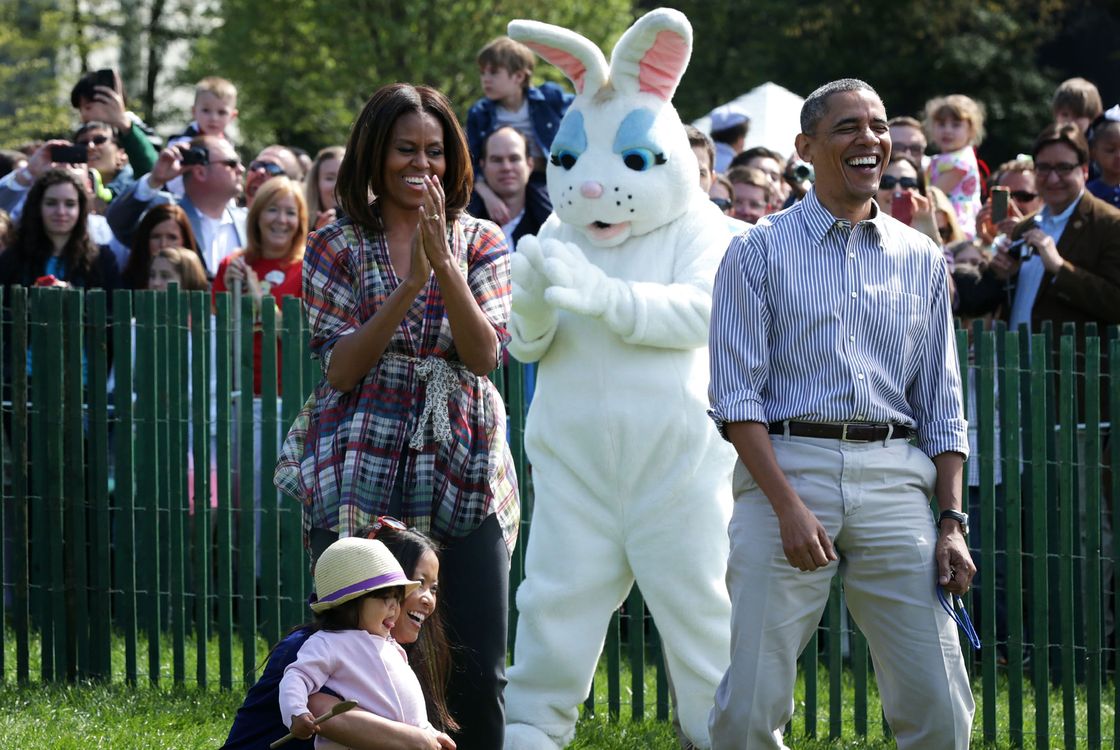
The greatest trick the Easter Bunny ever pulled was to convince the world he didn't exist.Alex Wong/Getty Images
A recent psychological study found that, when researchers read a news story reporting the rising share of minorities in the United States to a group of white subjects, the subjects grew more Republican. The study has attracted widespread attention, confirming the liberal fear, and the conservative hope, that the growth of Asian and Latino voters will produce an offsetting shift to the right among whites. “The changing American polity may come to look more like Texas than like the multicultural Democratic stronghold of California,” concludes political scientist Larry Bartels. “In an increasingly diverse America, identity politics will continue to cut both ways.”
It is certainly plausible that this study portends a future racially polarized America. But it seems strange to treat mass trends in evidence among successive elections involving over 125 million Americans while hanging confident predictions of the future of American politics on a laboratory microsimulation. People are highly susceptible to priming — which is to say, even slight changes to the context in which they make a decision can produce large differences in their actions. Making white people focus on increasing diversity while sitting in a controlled room may cause them to immediately report more conservative beliefs. That does not necessarily tell you what the open vista of American politics, a vast ecosystem teeming with messages and context of all kinds, will look like.

 Read More Here

.....

Enhanced by Zemanta

Cliven Bundy : From National political star fighting an out of control Federal Government for Grazing rights to disappointing Poster boy for Foot - in - Mouth Disease. With Politicians feigning outrage and pointing fingers to cover their political assets.


By MICHELLE RINDELS

Associated Press
— A Nevada rancher who became a conservative folk hero for standing up to the government in a fight over grazing rights lost some of his staunch defenders after wondering aloud whether blacks might have had it better under slavery.


Republican politicians from around the country who have rallied to Cliven Bundy's defense in recent weeks denounced the comments and distanced themselves from the rancher, including potential 2016 presidential contender U.S. Sen. Rand Paul of Kentucky and U.S. Sen. Dean Heller of Nevada.
Democrats were quick to pounce on the comments and label Bundy a racist.
Bundy has gone from a little-known rancher and melon farmer in rural Nevada to a national political star since he resisted the federal government's attempts to round up his cattle from federal land because he hadn't paid grazing fees for two decades. His supporters, especially those on the right, have praised him for standing up to what they believe is a heavy-handed federal government, and several armed militia members traveled to his ranch to back Bundy.
His comments were first published in The New York Times on Wednesday, but he did little to tamp down the controversy as he sought to address the public outrage on Thursday.
Bundy was quoted in a Times story referring to black people as "the Negro" and recalling a time decades ago when he drove past homes in North Las Vegas and saw black people who "didn't have nothing to do." He said he wondered if they were "better off as slaves" than "under government subsidy."

Read more here: http://www.kansascity.com/2014/04/25/4981156/nevada-rancher-defends-remarks.html#storylink=cpy
Read More Here
.....
CNN Opinion

On race, Cliven Bundy isn't the problem

By LZ Granderson, CNN Contributor
updated 2:14 PM EDT, Fri April 25, 2014
Rancher Cliven Bundy, right, leaves the podium with bodyguards after a news conference near his ranch in Bunkerville, Nevada, on Thursday, April 24. Bundy and the Bureau of Land Management have been locked in a dispute for a couple of decades over grazing rights on public lands. Rancher Cliven Bundy, right, leaves the podium with bodyguards after a news conference near his ranch in Bunkerville, Nevada, on Thursday, April 24. Bundy and the Bureau of Land Management have been locked in a dispute for a couple of decades over grazing rights on public lands.

..
Editor's note: LZ Granderson is a CNN contributor, a senior writer for ESPN and lecturer at Northwestern University. Commentary by the former Hechinger Institute fellow has been recognized by the Online News Association, the National Association of Black Journalists and the National Lesbian and Gay Journalists Association. Follow him on Twitter @locs_n_laughs. The opinions expressed in this commentary are solely those of the author.
(CNN) -- Bashing Cliven Bundy for his remarks regarding race is like Lebron James dunking on a 5-foot rim: Pointless. But we're going to do it anyway because it's fun. He said a lot of stupid things, and there are few things more entertaining than well-executed memes and a hashtag in front of stupidity.
The problem is Bundy is not the face of racism.
Not today's version.
But we'll place that yoke on his shoulders anyway because it's easy. Some conservatives will quickly pedal away from the Bundys and the Ted Nugents of the world, insisting that they are not like those rodeo clowns. They don't have a racist bone in their body because they would never make such outlandish statements. But then they turn around and marvel at how "well-spoken" or "articulate" a black person is and think nothing of it.
Politicians of all stripes will publicly denounce the offensive things that Bundy said but continue to construct policies that caters to his sensibilities. Today, racism isn't a crazy old white man with a dead calf on his shoulders proclaiming he's "unracist." No, it's elected officials like Paul Ryan saying inner-city men are "not even thinking about working or learning the value and the culture of work" and then feigning shock that people see a racist element to his statements.


.....

Civilian Militia Remains at Bundy Ranch After Standoff Ends


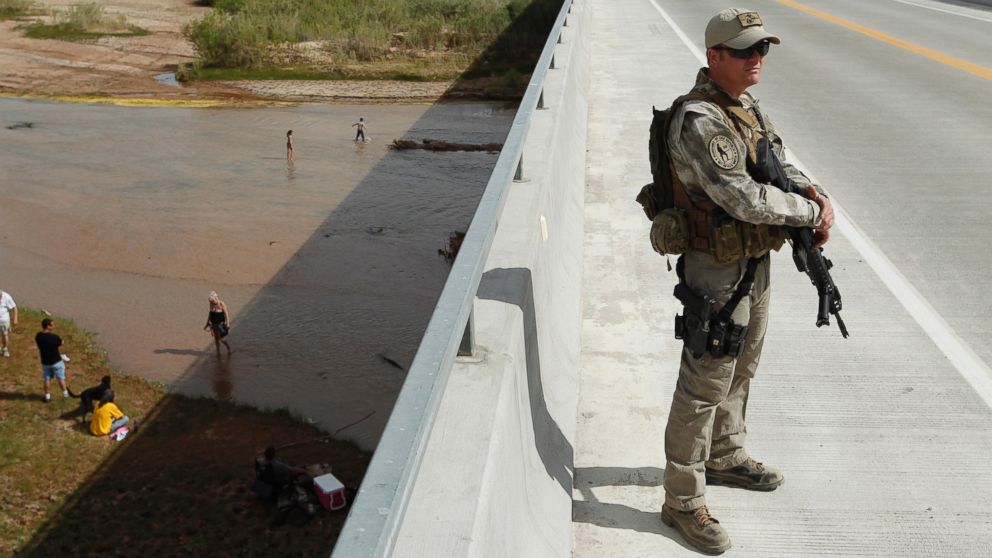
PHOTO: Justin Giles of Wasilla, Alaska stands guard on a bridge over the Virgin River during a rally in support of Cliven Bundy near Bunkerville, Nev. Friday, April 18, 2014.

A group of armed militia and protesters, some sporting nametags reading "domestic terrorist," remain camped out on a cattle ranch in Nevada, where they have been purportedly defending the property since a tense showdown ended with the federal government last week.
A 20-year struggle between rancher Cliven Bundy and the Bureau of Land Management over decades of alleged illegal cattle grazing on public land ended last Sunday, with the government backing down from a controversial week-long cattle round-up.

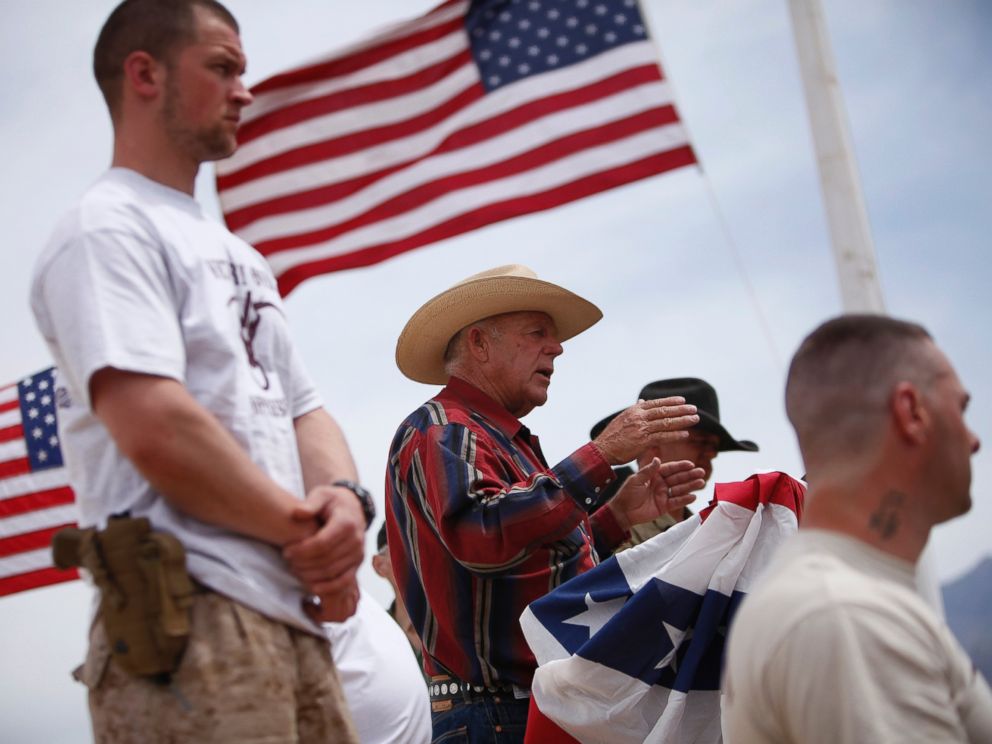
PHOTO: Flanked by armed supporters, rancher Cliven Bundy speaks at a protest camp near Bunkerville, Nev. Friday, April 18, 2014.
Las Vegas Review-Journal, John Locher/AP Photo
Flanked by armed supporters, rancher Cliven Bundy speaks at a protest camp near Bunkerville, Nev. Friday, April 18, 2014.

The BLM defused the standoff, citing safety concerns for its employees and the protesters, some of whom were on horseback and others who were set up in sniper positions on the Interstate 15 overpass pointing military-style rifles at federal agents. Among the citizen army were dozens of women and children under the overpass who could have been caught in the line of any possible gunfire.
But many people who say they support Bundy said they felt the battle was far from over, as evidenced by some responses ABC News received on social media, after the BLM first announced on April 12 that it was withdrawing from the area and releasing the 380 cattle already collected as part of the round-up on an area of land half the size of Delaware state.


The government maintains that Bundy owes more than $1.1 million in unpaid trespass fees and penalties after letting his herd of some 900 cattle graze on federal land near the town of Bunkerville, about 80 miles northeast of Las Vegas, for the last 20 years.
Agency officials also told The Associated Press that the roundup contract was $900,000.
The BLM said it would now move to resolve the matter "administratively and judicially," although the government has unsuccessfully gone head to head with Bundy in Court since 1993, after it established the area as a protected habitat for the endangered desert tortoise and slashed Bundy's cattle allotment.

Read More Here

.....

KLAS segment on militia at Bundy's Ranch 4/18/2014 

Part 1
[youtube http://www.youtube.com/watch?v=j2Zl1s6aGDs]
Published on Apr 20, 2014
KLAS segment on the militia at Bundy's Ranch 4/18/2014, part 1 of 2.


Part 2
[youtube http://www.youtube.com/watch?v=gEA_H2SBH6A]

Published on Apr 20, 2014
KLAS segment on the militia at Bundy's Ranch 4/18/2014, part 2 of 2.

.....
Enhanced by Zemanta