Showing posts with label Discrimination. Show all posts

Sunday, April 27, 2014

Political competition, not racism, changes voter alignments. Depends whom you ask.....


HumanEvents

Political competition, not racism, changes voter alignments

By Michael Barone | APRIL 20, 2014 AT 3:20 PM


Have the Republicans become the white man's party? Are the depth and bitterness of Republicans' opposition to Barack Obama and his administration the product of racism?
Those are questions you hear in the clash of political argument, and you will hear plenty of answers in the affirmative if you click onto MSNBC or salon.com with any regularity.
“
"Race ... has now became the primal grievance in our politics."
”
You can find a more nuanced and thoughtful analysis in Jonathan Chait's recent New York magazine article “The Color of His Presidency.”
Chait, a liberal, starts off by noting that the post-racial America that Obama seemed to promise in his 2004 national convention speech and his 2008 campaign has not come into being.
On the contrary. “Race, always the deepest and most volatile fault line in American history,” he writes, “has now became the primal grievance in our politics, the source of a narrative of persecution each side uses to make sense of the world.”
Many liberals see racism in every criticism of the Obama presidency, even though, as Chait points out, Bill Clinton met with similar and in some cases more strident opposition.
Conservatives, he argues, “dwell in a paranoia of their own, in which racism is used as a cudgel to delegitimize their core beliefs.” Understandably so, given his description of liberals’ “paranoia of a white racism.”
Chait defends liberals by arguing that the debates on big government inevitably produced by the Obama agenda and “there is no separating this discussion from one’s sympathies or prejudices toward, and identification with, black America.”
But he also admits that “advocating tax cuts is not in any meaningful sense racist.” And he seems to ignore the argument that policies that directed large sums of money disproportionately at blacks--like the welfare programs from the 1970s to the 1990s, which the Obama administration is trying to partially resurrect--harm more than benefit their intended beneficiaries.
This is, after all, what House Budget Chairman Paul Ryan was getting at when he lamented “a culture, in our inner cities in particular, of men not working.” The fact that Obama has made similar arguments didn't prevent Ryan from being excoriated as racist by some liberals.

Read More Here

.....

NY Mag.com


Is the Rising Democratic Majority Doomed?

By


Oooh, I know! I know! It's "no," right?
Oooh, I know! I know! It's "no," right? Photo: Chip Somodevilla/Getty Images
The slow, increasingly Democratic cast of the American electorate would seem to be a cardinal fact of American politics. The electorate is firmly polarized, with few voters actually liable to change their minds. The proportion of nonwhite voters has risen by about two percentage points every four years, a rate that seems likely to persist indefinitely as the population grows steadily more diverse. The youngest voting cohort has decidedly more liberal views, and more Democratic voting habits, than its elders, and partisan loyalty tends to stick throughout a voter’s lifetime. And yet the phenomenon continues to be met with an unduly wide, deep array of skepticism.
When Ruy Teixeira and John Judis wrote The Emerging Democratic Majority a dozen years ago, few of us placed much credence in their then-wild-sounding prediction. As recently as two and a half years ago, it was still being ridiculed.
As political events have increasingly borne out the prediction, it has been met with a series of objections, most of which have either been confounded or made no sense to begin with. Consider a few:
Objection: The growth of the Latino vote might stop (Sean Trende).
Result: Nope, the Latino vote has continued to rise.
Objection: Younger millennial voters entering the electorate during the sluggish Obama recovery would turn against him (Dana Milbank, Michael Barone).
Result: No, it turns out “Younger and older millennials also have similar assessments of the job Barack Obama is doing as president.”
Objection: Young voters are “libertarian,” and politically independent, and thus up for grabs (Ron Fournier, Julie Borowski, Nick Gillespie, and pretty much all the libertarians).
Result: This goes in the “never made any sense” category. Like libertarians, millennial voters do tend to have left-wing views on social policy and culture. Very much unlike libertarians, they also tend to have left-wing views on economics. They self-identify as “liberal,” believe the government has a duty to provide health insurance to all Americans, and support “bigger government” in the abstract at a far higher rate than any other age cohort. It’s true that millennial voters self-identify as “independent” more than Democrat, but they vote heavily Democratic. (Political scientists understand that most self-identified “independents” reliably vote for the same party).
**
The most popular new grounds for skepticism hold that the browning of America will provoke a backlash among whites — as the proportion of Latinos and Asians rises, threatened whites will grow increasingly conservative. Versions of this hypothesis have reverberated not only among conservatives like Trende and Barone, but also among liberals like Jamelle Bouie. And this theory does have at least some suggestive evidence that it may be true.
The greatest trick the Easter Bunny ever pulled was to convince the world he didn't exist.Alex Wong/Getty Images
A recent psychological study found that, when researchers read a news story reporting the rising share of minorities in the United States to a group of white subjects, the subjects grew more Republican. The study has attracted widespread attention, confirming the liberal fear, and the conservative hope, that the growth of Asian and Latino voters will produce an offsetting shift to the right among whites. “The changing American polity may come to look more like Texas than like the multicultural Democratic stronghold of California,” concludes political scientist Larry Bartels. “In an increasingly diverse America, identity politics will continue to cut both ways.”
It is certainly plausible that this study portends a future racially polarized America. But it seems strange to treat mass trends in evidence among successive elections involving over 125 million Americans while hanging confident predictions of the future of American politics on a laboratory microsimulation. People are highly susceptible to priming — which is to say, even slight changes to the context in which they make a decision can produce large differences in their actions. Making white people focus on increasing diversity while sitting in a controlled room may cause them to immediately report more conservative beliefs. That does not necessarily tell you what the open vista of American politics, a vast ecosystem teeming with messages and context of all kinds, will look like.

 Read More Here

.....

Enhanced by Zemanta

Thursday, April 17, 2014

The 1% wants to ban sleeping in cars – because it hurts their 'quality of life'

Depriving the homeless of their last shelter is Silicon Valley at its worst – especially when rich cities aren't doing anything to end homelessness


homeless in california
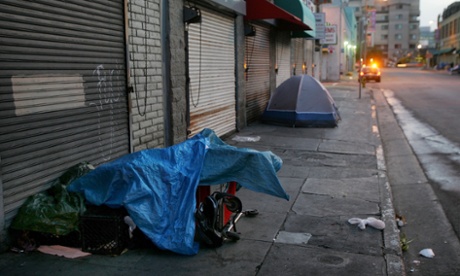
There are nearly 90,000 homeless people live in Los Angeles County but only 9,000 to 10,000 beds available in homeless shelters, single-room occupancy hotels, and other facilities. Photograph: David McNew / Getty Images
Across the United States, many local governments are responding to skyrocketing levels of inequality and the now decades-long crisis of homelessness among the very poor ... by passing laws making it a crime to sleep in a parked car.
This happened most recently in Palo Alto, in California's Silicon Valley, where new billionaires are seemingly minted every month – and where 92% of homeless people lack shelter of any kind. Dozens of cities have passed similar anti-homeless laws. The largest of them is Los Angeles, the longtime unofficial "homeless capital of America", where lawyers are currently defending a similar vehicle-sleeping law before a skeptical federal appellate court. Laws against sleeping on sidewalks or in cars are called "quality of life" laws. But they certainly don't protect the quality of life of the poor.
To be sure, people living in cars cannot be the best neighbors. Some people are able to acquire old and ugly – but still functioning – recreational vehicles with bathrooms; others do the best they can. These same cities have resisted efforts to provide more public toilet facilities, often on the grounds that this will make their city a "magnet" for homeless people from other cities. As a result, anti-homeless ordinances often spread to adjacent cities, leaving entire regions without public facilities of any kind.
Their hope, of course, is that homeless people will go elsewhere, despite the fact that the great majority of homeless people are trying to survive in the same communities in which they were last housed – and where they still maintain connections. Americans sleeping in their own cars literally have nowhere to go.
Indeed, nearly all homelessness in the US begins with a loss of income and an eviction for nonpayment of rent – a rent set entirely by market forces. The waiting lists are years long for the tiny fraction of housing with government subsidies. And rents have risen dramatically in the past two years, in part because long-time tenants must now compete with the millions of former homeowners who lost their homes in the Great Recession.
The paths from eviction to homelessness follow familiar patterns. For the completely destitute without family or friends able to help, that path leads more or less directly to the streets. For those slightly better off, unemployment and the exhaustion of meager savings – along with the good graces of family and friends – eventually leaves people with only two alternatives: a shelter cot or their old automobile.

Read More Here
Enhanced by Zemanta

Saturday, March 15, 2014

Saudi’s Lonely, Costly Bid for Sunni-Shiite Equality

By
RIYADH, Saudi Arabia — MIKHLIF AL-SHAMMARI has been jailed repeatedly, declared an infidel, ruined financially and shot four times — by his own son — all for this: He believes his fellow Sunni Muslims should treat Shiites as equals.
In a Middle East torn by deepening sectarian hatred, that is a very unusual conviction. He has made it a kind of crusade for eight years now, visiting and praying with prominent Shiites and defending them in print, at enormous personal cost. The government of this deeply conservative kingdom continues to file new accusations against him, under charges like “annoying other people” and “consorting with dissidents.”
But Mr. Shammari, a gaunt 58-year-old with an aquiline nose and a jaunty smile, is not easily discouraged. “I’m not against my government or my religion, but things must be corrected,” he said in a furtive interview in a hotel lobby (he has been banned from talking with the news media). “We must all encourage human rights and stop the violence between Sunni and Shia.”
Photo
‘I’m ready to pay with my life for my beliefs.’ MIKHLIF AL-SHAMMARI Credit Abdurahman al Shammari
Mr. Shammari is not Saudi Arabia’s best-known human rights activist, and others have put in more time and suffered much longer prison terms. But he has a rare distinction: No other member of the kingdom’s Sunni Muslim majority has made it a mission to demand equal rights for the Shiite Muslim minority.
Even the most educated and cosmopolitan Saudis often look down on Shiites, who make up about 10 percent of the Saudi population, as closet Iranians or undesirables. Some of the religious conservatives who wield great influence here go much further, saying Shiites are worse than Jews because, unlike genuine infidels, they have been exposed to the truth of Islam and nevertheless choose to pervert it. Shiites have long complained of discrimination of various kinds, as well as the vitriolic abuse hurled at them by government-employed clerics.
Mr. Shammari believes this is not just ancient religious prejudice, but a deliberate strategy by the Saudi monarchy to keep its subjects divided and therefore less likely to demand a voice in their government.
Whatever the reasons, it is clear that the sectarian divide helps to tamp down dissent in the kingdom. In 2011, for instance, even liberal and democratic-leaning Saudis were frightened off by protests in the kingdom’s eastern province and in neighboring Bahrain because they were carried out mostly by Shiites, the majority population there. Street protests are illegal in Saudi Arabia.
MR. SHAMMARI says his protest derives partly from his origins: He is a leader of the Shammar tribe, which includes both Shiites and Sunnis and straddles the border between Saudi Arabia and Iraq. The Shammar suffered discrimination in the early days of the Saudi kingdom, because they were viewed as having divided loyalties.


Read More Here
Enhanced by Zemanta