About
a year ago, I was having lunch with a friend when I made a throwaway
comment: “Have you seen the rent in San Francisco? If I get a job in the
Bay Area, I’ll totally live in a van.”
As I
sit in darkness writing this, I’m trying to keep my typing quiet, lest a
real inhabitant of the neighborhood I’m parked in should walk by and
wonder about the sounds coming from the rusty bus loitering on their
block. Yes, you understood that correctly: Today, I work in a
multi-million dollar office complex, and I live in a van.
This
summer, after receiving a job offer in Silicon Valley, I went on
Craigslist and began sifting through housing listings: “verrrrrryyy
cheap bedroom ;),” “great deal on rent!” A single room with a shared
bathroom? Two thousand per month on the low-end. A small studio
apartment, you ask? If your startup wasn’t recently bought for seven
figures, forget about it.
I perked up after
finding a listing for $1,000 per month. Now this could work. Clicking
through to the details section however revealed the offer was for a
single bunk in a room with eight people, a set-up referred to as a
“hacker house” by an (evil) marketing genius.
Even
if I was to spend the huge majority of my salary on rent, I knew I
would likely still be in a grim living situation, resenting every penny I
handed over that could have gone towards paying back my student loans.
And as a software engineer, I’m one of the lucky ones! Imagine those who
aren’t lucky enough to be on the tech payroll.
Anyway,
three weeks ago I took the equivalent of three months’ rent and bought
an old red bus. It’s a 1969 VW camper van with a hole in the floor and a
family of spiders that has more of a right to be here than I do
(sleeping in your car on public land in California is illegal).
(Katharine Patterson/blog.thinkkappi.com)
But with the help of Ikea and an army of cleaning supplies I was able to get the bus into livable condition.
There
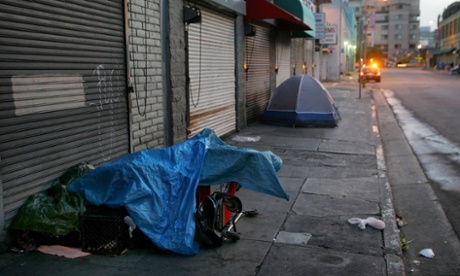
are nearly 90,000 homeless people live in Los Angeles County but only
9,000 to 10,000 beds available in homeless shelters, single-room
occupancy hotels, and other facilities. Photograph: David McNew / Getty
Images
Across
the United States, many local governments are responding to
skyrocketing levels of inequality and the now decades-long crisis of
homelessness among the very poor ... by passing laws making it a crime
to sleep in a parked car.
This happened most recently in Palo Alto,
in California's Silicon Valley, where new billionaires are seemingly
minted every month – and where 92% of homeless people lack shelter of
any kind. Dozens of cities have passed similar anti-homeless laws. The
largest of them is Los Angeles, the longtime unofficial "homeless
capital of America", where lawyers are currently defending a similar
vehicle-sleeping law before a skeptical federal appellate court.
Laws against sleeping on sidewalks or in cars are called "quality of
life" laws. But they certainly don't protect the quality of life of the
poor.
To be sure, people living in cars cannot be the best
neighbors. Some people are able to acquire old and ugly – but still
functioning – recreational vehicles with bathrooms; others do the best
they can. These same cities have resisted efforts to provide more public
toilet facilities, often on the grounds that this will make their city a
"magnet" for homeless people from other cities. As a result,
anti-homeless ordinances often spread to adjacent cities, leaving entire
regions without public facilities of any kind.
Their hope, of
course, is that homeless people will go elsewhere, despite the fact that
the great majority of homeless people are trying to survive in the same
communities in which they were last housed – and where they still
maintain connections. Americans sleeping in their own cars literally
have nowhere to go.
Indeed, nearly all homelessness in the US
begins with a loss of income and an eviction for nonpayment of rent – a
rent set entirely by market forces. The waiting lists are years long for
the tiny fraction of housing with government subsidies. And rents have risen dramatically
in the past two years, in part because long-time tenants must now
compete with the millions of former homeowners who lost their homes in
the Great Recession.
The paths from eviction to homelessness
follow familiar patterns. For the completely destitute without family or
friends able to help, that path leads more or less directly to the
streets. For those slightly better off, unemployment and the exhaustion
of meager savings – along with the good graces of family and friends –
eventually leaves people with only two alternatives: a shelter cot or
their old automobile.
As the drought deepens, California's
Department of Water Resources said today it will provide no more water
from the state water project to the 29 agencies that use it. KABC's
Michael Linder reports.
.....
California drought: State Water Project will deliver no water this summer
Posted: 01/31/2014 01:10:58 PM PST |Updated: a day ago
At Folsom Lake, Calif., the boat ramp is several hundred yards from the water's edge, January 2014. (Rich Pedroncelli / AP)
For
the first time in its 54-year history, the State Water Project, a
backbone of California's water system, will provide no water to urban
residents or farmers this year because of the severe drought, state
officials said Friday.
The announcement does not mean that
communities will have no water this summer. But it does mean that every
region is largely on its own now and will have to rely on water stored
in local reservoirs, pumped from underground wells, recycled water and
conservation to satisfy demand.
Silicon Valley and parts of the
East Bay -- particularly residents of Livermore, Pleasanton and Dublin,
who receive 80 percent of their water each year from the State Water
Project -- will feel the impact the most in the Bay Area.
Hardest hit, however, will be the state's huge agriculture industry.
"We
expect hundreds of thousands of acres of land in the Central Valley to
go unplanted," said Paul Wenger, president of the California Farm Bureau
Federation. "That will cause severe economic problems in our rural
regions -- loss of jobs and economic activity, with all the heartache
that entails."
The state's decision to turn off its main spigot
will be re-evaluated every month and could change if California sees
significant rainfall in February, March and April, state water officials
said at a Friday morning news conference.
Still, the news
highlighted how California is in uncharted territory this year. Last
year was the driest in the state's recorded history back to 1850. The
Sierra Nevada snowpack is at 15 percent of normal, even after a storm
this week. And January set more records for lack of rainfall.
"Today's
action is a stark reminder that California's drought is real," said
Gov. Jerry Brown. "We're taking every possible step to prepare the state
for the continuing dry conditions we face."
Bay Area impact
The
State Water Project, approved by voters in 1960 and a key legacy of
former Gov. Pat Brown, the governor's late father, is a massive system
of 21 dams and 701 miles of pipes and canals that moves water from
Northern California to the south. It essentially takes melting snow from
the Sierra Nevada, captures it and transports it from Lake Oroville in
Butte County through the Sacramento-San Joaquin River Delta all the way
to San Diego. In doing so, it provides drinking water for 23 million
people from Silicon Valley to the Los Angeles basin and irrigates about
750,000 acres of farmland. Read More Here
.....
Wine stocks could run dry as devastating drought in California threatens harvests and forces farmers to plant fewer crops
Officials ban access to vast reservoir to try to protect dwindling supplies
State would need snow and rain every other day from now until May to restore water levels
Ghost town submerged since 1950s revealed as reservoir runs low
By Daily Mail Reporter PUBLISHED: 09:48 EST, 1 February 2014 | UPDATED: 10:28 EST, 1 February 2014
As
a drought tightens its grip on California, farmers in the Golden State
are fearing harvests of almonds, oranges and grapes could be lost.
The
state's famed vineyards and other farms will be further affected by the
decision yesterday to not send water from a vast reservoir system to
local agencies in spring. The
unprecedented move means water supplies for 25 million people, and
irrigation for one million acres of farmland, will be forced to look to
other sources.
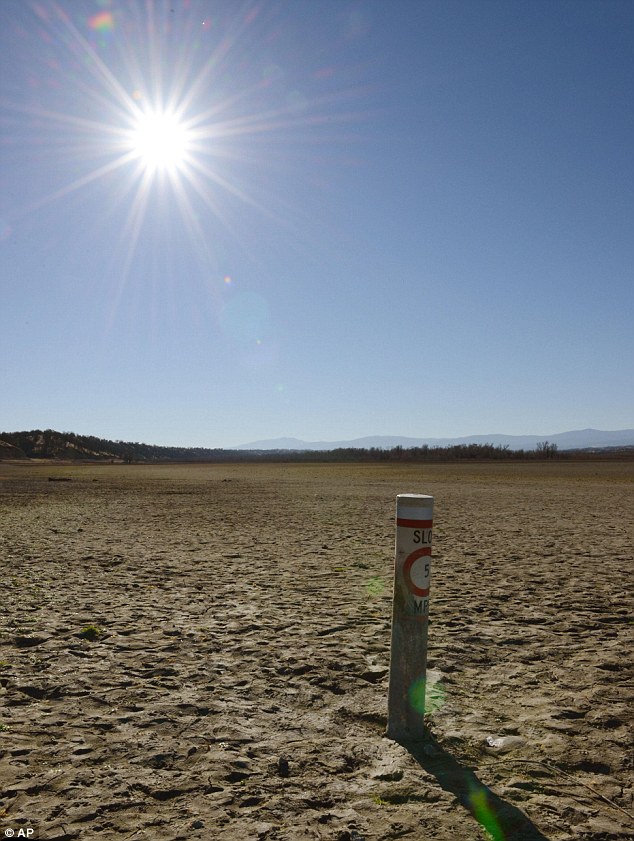
Run dry: A boating speed limit buoy stands out on the dry bed of Black Butte Lake last month
The announcement was timed to give farmers more time to determine what crops they will plant this year and in what quantities. Farmers
and ranchers throughout the state already have felt the drought's
impact, tearing out orchards, fallowing fields and trucking in alfalfa
to feed cattle on withered range land. Without
deliveries of surface water, farmers and other water users often turn
to pumping from underground aquifers. The state has no role in
regulating such pumping. 'A
zero allocation is catastrophic and woefully inadequate for Kern County
residents, farms and businesses,' Ted Page, president the Kern County
Water Agency's board, said in a statement.
'While
many areas of the county will continue to rely on ground water to make
up at least part of the difference, some areas have exhausted their
supply.'
Concerns: California's $61 billion a year wine industry may suffer if it loses access to vital water for next year's crop
• Secret files show scale of Silicon Valley co-operation on Prism • Outlook.com encryption unlocked even before official launch • Skype worked to enable Prism collection of video calls • Company says it is legally compelled to comply
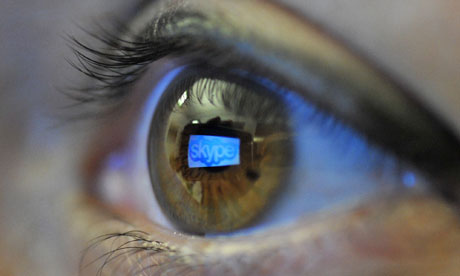
Skype worked with
intelligence agencies last year to allow Prism to collect video and
audio conversations. Photograph: Patrick Sinkel/AP
Microsoft
has collaborated closely with US intelligence services to allow users'
communications to be intercepted, including helping the National
Security Agency to circumvent the company's own encryption, according to
top-secret documents obtained by the Guardian.
The files provided by Edward Snowden
illustrate the scale of co-operation between Silicon Valley and the
intelligence agencies over the last three years. They also shed new
light on the workings of the top-secret Prism program, which was disclosed by the Guardian and the Washington Post last month.
The documents show that:
• Microsoft helped the NSA
to circumvent its encryption to address concerns that the agency would
be unable to intercept web chats on the new Outlook.com portal;
• The agency already had pre-encryption stage access to email on Outlook.com, including Hotmail;
• The company worked with the FBI this year to allow the NSA easier access via Prism to its cloud storage service SkyDrive, which now has more than 250 million users worldwide;
•
Microsoft also worked with the FBI's Data Intercept Unit to
"understand" potential issues with a feature in Outlook.com that allows
users to create email aliases;
• In July last year, nine months after Microsoft bought Skype, the NSA boasted that a new capability had tripled the amount of Skype video calls being collected through Prism;
• Material collected through Prism is routinely shared with the FBI and CIA, with one NSA document describing the program as a "team sport".
The latest NSA revelations further expose the tensions between Silicon Valley and the Obama administration.
All the major tech firms are lobbying the government to allow them to
disclose more fully the extent and nature of their co-operation with the
NSA to meet their customers' privacy
concerns. Privately, tech executives are at pains to distance
themselves from claims of collaboration and teamwork given by the NSA
documents, and insist the process is driven by legal compulsion.
In
a statement, Microsoft said: "When we upgrade or update products we
aren't absolved from the need to comply with existing or future lawful
demands." The company reiterated its argument that it provides customer
data "only in response to government demands and we only ever comply
with orders for requests about specific accounts or identifiers".
In June, the Guardian revealed that the NSA claimed to have "direct access" through the Prism program to the systems of many major internet companies, including Microsoft, Skype, Apple, Google, Facebook and Yahoo.
Blanket orders from the secret surveillance court allow these communications to be collected without an individual warrant if the NSA
operative has a 51% belief that the target is not a US citizen and is
not on US soil at the time. Targeting US citizens does require an
individual warrant, but the NSA is able to collect Americans'
communications without a warrant if the target is a foreign national located overseas.
Since Prism's existence became public, Microsoft and the other companies listed on the NSA
documents as providers have denied all knowledge of the program and
insisted that the intelligence agencies do not have back doors into
their systems.
Microsoft's latest marketing campaign, launched in
April, emphasizes its commitment to privacy with the slogan: "Your
privacy is our priority."
Similarly, Skype's privacy policy
states: "Skype is committed to respecting your privacy and the
confidentiality of your personal data, traffic data and communications
content."
But internal NSA
newsletters, marked top secret, suggest the co-operation between the
intelligence community and the companies is deep and ongoing.
The latest documents come from the NSA's
Special Source Operations (SSO) division, described by Snowden as the
"crown jewel" of the agency. It is responsible for all programs aimed at
US communications systems through corporate partnerships such as Prism.
The files show that the NSA
became concerned about the interception of encrypted chats on
Microsoft's Outlook.com portal from the moment the company began testing
the service in July last year.
Within five months, the documents explain, Microsoft and the FBI had come up with a solution that allowed the NSA to circumvent encryption on Outlook.com chats
A
newsletter entry dated 26 December 2012 states: "MS [Microsoft],
working with the FBI, developed a surveillance capability to deal" with
the issue. "These solutions were successfully tested and went live 12
Dec 2012."
Two months later, in February this year, Microsoft officially launched the Outlook.com portal.
Another newsletter entry stated that NSA already had pre-encryption access to Outlook email. "For Prism
collection against Hotmail, Live, and Outlook.com emails will be
unaffected because Prism collects this data prior to encryption."