Showing posts with label Assassination. Show all posts

Tuesday, December 8, 2015

Court: Obama Can Continue Assassination Program in Secret, Even Against Americans


Activist Post

Interrupt Your Regularly Scheduled Program


original
By Derrick Broze

While much of the media has focused on the recent violence in Paris, Georgia, and San Bernardino, as well as the escalating conflicts in Iraq and Syria, another profound and troubling domestic issue seems to have been overlooked.

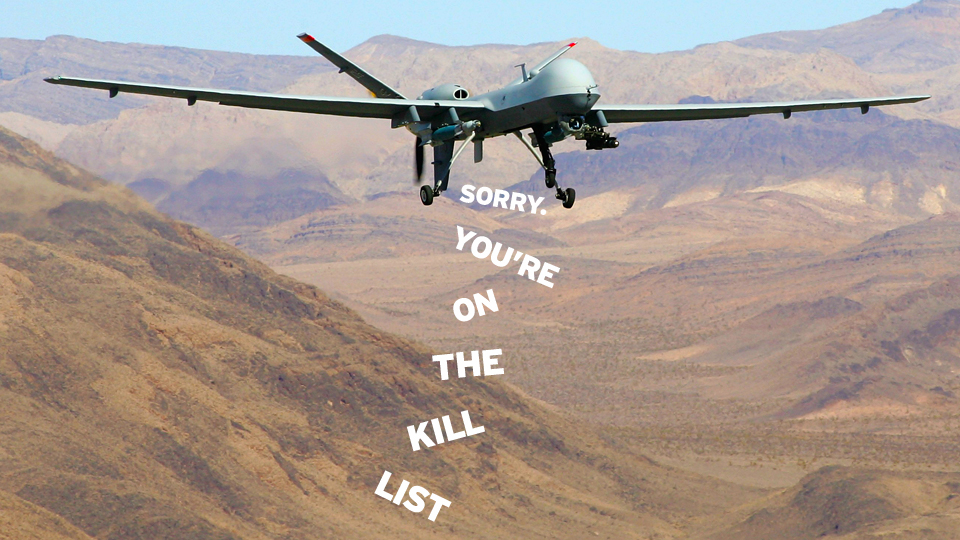
Indeed, the issue at hand was first reported on November 24th — and covered for roughly a day — before it was quickly forgotten in the daily barrage of news stories. But we should not be so quick to dismiss the possibility of a future president (maybe one with fascist leanings?) choosing to exercise “targeted killings” against the American public. This practice, of course, is embodied by the Obama administration’s program of assassinating individuals suspected of terrorism, also known as the “disposition matrix.”
 
The Washington Post first reported on the disposition matrix in 2012:
Over the past two years, the Obama administration has been secretly developing a new blueprint for pursuing terrorists, a next-generation targeting list called the ‘disposition matrix.’
The matrix contains the names of terrorism suspects arrayed against an accounting of the resources being marshaled to track them down, including sealed indictments and clandestine operations. U.S. officials said the database is designed to go beyond existing kill lists, mapping plans for the ‘disposition’ of suspects beyond the reach of American drones.
Although the matrix is a work in progress, the effort to create it reflects a reality setting in among the nation’s counterterrorism ranks: The United States’ conventional wars are winding down, but the government expects to continue adding names to kill or capture lists for years.
For the last four years, New York Times journalist Charlie Savage has waged a legal battle against the Obama administration, seeking to reveal the government’s legal justifications for assassinating terror suspects without a trial. Specifically, Savage sued the Obama administration in an attempt to obtain details about the murder of al-Qaeda affiliated cleric, Anwar al-Awlaki. Al-Awlaki was born in New Mexico and eventually found himself on the U.S. government’s radar under suspicion of terrorism.


Read More Here

Tuesday, April 8, 2014

Judge Orders FBI to Explain Withholding Records of Occupy Houston Assassination Plot

Why Did FBI Monitor Occupy Houston, and Then Hide Sniper Plot Against Protest Leaders?

freespeechtv freespeechtv


Published on Mar 25, 2014
Transparency activist Ryan Shapiro discusses a growing controversy over the FBI's monitoring of Occupy Houston in 2011. The case centers on what the FBI knew about an alleged assassination plot against Occupy leaders and why it failed to share this information. The plot was first revealed in a heavily redacted document obtained by the Partnership for Civil Justice Fund through a FOIA request. The document mentioned an individual "planned to engage in sniper attacks against protesters in Houston, Texas." When Shapiro asked for more details, the FBI said it found 17 pages of pertinent records and gave him five of them, with some information redacted. Shapiro sued, alleging the FBI had improperly invoked FOIA exemptions.

.....


Transparency activist Ryan Shapiro discusses a growing controversy over the FBI’s monitoring of Occupy Houston in 2011. The case centers on what the FBI knew about an alleged assassination plot against Occupy leaders and why it failed to share this information. The plot was first revealed in a heavily redacted document obtained by the Partnership for Civil Justice Fund through a FOIA request. The document mentioned an individual "planned to engage in sniper attacks against protesters in Houston, Texas." When Shapiro asked for more details, the FBI said it found 17 pages of pertinent records and gave him five of them, with some information redacted. Shapiro sued, alleging the FBI had improperly invoked FOIA exemptions. Last week, Federal District Judge Rosemary Collyer agreed with Shapiro, ruling the FBI had to explain why it withheld the records.

Transcript

This is a rush transcript. Copy may not be in its final form.
AMY GOODMAN: I want to talk about your work around animal rights activism and getting information, but I want to first turn to Occupy Houston. You have been working on getting information from the FBI around Occupy Houston. The particular issue focuses on what the FBI knew about an alleged assassination plot in 2011 against leaders of Occupy Houston and why it failed to share this information. The plot was first revealed in a heavily redacted document obtained by the Partnership for Civil Justice through a FOIA request. It read, quote, "An identified [REDACTED] as of October planned to engage in sniper attacks against protestors in Houston, Texas if deemed necessary," unquote. When our guest, Ryan Shapiro, asked for more details, the FBI said it found 17 pages of pertinent records and gave him five of them with some information redacted. So, Ryan Shapiro, you sued, alleging the FBI had improperly invoked FOIA exemptions.
Last week, Federal District Judge Rosemary Collyer seemed to agree with you, when she ruled the FBI had to explain why it withheld records. She made reference in her ruling to David Hardy, the head of the FBI’s FOIA division, writing, quote, "At no point does Mr. Hardy supply specific facts as to the basis for FBI’s belief that the Occupy protesters might have been engaged in terroristic or other criminal activity. ... Neither the word 'terrorism' nor the phrase 'advocating the overthrow of the government' are talismanic, especially where FBI purports to be investigating individuals who ostensibly are engaged in protected First Amendment activity."
Ryan Shapiro, explain what the judge ruled and what "talismanic" means.


......

Judge Orders FBI to Explain Withholding Records of Occupy Houston Assassination Plot

Fri, 3/21/2014 - by Carol Christian
This article originally appeared on Houston Chronicle

A federal judge has ordered the FBI to explain why it withheld some information requested by a graduate student for his research on a plot to assassinate Occupy Houston protest leaders.
Ryan Noah Shapiro, a doctoral student at Massachusetts Institute of Technology in Cambridge, Mass., filed a lawsuit April 29, 2013, against the U.S. Department of Justice in the U.S. District Court in Washington, D.C.
U.S. District Judge Rosemary M. Collyer issued her order, with an accompanying memo, on March 12.
The FBI, as part of the Department of Justice, controls the records Shapiro wanted for his study of "conflicts at the nexus of American national security, law enforcement and political dissent," the plaintiff's complaint stated.
Houston was among hundreds of U.S. cities where protesters occupied outdoor spaces as part of the Occupy Movement that started in New York's Zucotti Park on Sept. 17, 2011.
"The movement has sought to expose how the wealthiest 1 percent of society promulgates an unfair global economy that harms people and destroys communities worldwide," the complaint stated.
Shapiro said in his complaint that the existence of an assassination plot against Occupy Houston's leaders became known through the FBI's earlier release of information in response to a Freedom of Information Act request.
"According to one of the released records, ... [REDACTED] planned to gather intelligence against the leaders of the protest groups and obtain photographs, then formulate a plan to kill the leadership via suppressed sniper rifles...," Shapiro stated in his complaint.
Shapiro requested additional information from the FBI in January 2013.
"There is presently a vigorous and extraordinarily important debate in the United States about the authority of the government to conduct extrajudicial killings on American soil," the complaint stated.
"The records sought by plaintiff would likely be an invaluable contribution to the public discourse on this issue," Shapiro's complaint said. "It would also be a significant controversy if it was revealed that the FBI deliberately failed to act to prevent a plot to assassinate American protest leaders."


Read More Here

.....


Enhanced by Zemanta

Wednesday, February 12, 2014

The NSA’s Secret Role in the U.S. Assassination Program

The//Intercept

By and 10 Feb 2014, 12:03 AM EST

Featured photo - The NSA’s Secret Role in the U.S. Assassination Program 
 
 Credit: Kirsty Wigglesworth/Associated Press. 
 
The National Security Agency is using complex analysis of electronic surveillance, rather than human intelligence, as the primary method to locate targets for lethal drone strikes – an unreliable tactic that results in the deaths of innocent or unidentified people.
According to a former drone operator for the military’s Joint Special Operations Command (JSOC) who also worked with the NSA, the agency often identifies targets based on controversial metadata analysis and cell-phone tracking technologies. Rather than confirming a target’s identity with operatives or informants on the ground, the CIA or the U.S. military then orders a strike based on the activity and location of the mobile phone a person is believed to be using.
The drone operator, who agreed to discuss the top-secret programs on the condition of anonymity, was a member of JSOC’s High Value Targeting task force, which is charged with identifying, capturing or killing terrorist suspects in Yemen, Somalia, Afghanistan and elsewhere.
His account is bolstered by top-secret NSA documents previously provided by whistleblower Edward Snowden. It is also supported by a former drone sensor operator with the U.S. Air Force, Brandon Bryant, who has become an outspoken critic of the lethal operations in which he was directly involved in Iraq, Afghanistan and Yemen.
In one tactic, the NSA “geolocates” the SIM card or handset of a suspected terrorist’s mobile phone, enabling the CIA and U.S. military to conduct night raids and drone strikes to kill or capture the individual in possession of the device.
The former JSOC drone operator is adamant that the technology has been responsible for taking out terrorists and networks of people facilitating improvised explosive device attacks against U.S. forces in Afghanistan. But he also states that innocent people have “absolutely” been killed as a result of the NSA’s increasing reliance on the surveillance tactic.
One problem, he explains, is that targets are increasingly aware of the NSA’s reliance on geolocating, and have moved to thwart the tactic. Some have as many as 16 different SIM cards associated with their identity within the High Value Target system. Others, unaware that their mobile phone is being targeted, lend their phone, with the SIM card in it, to friends, children, spouses and family members.
Some top Taliban leaders, knowing of the NSA’s targeting method, have purposely and randomly distributed SIM cards among their units in order to elude their trackers. “They would do things like go to meetings, take all their SIM cards out, put them in a bag, mix them up, and everybody gets a different SIM card when they leave,” the former drone operator says. “That’s how they confuse us.”
As a result, even when the agency correctly identifies and targets a SIM card belonging to a terror suspect, the phone may actually be carried by someone else, who is then killed in a strike. According to the former drone operator, the geolocation cells at the NSA that run the tracking program – known as Geo Cell –sometimes facilitate strikes without knowing whether the individual in possession of a tracked cell phone or SIM card is in fact the intended target of the strike.
“Once the bomb lands or a night raid happens, you know that phone is there,” he says. “But we don’t know who’s behind it, who’s holding it. It’s of course assumed that the phone belongs to a human being who is nefarious and considered an ‘unlawful enemy combatant.’ This is where it gets very shady.”
The former drone operator also says that he personally participated in drone strikes where the identity of the target was known, but other unknown people nearby were also killed.
“They might have been terrorists,” he says. “Or they could have been family members who have nothing to do with the target’s activities.”
What’s more, he adds, the NSA often locates drone targets by analyzing the activity of a SIM card, rather than the actual content of the calls. Based on his experience, he has come to believe that the drone program amounts to little more than death by unreliable metadata.
“People get hung up that there’s a targeted list of people,” he says. “It’s really like we’re targeting a cell phone. We’re not going after people – we’re going after their phones, in the hopes that the person on the other end of that missile is the bad guy.”
The Obama administration has repeatedly insisted that its operations kill terrorists with the utmost precision.
In his speech at the National Defense University last May, President Obama declared that “before any strike is taken, there must be near-certainty that no civilians will be killed or injured – the highest standard we can set.” He added that, “by narrowly targeting our action against those who want to kill us and not the people they hide among, we are choosing the course of action least likely to result in the loss of innocent life.”
But the increased reliance on phone tracking and other fallible surveillance tactics suggests that the opposite is true. The Bureau of Investigative Journalism, which uses a conservative methodology to track drone strikes, estimates that at least 273 civilians in Pakistan, Yemen and Somalia have been killed by unmanned aerial assaults under the Obama administration. A recent study conducted by a U.S. military adviser found that, during a single year in Afghanistan – where the majority of drone strikes have taken place – unmanned vehicles were 10 times more likely than conventional aircraft to cause civilian casualties.
The NSA declined to respond to questions for this article. Caitlin Hayden, a spokesperson for the National Security Council, also refused to discuss “the type of operational detail that, in our view, should not be published.”
In describing the administration’s policy on targeted killings, Hayden would not say whether strikes are ever ordered without the use of human intelligence. She emphasized that “our assessments are not based on a single piece of information. We gather and scrutinize information from a variety of sources and methods before we draw conclusions.”
Hayden felt free, however, to note the role that human intelligence plays after a deadly strike occurs. “After any use of targeted lethal force, when there are indications that civilian deaths may have occurred, intelligence analysts draw on a large body of information – including human intelligence, signals intelligence, media reports, and surveillance footage – to help us make informed determinations about whether civilians were in fact killed or injured.”
The government does not appear to apply the same standard of care in selecting whom to target for assassination. The former JSOC drone operator estimates that the overwhelming majority of high-value target operations he worked on in Afghanistan relied on signals intelligence, known as SIGINT, based on the NSA’s phone-tracking technology.
“Everything they turned into a kinetic strike or a night raid was almost 90 percent that,” he says. “You could tell, because you’d go back to the mission reports and it will say ‘this mission was triggered by SIGINT,’ which means it was triggered by a geolocation cell.”
In July, the Washington Post relied exclusively on former senior U.S. intelligence officials and anonymous sources to herald the NSA’s claims about its effectiveness at geolocating terror suspects.
Within the NSA, the paper reported, “A motto quickly caught on at Geo Cell: ‘We Track ’Em, You Whack ’Em.’”
But the Post article included virtually no skepticism about the NSA’s claims, and no discussion at all about how the unreliability of the agency’s targeting methods results in the killing of innocents.
In fact, as the former JSOC drone operator recounts, tracking people by metadata and then killing them by SIM card is inherently flawed. The NSA “will develop a pattern,” he says, “where they understand that this is what this person’s voice sounds like, this is who his friends are, this is who his commander is, this is who his subordinates are. And they put them into a matrix. But it’s not always correct. There’s a lot of human error in that.”
The JSOC operator’s account is supported by another insider who was directly involved in the drone program. Brandon Bryant spent six years as a “stick monkey” – a drone sensor operator who controls the “eyes” of the U.S. military’s unmanned aerial vehicles. By the time he left the Air Force in 2011, Bryant’s squadron, which included a small crew of veteran drone operators, had been credited with killing 1,626 “enemies” in action.


Read More Here
Enhanced by Zemanta

Monday, January 27, 2014

Member of Somali rebel group al-Shabab killed by U.S. military missile strike


Afgoye and Mogadishu, SomaliaAfgoye and Mogadishu, Somalia

Somali Militant Killed in Drone Attack     :    VOA

.....

U.S. missile strike targets suspected militant leader in Somalia

The U.S. military carried out a missile strike in Somalia on Sunday, targeting a suspected militant leader with links to the al-Qaeda and al-Shabaab terror groups, U.S. military officials told NBC News.
U.S. military and intelligence officials are reviewing bomb damage assessment to determine if the terror leader was killed or wounded in the strike.
The officials would not yet identify the target of the strike.
The al-Shabaab group — which the State Department designates as a terrorist organization — is a loosely affiliated band of militia insurgents in southern Somalia that has close ties to the al-Qaeda terror network.
At least two senior al-Shabaab rebels, including the group’s leading explosives expert, were killed in a military strike last October.
Read More Here
.....

Somali Militant Killed in Missile Attack


A member of Somali rebel group al-Shabab was killed Sunday by a missile fired by a suspected drone, a rebel commander said, blaming the U.S. for the strike.
Abu Mohamed told The Associated Press that Sahal Iskudhuq, a militant commander who was believed to be close to al-Shabab's top leader, was killed when his car was hit by a missile in Somalia's Lower Shabelle region. The attack took place in a village called Hawai, he said.
A Somali intelligence official confirmed the attack, describing the victim as a "dangerous" militant. His driver was also killed in the attack, the official said on condition of anonymity because he wasn't authorized to reveal the information.
Mohamed blamed the attack on the U.S., which flies drones over Somalia that occasionally fire at one of al-Shabab's top leaders.
Two U.S. military officials confirm that there was a missile strike against a senior al-Shabab leader in Somalia today. The officials wouldn't identify the target of the strike, and one of the officials said U.S. intelligence is still "assessing the effectiveness of the strike."
.....

Enhanced by Zemanta

Sunday, December 22, 2013

Philippines Mayor His Wife And Baby Among 4 Killed By Gunmen At Manila Airport

MOXNEWSd0tC0M MOXNEWSd0tC0M


Published on Dec 20, 2013
December 20, 2013 Al Jazeera News http://MOXNews.com.....

Philippines mayor among four killed in Manila airport gunman attack

Manila News.Net Friday 20th December, 2013

The mayor of a southern Philippines town, two members of his family and a young child have died after a gunman opened fire outside a terminal at Manila's international airport.

The attack, which was aimed at Ukol Talumpa, the mayor of Labangan, wounded five people and caused panic among travellers.
According to CNN, initial reports suggested more than one attacker carried out the shooting.
The police however said a lone gunman was carried out the brazen attack
The dead include Talumpa, his wife and a 28-year-old niece, said Jose Erwin Villacorte, director of the Manila region's Southern Police District.


Read More Here
.....


Enhanced by Zemanta

Saturday, December 21, 2013

Air strike kills 15 civilians in Yemen by mistake: officials ...

File:MQ-1 Predator unmanned aircraft.jpg

A Predator drone in US Air Force base in 2011's summer.
Image Source Wikimedia. Org

.....

U.S. Drone Strike Hits Convoy Headed To Wedding Party In Yemen, Killing At Least 13, Officials Say

Posted:   |  Updated: 12/13/2013 5:33 pm EST
The Associated Press reports Yemeni officials have said a U.S. drone strike hit a convoy headed to a wedding party:
According to the report, at least 13 people were killed in the targeted strike.
Reuters quotes Yemeni security officials as saying the wedding party was targeted after it "was mistaken for an al-Qaeda convoy." Additionally, the news outlet cites 15 deaths, with another five people injured in the attack.
"An air strike missed its target and hit a wedding car convoy, ten people were killed immediately and another five who were injured died after being admitted to the hospital," one security official said.
Al-Qaeda in the Arabian Peninsula, or AQAP, is believed to be among the most active wings of the terrorist organization. In response to the militant group's increased activity, the U.S. has ramped up its use of drone strikes in Yemen since 2011.
More from the Associated Press:
SANAA, Yemen (AP) — Missiles fired by a U.S. drone slammed into a convoy of vehicles traveling to a wedding party in central Yemen on Thursday, killing at least 13 people, Yemeni security officials said. The officials said the attack took place in the city of Radda, the capital of Bayda province, and left charred bodies and burnt out cars on the road. The city, a stronghold of al-Qaida militants, witnessed deadly clashes early last year between armed tribesmen backed by the military and al-Qaida gunmen in an attempt to drive them out of the city.
There were no immediate details on who was killed in the strike, and there were conflicting reports about whether there were militants traveling with the wedding convoy.
A military official said initial information indicated the drone mistook the wedding party for an al-Qaida convoy. He said tribesmen known to the villagers were among the dead.
One of the three security officials, however, said al-Qaida militants were suspected to have been traveling with the wedding convoy.
While the U.S. acknowledges its drone program in Yemen, it does not usually talk about individual strikes.
If further investigations determine that the victims were all civilians, the attack could fuel an outburst of anger against the United States and the government in Sanaa among a Yemeni public already opposed to the U.S. drone strikes.

Read More and Watch Video Here


.....

Air strike kills 15 civilians in Yemen by mistake: officials


SANAA Thu Dec 12, 2013 1:34pm EST


(Reuters) - Fifteen people on their way to a wedding in Yemen were killed in an air strike after their party was mistaken for an al Qaeda convoy, local security officials said on Thursday.
The officials did not identify the plane in the strike in central al-Bayda province, but tribal and local media sources said that it was a drone.
"An air strike missed its target and hit a wedding car convoy, ten people were killed immediately and another five who were injured died after being admitted to the hospital," one security official said.
Five more people were injured, the officials said.
The United States has stepped up drone strikes as part of a campaign against Al Qaeda in the Arabian Peninsula (AQAP), regarded by Washington as the most active wing of the militant network.

Read More Here

.....
National flag of Yemen
Officials report 15 wedding guests in the Yemen province of al-Bayda were hit by an air strike, believed to be a US drone. Photograph: Malcolm Harris / Alamy/Alamy
Fifteen people on their way to a wedding in Yemen were killed in an air strike after their party was mistaken for an al-Qaida convoy, local security officials said on Thursday.
The officials did not identify the plane in the strike in central al-Bayda province, but tribal and local media sources said that it was a drone.
"An air strike missed its target and hit a wedding car convoy, 10 people were killed immediately and another five who were injured died after being admitted to the hospital," one security official said.
Five more people were injured, the officials said.
The United States has stepped up drone strikes as part of a campaign against al-Qaida in the Arabian Peninsula (AQAP), regarded by Washington as the most active wing of the militant network.
Yemen, AQAP's main stronghold, is among a handful of countries where the United States acknowledges using drones, although it does not comment on the practice.
Human Rights Watch said in a detailed report in August that US missile strikes, including armed drone attacks, have killed dozens of civilians in Yemen.

Read More Here

.....
Enhanced by Zemanta

Monday, November 4, 2013

Last Year President Obama Reportedly Told His Aides That He's 'Really Good At Killing People'


Nov. 2, 2013, 10:44 PM

Barack Obama
AP

This will not go over well for the 2009 Nobel Peace Prize winner.

According to the new book “Double Down,” in which journalists Mark Halperin and John Heilemann chronicle the 2012 presidential election, President Barack Obama told his aides that he’s “really good at killing people” while discussing drone strikes.
Peter Hamby of The Washington Post noted the moment in his review of the book.
The reported claim by the commander-in-chief is as indisputable as it is grim.
Obama oversaw the 2009 surge in Afghanistan, 145 Predator drone strikes in NATO’s 2011 Libya operations, the May 2011 raid that killed Osama bin Laden, and drone strikes that killed the Pakistani Taliban leader and a senior member of the Somali-based militant group al-Shabab this week.
His administration also expanded the drone war: There have been 326 drone strikes in Pakistan, 93 in Yemen, and several in Somalia under Obama — upwards of 4,000 people overall — compared to a total of 52 strikes under George Bush.
In 2011 two of those strikes killed American-born al-Qaeda propagandist Anwar al-Awlaki and his American-born, 16-year-old son within two weeks.

Read More Here

Enhanced by Zemanta

Friday, September 20, 2013

Drones used by the US to spy on, hunt, and kill terror suspects are “useless” in just about every other combat-related scenario, a top Air Force general said.


Predator drones ‘useless’ in combat scenarios - Air Force general


Published time: September 20, 2013 00:15
Edited time: September 20, 2013 03:37

Maintenence personel check a Predator drone operated by U.S. Office of Air and Marine (OAM), before its surveillance flight near the Mexican border.(AFP Photo / John Moore)

The fleet of MQ-1 Predator and MQ-9 Reaper drones are no match for aircraft that can fly higher and faster, like those employed by the most basic of air defenses around the world, Gen. Mike Hostage, chief of the air service's Air Combat Command, said at an Air Force Association conference.

"Predators and Reapers are useless in a contested environment," Hostage said, as quoted by Foreign Policy.

"Today...I couldn't put [a Predator or Reaper] into the Strait of Hormuz without having to put airplanes there to protect it," he added.

The Air Force revealed this week that an F-22 intercepted an Iranian F-4 Phantom jet fleet closing in on a US Predator over the strait earlier this year. In late 2012, Iranian jets fired on and missed a Predator drone in the strait.

Read More Here
Enhanced by Zemanta