Showing posts with label Eric Holder. Show all posts

Saturday, May 10, 2014

Hmmmm Factor : Six years after the biggest bank bailout in history Eric Holder now announces, "I intend to reaffirm the principle that no individual or entity that does harm to our economy is ever above the law,"

US attorney general says banks under investigation not 'too big to jail'

Eric Holder announced in video address that Justice Department pursuing criminal investigations of financial institutions

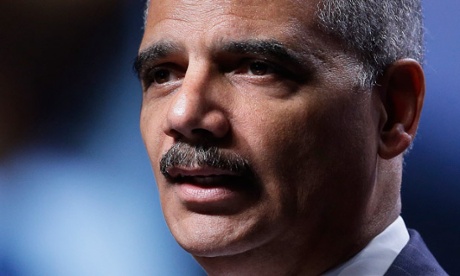
Eric Holder
While Holder did not name any banks, he said he is personally monitoring the ongoing investigations into financial institutions. Photo: Matt Rourke /AP
The US Justice Department is pursuing criminal investigations of financial institutions that could result in action in the coming weeks and months, US attorney general Eric Holder said in a video, adding that no company was "too big to jail."
The comments, made in a video posted on the Justice Department's website on Monday, came as federal prosecutors push two banks, BNP Paribas SA and Credit Suisse AG , to plead guilty to criminal charges to resolve investigations into sanctions and tax violations, respectively, according to people familiar with the probes.
While Holder did not name any banks, he said he is personally monitoring the ongoing investigations into financial institutions and is "resolved to seeing them through."
"I intend to reaffirm the principle that no individual or entity that does harm to our economy is ever above the law," Holder said in the video. "There is no such thing as 'too big to jail.'"
French bank BNP Paribas warned last week it faces fines from US authorities in excess of $1.1bn over allegations that it violated US sanctions against Iran and other countries.
The Swiss finance minister met Holder on Friday to discuss a US probe into Swiss banks that allegedly helped Americans evade US taxes, which includes Credit Suisse.
While units of financial institutions have agreed to plead guilty to breaking US criminal laws, such agreements have usually involved foreign subsidiaries who have little contact with US regulators.
Japanese units of UBS AG and Royal Bank of Scotland plc, for example, pleaded guilty in the past two years to resolve criminal charges that their traders manipulated the Libor benchmark interest rate.
A criminal conviction of an entity regulated in the United States could lead authorities to potentially revoke a charter or undertake other punitive measures.

Read More Here
Enhanced by Zemanta

Tuesday, April 8, 2014

Hmmmm Factor : Fast and Furious Eric Holder wants to explore gun tracking bracelets for law abiding gun owners.


 Holder: We Want to Explore Gun Tracking Bracelets

DOJ requesting $2 million for ‘Gun Safety Technology’ grants


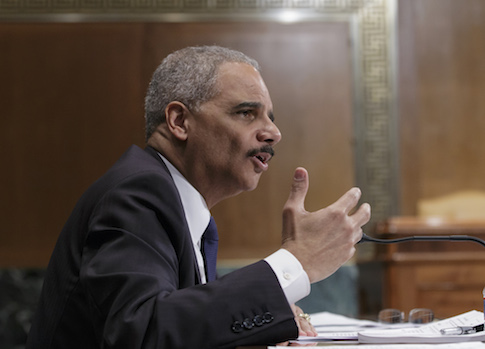
Attorney General Eric Holder / AP
BY:

Attorney General Eric Holder said on Friday that gun tracking bracelets are something the Justice Department (DOJ) wants to “explore” as part of its gun control efforts.
When discussing gun violence prevention programs within the DOJ, Holder told a House appropriations subcommittee that his agency is looking into technological innovations.

“I think that one of the things that we learned when we were trying to get passed those common sense reforms last year, Vice President Biden and I had a meeting with a group of technology people and we talked about how guns can be made more safe,” he said.
“By making them either through finger print identification, the gun talks to a bracelet or something that you might wear, how guns can be used only by the person who is lawfully in possession of the weapon.”
“It’s those kinds of things that I think we want to try to explore so that we can make sure that people have the ability to enjoy their Second Amendment rights, but at the same time decreasing the misuse of weapons that lead to the kinds of things that we see on a daily basis,” Holder said.

Read More and  Watch Video Here
Enhanced by Zemanta

Monday, September 30, 2013

Justice Department began it's voter ID law challenge with Texas and has now commenced it's lawsuit against North Carolina, with promises of more to come.

POLITICO

Justice Department to challenge North Carolina voter ID law


Eric Holder is pictured. | AP Photo
The justices’ 5-4 ruling outraged civil rights advocates. | AP Photo

The Justice Department will file suit against North Carolina on Monday, charging that the Tar Heel State’s new law requiring voters to show photo identification at the polls violates the Voting Rights Act by discriminating against African Americans, according to a person familiar with the planned litigation.
Attorney General Eric Holder is expected to announce the lawsuit at 11 a.m. Monday at Justice Department headquarters, flanked by the three U.S. Attorneys from North Carolina.
The suit, set to be filed in Greensboro, N.C., will ask that the state be barred from enforcing the new voter ID law, the source said. However, the case will also go further, demanding that the entire state of North Carolina be placed under a requirement to have all changes to voting laws, procedures and polling places “precleared” by either the Justice Department or a federal court, the source added.
Until this year, 40 North Carolina counties were under such a requirement. However, in June, the Supreme Court declared unconstitutional the formula Congress used to subject parts or all of 15 states to preclearance in recent decades.
The justices’ 5-4 ruling outraged civil rights advocates, but did not disturb a rarely-used “bail in” provision in the law that allows judges to put states or localities under the preclearance requirement. Civil rights groups and the Justice Department have since seized on that provision to try to recreate part of the regime that existed prior to the Supreme Court decision.
North Carolina Gov. Pat McCrory (R) signed the voter ID measure into law last last month.

Read More Here


**********************************************************

MSNBC


The battle for voting rights is just the beginning, says Holder


US Attorney General Eric Holder arrives to address the Congressional Black Caucus Annual Legislative Conference during a public policy forum on voting rights in Washington on September 20, 2013. (Photo by Nicholas Kamm/AFP/Getty)

This story has been updated and a correction appended. 

Attorney General Eric Holder said Friday that the Justice Department will continue its efforts to protect voting rights in the wake of the Supreme Court’s decision which gutted the Voting Rights Act earlier this summer.
During remarks to the Congressional Black Caucus, Holder explained that the lawsuits filed to stop Texas’s discriminatory redistricting and voter ID laws are “just the beginning.”
“Thanks to the hard work of our Civil Rights Division, we are continuing to refine and re-focus current enforcement efforts across the country,” he said. “And while the suits we’ve filed in Texas mark the first voting rights enforcement actions the Justice Department has taken since the Supreme Court ruling, they will not be the last.”
So far, the Justice Department has filed lawsuits to block redistricting and voter ID laws in Texas, along with pushing to see the state returned to preclearance under a different provision of the Voting Rights Act that remains intact after the Supreme Court ruling.
Earlier this week, the NAACP and Mexican American Legislative Caucus filed a lawsuit joining the DOJ in its attempt to block the voter ID law.
Texas Attorney General Greg Abbott called the Justice Department’s efforts a “scheme” to win Texas for Democrats.


Read More Here


**********************************************************

Southern States Are Moving to Tighten Voting Rules


Emboldened by the Supreme Court decision that struck down the heart of the Voting Rights Act, a growing number of Republican-led states are moving aggressively to tighten voting rules. Lawsuits by the Obama administration and voting rights activists say those efforts disproportionately affect minorities.
At least five Southern states, no longer required to ask Washington's permission before changing election procedures, are adopting strict voter identification laws or toughening existing requirements.
Texas officials are battling the U.S. Justice Department to put in place a voter ID law that a federal court has ruled was discriminatory. In North Carolina, the GOP-controlled Legislature scaled back early voting and ended a pre-registration program for high school students nearing voting age.
Nowhere is the debate more heated than in Florida, where the chaotic recount in the disputed 2000 presidential race took place.
Florida election officials are set to resume an effort to remove noncitizens from the state's voting rolls. A purge last year ended in embarrassment after hundreds of American citizens, most of whom were black or Hispanic, were asked to prove their citizenship or risk losing their right to vote.
Republican leaders across the South say the new measures are needed to prevent voter fraud, even though such crimes are rare. Democrats and civil rights groups say the changes are political attacks aimed at minorities and students — voting groups that tend to lean toward Democrats — in states with legacies of poll taxes and literacy tests.
In North Carolina, for example, a state board of elections survey found that more than 600,000 registered voters did not have a state-issued ID, a requirement to vote under the state's new law. Many of those voters are young, black, poor or elderly.
"We're in the middle of the biggest wave of voter suppression since the Voting Rights Act was enacted," said Katherine Culliton-González, director of voter protection for the Advancement Project, a Washington-based civil rights group that has undertaken legal challenges in several states.
For five decades, states and localities with a history of discrimination had to submit all election laws, from new congressional district maps to precinct locations and voting hours, to federal lawyers for approval. That practice ended in June when the Supreme Court struck down the provision in the Voting Rights Act as outdated.
Voting rights groups said recent actions by Southern states highlight the need for Congress to retool the rejected sections of the landmark 1965 law that were credited with ensuring ballot access to millions of blacks, American Indians and other minorities.
The administration is using the remaining parts of the law to bring court cases.


**********************************************************


Enhanced by Zemanta

Tuesday, August 13, 2013

Eric Holder FULL SPEECH Outlining New Justice Department Drug Sentencing Reforms

Les Grossman


Published on Aug 12, 2013
AG Holder Address the ABA on Prison Sentences
Attorney General Eric Holder addresses the American Bar Association's annual meeting in San Francisco where he is expected to discuss drug offenses and prison sentencing. Founded in 1878, the national association of lawyers includes 410,000 members.
***************************************************************

This  coming  from  an Administration  that  raids and  prosecutes LEGAL Marijuana  Dispensaries  in States  where  Marijuana  has  been  LEGALIZED! 

While  totally  at  peace  with the  concept of   gun  running  to drug dealers via the DEA.

How   hypocritical  can  you  get ?

~Desert Rose~
***************************************************************

Holder seeks to avert mandatory minimum sentences for some low-level drug offenders

Attorney General Eric H. Holder Jr. announced Monday that low-level, nonviolent drug offenders with no ties to gangs or large-scale drug organizations will no longer be charged with offenses that impose severe mandatory sentences.The new Justice Department policy is part of a comprehensive prison reform package that Holder unveiled in a speech to the American Bar Association in San Francisco. He also introduced a policy to reduce sentences for elderly, nonviolent inmates and find alternatives to prison for nonviolent criminals.
Graphic
Drug offenses account for 17%, or nearly one in five, of those in state prisons, according to national incarceration data.
Click Here to View Full Graphic Story
Drug offenses account for 17%, or nearly one in five, of those in state prisons, according to national incarceration data.

Justice Department lawyers have worked for months on the proposals, which Holder wants to make the cornerstone of the rest of his tenure.
“We must face the reality that, as it stands, our system is, in too many ways, broken,” Holder said. “And with an outsized, unnecessarily large prison population, we need to ensure that incarceration is used to punish, to deter and to rehabilitate — not merely to warehouse and to forget.”
“A vicious cycle of poverty, criminality and incarceration traps too many Americans and weakens too many communities,” Holder said Monday. (Excerpts of his ­prepared remarks were provided Sunday to The Washington Post.) He added that “many aspects of our criminal justice system may actually exacerbate these problems rather than alleviate them.”
It is clear that “too many Americans go to too many prisons for far too long and for no truly good law enforcement reason,” Holder said. “We cannot simply prosecute or incarcerate our way to becoming a safer nation,” he added later in the speech.
Holder is calling for a change in Justice Department policies to reserve the most severe penalties for drug offenses for serious, high-level or violent drug traffickers. He has directed his 94 U.S. attorneys across the country to develop specific, locally tailored guidelines for determining when federal charges should be filed and when they should not.


Read More Here


***************************************************************

Holder’s move on mandatory minimums a boon to Rand Paul


Monday’s announcement that Attorney General Eric Holder will seek to get rid of mandatory minimum sentences for some low-level drug offenders could soon create some interesting bedfellows.
Sen. Rand Paul (R-Ky.) gestures as he speaks at a forum on immigration organized by the Latino Partnership for Conservative Principles and the National Hispanic Christian Leadership Conference, Wednesday, June 12, 2013, at the Hyatt Regency Hotel in Washington, D.C. (Jacquelyn Martin/Associated Press)
Reforming mandatory minimums is an issue that Sen. Rand Paul (R-Ky.) has been pushing (no pun intended) for a while now — including during an appearance at historically black Howard University earlier this year.
A Paul staffer said the potential 2016 presidential candidate, who has already proposed a bill giving judges more leeway in sentencing drug offenders below the mandatory minimums, will work with the Obama administration on the issue.
“This is already a bipartisan issue, led in the Senate by Sens. Paul, [Patrick] Leahy, [Mike] Lee and [Richard] Durbin,” said the staffer, granted anonymity to discuss strategy. “Senator Paul believes strongly in this issue and that we must find a solution. He is pleased to work with all who agree and want to push forward.”
The aide also said that there has been contact between Paul and the administration.
Update 1:17 p.m.: Paul has released the following statement: “I look forward to working with them to advance my bipartisan legislation, the Justice Safety Valve Act, to permanently restore justice and preserve judicial discretion in federal cases. … The Administration’s involvement in this bipartisan issue is a welcome development. Now the hard work begins to change the law to permanently address this injustice.”


Read More Here


***************************************************************
Enhanced by Zemanta

Sunday, July 28, 2013

Veterans Kept as Guinea Pigs to Get Some Relief : The veterans claimed that some soldiers died, and others suffered seizures and paranoia.

Veterans Today

Veterans Kept as Guinea Pigs to Get Some Relief


OAKLAND (CN) – The government must come clean about the hazards of drug experiments to which it subjected Vietnam veterans, a federal judg e ruled.
Vietnam Veterans of America filed a class action suit against the Army and CIA in 2009, claiming that at least 7,800 soldiers had been used as guinea pigs in Project Paperclip.
The soldiers say they were administered at least 250, and perhaps as many as 400, types of drugs, including Sarin, one of the most deadly drugs known, as well as amphetamines, barbiturates, mustard gas, phosgene gas and LSD.
Using tactics it often attributed to the Soviet enemy, the U.S. government sought drugs that could control human behavior, cause confusion, promote weakness or temporary loss of hearing and vision, induce hypnosis and enhance a person’s ability to withstand torture, according to the complaint.
The veterans claimed that some soldiers died, and others suffered seizures and paranoia.
They said the CIA knew it had to conceal the tests from “enemy forces” and the “American public in general” because revealing it “would have serious repercussions in political and diplomatic circles and would be detrimental to the accomplishment of its mission.”
After two failed attempts to dismiss the action, the defendants succeeded last year in getting claims against Attorney General Eric Holder and the CIA dismissed.
U.S. District Judge Claudia Wilken granted the plaintiffs class action status last September, which could make thousands of veterans eligible for relief.
The crux of the veterans’ argument has been that Administrative Procedure Act obligates the defendants to provide notice to test subjects and to provide them with medical care.


Read More Here


**********************************************************

National Geographic : CIA Secret Experiments . . : : Documentary : : . .

Eric Duguay


Published on Jul 6, 2012
 
It's the height of the Cold War and the United States government is desperate to combat the spread of Communism. The CIA launches a highly classified, top secret research program into the covert use of biological and chemical agents. In simulated attacks on enemy populations, entire cities in America are contaminated with bacteria, exposing millions of Americans to germ warfare. But the real focus of the research is on mastering the art of mind control. Psychiatrists at top academic institutions work under secret contract with the agency. Psychiatric patients, prisoners, even unwitting members of the public are exposed to a startling array of experiments designed to facilitate interrogations, induce amnesia and program in new behavior. Every psychological technique is explored, including hypnosis, electroshock therapy and lethal cocktails of drugs. What was the extent of these brainwashing experiments? How did the CIA become involved in such far-reaching and disturbing research? Join us as National Geographic presents: CIA Secret Experiments.


  **********************************************************


Enhanced by Zemanta

Friday, July 26, 2013

Texas Republicans on Thursday hammered the Obama administration's push to block their state’s new voting laws, arguing the president was singling out the Lone Star State.

English: Eric Holder, Attorney General Nominee

English: Eric Holder, Attorney General Nominee (Photo credit: Wikipedia)
**********************************************************************************

The Hill

Texas GOP pans Holder move

By Mike Lillis and Bernie Becker - 07/25/13 01:21 PM ET
The lawmakers say Thursday's surprise move by Attorney General Eric Holder asking a court to require “pre-clearance” of new Texas laws steps on states' rights, wastes taxpayer dollars and defies the Supreme Court's June decision to scrap a key part of the Voting Rights Act.

“Once again it's the federal government telling the states what they can and can't do,” said Rep. Blake Farenthold (R-Texas). “Even after some defeats on the Voting Rights Act in the Supreme Court, the administration still continues to thwart the will of the people of Texas.
“We're ending up wasting the taxpayers' money when the court has already telegraphed that the Voting Rights Act is constitutionally infirm,” he added.
Rep. Kevin Brady (R-Texas) argued that Holder “is trying to skirt the Supreme Court law” and “single out Texas.”
“My belief is [the] Voting Rights Act and those laws ought to be applied equally across states, and not played for political games, which is exactly what I see happening here,” Brady said. “Eric Holder [is] just singling us out – just skipped through the alphabet and happened to land on Texas.”
Rep. Michael Burgess (R-Texas) also panned Holder's move, saying it fits the pattern of an agency that Republicans have long-criticized as over-stepping its legal boundaries.
“It's pretty much par for the course with this Department of Justice,” he said.
Speaking in Philadelphia Thursday, Holder announced that the DOJ will ask a court to require Texas to get federal approval before newly passed voting rules, including a voter ID requirement, take effect.
The Voting Rights Act stipulated that such pre-clearance occur in Texas, but June's Supreme Court ruling scrapped the coverage formula, effectively eliminating the pre-clearance requirement.
Holder said Thursday that “evidence of intentional racial discrimination” in Texas – “as well as the history of pervasive voting-related discrimination against racial minorities that the Supreme Court itself has recognized” – is indication that minority voters in the state need extra protections.


Read More Here


******************************************************************************

KVUE


Associated Press
Posted on July 25, 2013 at 11:03 AM
Updated today at 11:07 AM

WASHINGTON (AP) — Attorney General Eric Holder announced Thursday that the Justice Department is opening a new front in the battle for voter protections, a response to the Supreme Court ruling that dealt a major setback to the Voting Rights Act.
In a speech to the National Urban League in Philadelphia, Holder said that as its first move, the department is asking a federal court in San Antonio to require the state of Texas to obtain advance approval before putting future political redistricting changes in place.
The attorney general called the Voting Rights Act "the cornerstone of modern civil rights law" and said that "we cannot allow the slow unraveling of the progress that so many, throughout history, have sacrificed so much to achieve."
The Supreme Court, on a 5-4 vote, threw out the most powerful part of the landmark Voting Rights Act, the law that became a major turning point in black Americans' struggle for equal rights and political power.
The move in Texas is the Justice Department's first action to further safeguard voting rights following the Supreme Court decision on June 25, said Holder, "but it will not be our last."
"Even as Congress considers updates to the Voting Rights Act in light of the court's ruling, we plan, in the meantime, to fully utilize the law's remaining sections to ensure that the voting rights of all American citizens are protected," Holder said.
The requirement to obtain advance approval from either the department or a federal court before changing voting laws is available under the Voting Rights Act when intentional discrimination against voters is found. If the court in San Antonio sides with the Justice Department position, the preapproval requirement would apply for 10 years.
The section of the Voting Rights Act Holder invoked can be applied to all types of voting changes — from moving the location of a polling place to imposing stringent requirements such as photo identification at the polls.
On Wednesday, the Republican-dominated North Carolina Senate gave preliminary approval to sweeping election law changes, including requiring voters to present photo ID at the polls and shortening early voting by a week.


Read More Here


Enhanced by Zemanta