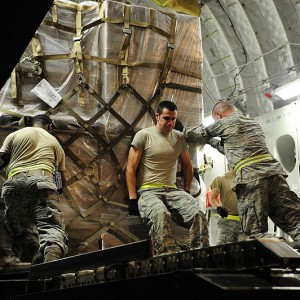
MOSCOW,
June 17 (RIA Novosti) – Russia and the United States have signed a
contract for the delivery of Russian Mi-17 helicopters for the Afghan
army, a Russian government agency said Monday.
The Russian state-owned defense firm Rosoboronexport and the US
Department of the Army signed the contract on Sunday in Paris “as part
of joint efforts to combat terrorism,” Russia’s Federal Service for
Military-Technical Cooperation said in a statement.
It did not say exactly how many helicopters were to be delivered, but
Rosoboronexport deputy head Alexander Mikheyev told RIA Novosti that
the contract was for 30 Mi-17V5 helicopters. He said the value could not
be disclosed, according to the contract’s terms.
(Reuters) - The
Pentagon said on Monday it will spend $572 million to buy 30
Russian-built military helicopters that will be used by Afghan security
forces.
The Mi-17 helicopters will be
used by Afghanistan's National Security Forces Special Mission Wing,
which supports counter-terrorism, counter-narcotics and special
operations missions...............
Hezbollah
supporters raise their hands in salute as Hezbollah leader Sheik Hassan
Nasrallah speaks on a screen via a video link from a secret place,
during a rally to mark the "wounded resistants day," in the southern
suburb of Beirut, Lebanon, June 14, 2013. (AP Photo/Bilal Hussein)
BEIRUT—The leader of Lebanon’s Hezbollah group vowed
Friday to keep fighting in Syria “wherever needed” and said his Shiite
Muslim group has made a “calculated” decision to defend the Syrian
regime no matter what the consequences.
The comments by Sheik Hassan Nasrallah in a speech to supporters in
southern Beirut signaled for the first time the Iranian-backed group
will stay involved in the civil war raging next door after helping
President Bashar Assad’s army recapture a key town in Syria’s central
Homs province from rebels.
President Barack Obama has authorized lethal aid to Syrian rebels
after the U.S. announced it had conclusive evidence that the Syrian
regime used chemical weapons. U.S. officials are still grappling with
what type and how much weaponry to send, but the announcement buoyed
opposition forces, which have found themselves heavily outgunned and
outmanned by the Hezbollah-backed regime.
The Syrian government on Friday dismissed U.S. charges that it used
chemical weapons as “full of lies,” accusing Obama of resorting to
fabrications to justify his decision to arm Syrian rebels.
U.S. officials said the administration could provide the rebel
fighters with a range of weapons, including small arms, ammunition,
assault rifles and a variety of anti-tank weaponry such as
shoulder-fired rocket-propelled grenades and other missiles. The
officials insisted on anonymity in order to discuss internal
administration discussions with reporters.
Hezbollah has come under harsh criticism at home and abroad for
sending its gunmen to Qusair, and Nasrallah’s gamble in Syria primarily
stems from his group’s vested interest in the Assad regime’s survival.
The Syrian government has been one of Hezbollah’s strongest backers for
decades and the militant group fears that if the regime falls it will be
replaced by a U.S.-backed government that will be hostile to Hezbollah.
Nasrallah said verbal and other attacks against his militant group “only serve to increase our determination.”
“We will be where we should be, we will continue to bear the
responsibility we took upon ourselves,” Nasrallah said. “There is no
need to elaborate… we leave the details to the requirements of the
battlefield.”
Assad’s forces, aided by fighters from Lebanon’s militant group
Hezbollah, captured Qusair on June 5, dealing a heavy blow to rebels who
had been entrenched in the strategic town for over a year.
Since then, the regime has shifted its attention to recapture other areas in the central Homs province and Aleppo to the north.
A visibly angry Nasrallah did not say outright whether his fighters
would go as far as fighting in Aleppo, but his words strongly suggested
the group was prepared to fight till the end.
“After Qusair for us will be the same as before Qusair,” he said.
“The project has not changed and our convictions have not changed.”
Nasrallah reiterated that the fight in Syria was one against the
“American, Israeli and Takfiri project” that was meant to destroy Syria,
which along with Iran has been the group’s main backer. Takfiri
Islamists refers to an ideology that urges Sunni Muslims to kill anyone
they consider an infidel.
Much of the group’s arsenal, including tens of thousands of rockets,
is believed to have come from Iran via Syria or from Syria itself.
In addition to the increased military aid, the U.S. also announced
Thursday it had conclusive evidence that Assad’s regime has used
chemical weapons, including the nerve agent sarin, on a small scale
against opposition forces. The White House said multiple chemical
attacks last year killed up to 150 people.
Obama has said the use of chemical weapons cross a “red line,” triggering greater U.S involvement in the crisis.
“The White House has issued a statement full of lies about the use of
chemical weapons in Syria, based on fabricated information,” a
statement issued Friday by the Syrian Foreign Ministry said. “The United
States is using cheap tactics to justify President Barack Obama’s
decision to arm the Syrian opposition,” it said.
By DEB RIECHMANN and LOLITA C. BALDOR Associated Press
WASHINGTON June 15, 2013 (AP)
The
Obama administration hopes its decision to give lethal aid to Syrian
rebels will prompt other nations to beef up assistance, now that the
U.S. has cited evidence that the Syrian government used chemical weapons
against its people. But the international reaction Friday ranged from
flat-out disbelief of the U.S. intelligence assessments to calls for
negotiation before more weapons pour into the vicious civil war.
The
administration now says it has "high confidence" that President Bashar
Assad's forces have killed up to 150 people with sarin gas. Although
that's a tiny percentage of the approximately 93,000 killed in the civil
war so far, the use of a chemical weapon crosses President Barack
Obama's "red line" for escalating U.S. involvement in the conflict and
prompted the decision to send arms and ammunition, not just humanitarian
aid and defensive non-lethal help like armored vests and night goggles.
The
administration's plan heading into the G8 meeting of industrialized
nations beginning Monday is to use the chemical weapons announcement and
Obama's decision on arms to persuade Russia to increase pressure on
Assad to send a credible negotiating team to Geneva for talks with the
opposition.
In
addition, Obama is expected to use the G8 meeting and discussions on
the sidelines to further coordinate with the British, French and
potentially others an increase of assistance — lethal, non-lethal and
humanitarian — to the rebels, the political opposition and refugees.
In
a letter to U.N. Secretary General Ban-Ki Moon, U.N. Ambassador Susan
Rice said the United States has determined that sarin was used in a
March 19 attack on the Aleppo suburb of Khan al-Assal and in an April 13
attack on the neighborhood of Shaykh Maqsud. She said unspecified
chemicals, possibly including chemical warfare agents, were used May 14
in an attack on Qasr Abu Samrah and in a May 23 attack on Adra.
U.S.
officials have not disclosed any details about the weapons they intend
to send to Syria or when and how they will be delivered. According to
officials, the U.S. is most likely to provide the rebel fighters with
small arms, ammunition, assault rifles and a variety of anti-tank
weaponry such as shoulder-fired rocket-propelled grenades and other
missiles.
As of Friday, however, no final decisions had been made
on the details or when it would reach the rebels, according to the
officials, who insisted on anonymity because they were not authorized to
discuss internal administration discussions with reporters.
Obama
has consistently said he will not put American troops in Syria, making
it less likely the U.S. will provide sophisticated arms or anti-aircraft
weapons that would require large-scale training. Administration
officials are also worried about high-powered weapons ending up in the
hands of terrorist groups. Hezbollah fighters are among those backing
Assad's armed forces, and al-Qaida-linked extremists back the rebellion.
The
lethal aid will largely be coordinated by the CIA, but that effort will
also be buttressed by an increased U.S. military presence in Jordan.
Pentagon
spokesman Dave Lapan sent the following statement to The Daily Beast
after this story posted: “There is no new planning effort underway. The
Joint Staff, along with the relevant combatant commanders, continue to
conduct prudent planning for a range of possible military options.”
Along
with no-fly zone plans, the White House is considering arming parts of
the Syrian opposition and formally recognizing the Syrian opposition
council, reports Josh Rogin.
The
White House has asked the Pentagon to draw up plans for a no-fly zone
inside Syria that would be enforced by the U.S. and other countries such
as France and Great Britain, two administration officials told The
Daily Beast.
A
Syrian army soldier holds a machine gun during a battle against
opposition fighters in the city of Qusayr, in Syria's central Homs
province on May 23, 2013. (AFP/Getty)
The
request was made shortly before Secretary of State John Kerry toured
the Middle East last week to try and finalize plans for an early June
conference between the Syrian regime and rebel leaders in Geneva. The
opposition, however, has yet to confirm its attendance and is demanding
that the end of Syrian President Bashar al-Assad’s rule be a
precondition for negotiations, a condition Assad is unlikely to accept.
President
Obama’s dual-track strategy of continuing to pursue a political
solution to the two-year-old uprising in Syria while also preparing for
more direct U.S. military involvement includes authorizing the Joint
Chiefs of Staff for the first time to plan for multilateral military
actions inside Syria, the two officials said. They added that no
decisions on actually using force have yet been made.
“The
White House is still in contemplation mode but the planning is moving
forward and it’s more advanced than it’s ever been,” one administration
official told The Daily Beast. “All this effort to pressure the regime
is part of the overall effort to find a political solution, but what
happens if Geneva fails? It’s only prudent to plan for other options.”
In
a May 8 meeting of the National Security Council Principals Committee,
the White House tasked several agencies with reporting on the pros and
cons of two additional potential courses of action: arming vetted and
moderate elements of the Syrian opposition, such as the Free Syrian
Army, and formally recognizing the Syrian opposition council as the
government of Syria, which would mean removing formal U.S. recognition
of the Assad regime.
Sen. John McCain—who’s advocated for more aggressive U.S. support of the Syrian rebels and who traveled secretly
into the country Monday to meet with the leaders of the Free Syrian
Army—told The Daily Beast last week that despite the request for plans
he doubts the White House will decide to implement a no-fly zone in
Syria. The Pentagon and the Joint Chiefs are opposed to the idea, he
said.
“One
thing about the Pentagon, if they don’t want to do something, they will
tell you all sorts of reasons why they can’t do it. It’s going to take
significant pressure for them to come up with realistic plans,” McCain
said. “They will invent ways for us not to do it until the president of
the United States says we’ve got to do it.”
McCain
said a realistic plan for a no-fly zone would include hundreds of
planes, and would be most effective if it included destroying Syrian
airplanes on runways, bombing those runways, and moving U.S. Patriot
missile batteries in Turkey close to the border so they could protect
airspace inside northern Syria.
In
April, Joint Chiefs of Staff Chairman Gen. Martin Dempsey told the
House Appropriations Subcommittee on Defense that the military was
planning for a range of options in Syria but that he did not necessarily
support using those options.
***************************************************************************** The Economic Collapse
Is Obama Starting A War With Syria Just To Distract Us From All The Scandals?
By Michael, on June 13th, 2013
Well,
isn't that convenient? At the moment when the Obama administration is
feeling more heat then ever before, it starts another war. Suddenly
everyone in the mainstream media is talking all about Syria and not
about the IRS scandal, Benghazi, NSA snooping
or any of the other political scandals that have popped up in recent
weeks. As if on cue, Obama made headlines all over the globe on
Thursday by claiming that the Syrian government has used chemical
weapons against the rebels "multiple times", and that the U.S. was now
ready to do more to assist the rebels. That assistance is reportedly
going to include "military support" for the rebels and a no-fly zone
over at least part of Syria is being discussed. Without a doubt, these
are acts of war, and this conflict is not going to end until Assad has
been ousted. But Assad will not go quietly. And all it would take is
for Assad to fire a couple of missiles at Tel Aviv for a huge regional
war to erupt in the Middle East. And what happens if Russia or China
decides to get involved in the conflict in Syria? Obama is playing with
fire, but he has shown again and again that he is willing to do
virtually anything if it will benefit him politically.
As far as the Obama administration is concerned, there is no such
thing as a coincidence. The timing of this announcement regarding Syria
was not an accident. If Obama wanted to use chemical weapons as an
excuse to go after Syria he could have done it weeks ago, or he could
have waited several more months before taking action. He chose to do it
right now for a reason, and hopefully the American people will be able
to see right through this.
So exactly what are we going to be doing for the Syrian rebels?
Well, we will definitely be arming them and training them. And it is
probably reasonable to assume that there will be American "advisers" on
the ground inside Syria helping to organize the Syrian resistance. In
fact, according to Debka, a large U.S. Marine force has already been deployed to the Jordanian border with Syria.
In addition, according to the Wall Street Journal, U.S. aircraft may be involved in enforcing a no-fly zone inside Syria...
A U.S. military proposal for arming Syrian rebels also
calls for a limited no-fly zone inside Syria that would be enforced from
Jordanian territory to protect Syrian refugees and rebels who would
train there, according to U.S. officials.
Asked by the White House to develop options for Syria, military
planners have said that creating an area to train and equip rebel forces
would require keeping Syrian aircraft well away from the Jordanian
border.
To do that, the military envisages creating a no-fly zone stretching
up to 25 miles into Syria which would be enforced using aircraft flown
from Jordanian bases and flying inside the kingdom, according to U.S.
officials.
No matter how you slice it, the United States is now in a state of
war with Syria. The only question is how "involved" we are going to
get.
And several prominent Republicans are already rushing forward to
applaud Barack Obama on this latest move. The following comes from a CBS News report...
Sen. John McCain, R-Ariz., who met with the rebels last
month and has been a vocal critic of the president's Syria policy said
in a joint statement with Sen. Lindsey Graham, R-S.C.: "We appreciate
the President's finding that the Assad regime has used chemical weapons
on several occasions. We also agree with the President that this fact
must affect U.S. policy toward Syria. The President's red line has been
crossed. U.S. credibility is on the line. Now is not the time to merely
take the next incremental step. Now is the time for more decisive
actions."
But you know what? Many of these Syrian rebels have actually pledged allegiance to al-Qaeda.
Yes, you read that correctly.
The whole point of the "war on terror" was to supposedly fight al-Qaeda, but now the U.S. military is allied with them.
Why in the world would we want to help the people who are supposed to be our greatest global enemy?...


 U.S. Buys More Russian Helicopters for Afghanistan






 By Michael, on June 13th, 2013