Showing posts with label ACLU. Show all posts

Tuesday, December 22, 2015

Militarized out of control chickens come home to roost and Cops Don’t Like It One Bit

Police brutality.svg
liftarn   Wikimedia.org


........................................................................................................


Home

People Are Waking Up to the Dark Side of American Policing, and Cops Don’t Like It One Bit


Pushing back against a creeping police state.
If you've been listening to various police agencies and their supporters, then you know what the future holds: anarchy is coming -- and it's all the fault of activists.


In May, a Wall Street Journal op-ed warned of a "new nationwide crime wave" thanks to "intense agitation against American police departments" over the previous year. New Jersey Governor Chris Christie went further. Talking recently with the host of CBS's Face the Nation, the Republican presidential hopeful asserted that the Black Lives Matter movement wasn't about reform but something far more sinister. "They've been chanting in the streets for the murder of police officers," he insisted. Even the nation's top cop, FBI Director James Comey, weighed in at the University of Chicago Law School, speaking of "a chill wind that has blown through American law enforcement over the last year."


According to these figures and others like them, lawlessness has been sweeping the nation as the so-called Ferguson effect spreads. Criminals have been emboldened as police officers are forced to think twice about doing their jobs for fear of the infamy of starring in the next viral video. The police have supposedly become the targets of assassins intoxicated by "anti-cop rhetoric," just as departments are being stripped of the kind of high-powered equipment they need to protect officers and communities. Even their funding streams have, it's claimed, come under attack as anti-cop bias has infected Washington, D.C. Senator Ted Cruz caught the spirit of that critique by convening a Senate subcommittee hearing to which he gave the title, "The War on Police: How the Federal Government Undermines State and Local Law Enforcement." According to him, the federal government, including the president and attorney general, has been vilifying the police, who are now being treated as if they, not the criminals, were the enemy.


Beyond the storm of commentary and criticism, however, quite a different reality presents itself. In the simplest terms, there is no war on the police. Violent attacks against police officers remain at historic lows, even though approximately 1,000 people have been killed by the police this year nationwide. In just the past few weeks, videos have been released of problematic fatal police shootings in San Francisco and Chicago.


While it's too soon to tell whether there has been an uptick in violent crime in the post-Ferguson period, no evidence connects any possible increase to the phenomenon of police violence being exposed to the nation. What is taking place and what the police and their supporters are largely reacting to is a modest push for sensible law enforcement reforms from groups as diverse as Campaign Zero, Koch Industries, the Cato Institute, The Leadership Conference, and the ACLU (my employer). Unfortunately, as the rhetoric ratchets up, many police agencies and organizations are increasingly resistant to any reforms, forgetting whom they serve and ignoring constitutional limits on what they can do.


Read More Here

Saturday, February 8, 2014

State lawmakers take action in the US as individuals prepare a globalized mobilization against encroaching digital surveillance


- Jon Queally, staff writer
Not content to wait for action at the federal level, those opposed to the ongoing mass surveillance of the NSA and other agencies are speaking out and pushing laws at the state level to ensure privacy rights are protected. (Image: thedaywefightback.org)Concerned about the government's increasing surveillance powers but unimpressed with the congressional response in Washington so far, state lawmakers from both major political parties are now taking it upon themselves to protect the online and communication privacy of their constituents.
Meanwhile, individuals and privacy groups are planning their own grassroots response to mass surveillance, hoping to repeat past victories by harnessing the power of digital communications to ensure they are adequately protected from government overreach.
As the Associated Press reports Wednesday, efforts are now underway "in at least 14 states are a direct message to the federal government: If you don't take action to strengthen privacy, we will."
According to AP:
Republican and Democratic lawmakers have joined in proposing the measures, reflecting the unusual mix of political partnerships that have arisen since the NSA revelations that began in May. Establishment leadership has generally favored the programs, while conservative limited government advocates and liberal privacy supporters have opposed them.
Supporters say the measures are needed because technology has grown to the point that police can digitally track someone's every move.
Devices such as license plate readers and cellphone trackers "can tell whether you stayed in a motel that specializes in hourly rates, or you stopped at tavern that has nude dancers," said David Fidanque, director of the American Civil Liberties Union of Oregon.
"It's one thing to know you haven't violated the law, but it's another thing to know you haven't had every one of your moves tracked," he said.
Next week, on February 11, privacy advocates and online freedom groups are mobilizing against NSA and other government surveillance in a day of action they've dubbed 'The Day We Fight Back.'
According to Katitza Rodriguez at the Electronic Frontier Foundation, one of the groups organizing the action, those participating will be demanding "an end to mass surveillance in every country, by every state, regardless of boundaries or politics."
Galvanized by what they see as 13 Principles of internet and communication freedoms, activists will use the day to call attention to those goals, lobby on their behalf with their representatives, and declare an end to the encroaching, unaccountable, and unregulated surveillance apparatus.
"The Principles spellout just why mass surveillance is a violation of human rights," explained Rodriguez, and they "give sympathetic lawmakers and judges a list of fixes they could apply to the lawless Internet spooks. On the day we fight back, we want the world to sign onto those principles. We want politicians to pledge to uphold them. We want the world to see we care."
_______________________________
Enhanced by Zemanta

Thursday, January 23, 2014

Blimplike surveillance craft set to deploy over Maryland heighten privacy concerns


Video: The Army says the aerostats being deployed near D.C., will not be equipped with cameras like the ones in Afghanistan. The Post's Craig Timberg, explains how aerostats work and how powerful their radar and camera sensors can be.


They will look like two giant white blimps floating high above I-95 in Maryland, perhaps en route to a football game somewhere along the bustling Eastern Seaboard. But their mission will have nothing to do with sports and everything to do with war.
The aerostats — that is the term for lighter-than-air craft that are tethered to the ground — are to be set aloft on Army-owned land about 45 miles northeast of Washington, near Aberdeen Proving Ground, for a three-year test slated to start in October. From a vantage of 10,000 feet, they will cast a vast radar net from Raleigh, N.C., to Boston and out to Lake Erie, with the goal of detecting cruise missiles or enemy aircraft so they could be intercepted before reaching the capital.

Graphic
Surveillance aircraft floating high above Maryland
Click Here to View Full Graphic Story
Surveillance aircraft floating high above Maryland


GRAPHIC: How the aerostats work
Aerostats deployed by the military at U.S. bases in Iraq and Afghanistan typically carried powerful surveillance cameras as well, to track the movements of suspected insurgents and even U.S. soldiers. When Army Staff Sgt. Robert Bales murdered 16 civilians in Kandahar in March 2012, an aerostat above his base captured video of him returning from the slaughter in the early-morning darkness with a rifle in his hand and a shawl over his shoulders.
Defense contractor Raytheon last year touted an exercise in which it outfitted the aerostats planned for deployment in suburban Baltimore with one of the company’s most powerful high-altitude surveillance systems, capable of spotting individual people and vehicles from a distance of many miles.
The Army said it has “no current plans” to mount such cameras or infrared sensors on the aerostats or to share information with federal, state or local law enforcement, but it declined to rule out either possibility. The radar system that is planned for the aerostats will be capable of monitoring the movement of trains, boats and cars, the Army said.
The prospect of military-grade tracking technology floating above suburban Baltimore — along one of the East Coast’s busiest travel corridors — has sparked privacy concerns at a time of rising worry about the growth of government eavesdropping in the dozen years since the Sept. 11, 2001, attacks.
“That’s the kind of massive persistent surveillance we’ve always been concerned about with drones,” said Jay Stanley, a privacy expert for the American Civil Liberties Union. “It’s part of this trend we’ve seen since 9/11, which is the turning inward of all of these surveillance technologies.”
The Army played down such concerns in written responses to questions posed by The Washington Post, saying its goal is to test the ability of the aerostats to bolster the region’s missile-defense capability, especially against low-flying cruise missiles that can be hard for ground-based systems to detect in time to intercept them.
The Army determined it did not need to conduct a Privacy Impact Assessment, required for some government programs, because it was not going to collect any personally identifiable information, officials said in their written responses to The Post.
“The primary mission . . . is to track airborne objects,” the Army said. “Its secondary mission is to track surface moving objects such as vehicles or boats. The capability to track surface objects does not extend to individual people.”
Even the most powerful overhead surveillance systems, experts say, struggle to make out individual faces or other identifying features such as license plates because of the extreme angles when viewing an area from above.
But privacy advocates say location information can easily lead to the identification of individuals if collected on a mass scale and analyzed over time.
Researchers have found that people vary their movements little day to day, typically traveling from home to work and back while also regularly visiting a small number of other locations, such as stores, gyms or the homes of friends.

Read More Here
Enhanced by Zemanta

Thursday, January 2, 2014

ACLU will appeal ruling that NSA bulk phone record collection is legal


• Appeal is against verdict by New York federal judge
• Federal appeals courts drawn into controversy
NSA HQ
The National Security Agency campus in Fort Meade, Maryland. Photograph: Patrick Semansky/AP
The American Civil Liberties Union gave notice on Thursday that it will continue its legal case challenging the constitutionality of the National Security Agency’s collection of all US phone records, drawing the federal appeals courts into a decision on the controversial surveillance.
A federal judge in New York, William Pauley, gave the NSA a critical courtroom victory last week when he found the ACLU “has no traction” in arguing that intercepting the records of every phone call made in the United States is a violation of the constitutional protection against unreasonable search and seizures.
As expected, on Thursday the ACLU filed notice that it will appeal Pauley’s decision before the second circuit court of appeals. The civil liberties group said in a statement that it anticipates making its case before the appellate court in the spring.
“The government has a legitimate interest in tracking the associations of suspected terrorists, but tracking those associations does not require the government to subject every citizen to permanent surveillance,” deputy ACLU legal director Jameel Jaffer said in the statement.

Read More Here
Enhanced by Zemanta

Monday, November 4, 2013

Pot capital of America? D.C. on fast track to decriminalizing marijuana

The Washington Times


Photo by: Ted S. Warren
This photo taken Oct. 16, 2013 shows marijuana clone plants that are used to grow medical marijuana displayed under a light, at The Joint, a medical marijuana cooperative in Seattle. It took nearly 15 years after voters approved it for medical marijuana to become available in the District of Columbia, but the next major change to the district’s pot laws is on the fast track. The D.C. Council is poised to approve a bill to decriminalize possession of small amounts of pot, and Democratic Mayor Vincent Gray supports it. He could sign the bill into law as early as January. (AP Photo/Ted S. Warren)
WASHINGTON — It took nearly 15 years after voters approved medical marijuana for it to become available in the District of Columbia, but the next major change to pot laws in the nation’s capital is on the fast track.
The D.C. Council is poised to approve a bill that would decriminalize possession of small amounts of pot, and Democratic Mayor Vincent Gray announced last month that he supports it. He could sign the bill into law as early as January.


Some activists want the city to go further by legalizing, taxing and regulating marijuana as Colorado and Washington state do, and they’re considering a ballot initiative if the council doesn’t take that step.
It’s a big change from a year ago, when there was no medical marijuana in the capital and elected officials weren’t talking about relaxing recreational pot laws. Now, there are three tightly regulated marijuana dispensaries in the city, although there aren’t many patients yet.
City leaders have long been cautious about pot, in part because Congress has the final say on what’s legal in the district. But with 17 states having some form of decriminalization and the Justice Department taking a hands-off approach to legalization in Colorado and Washington state, city leaders think Congress won’t be interested in fighting that battle.
“What the states do would not matter if there were serious interest in the subject” on Capitol Hill, said Del. Eleanor Holmes Norton, a Democrat who represents the district in Congress. “I don’t think there’s a serious interest in the subject.”
The new sense of urgency has been fueled in part by two studies released this year that found large racial disparities in marijuana arrests in the city. Blacks were eight times more likely to be arrested than whites in the district in 2010, the American Civil Liberties Union found, and 91 percent of those arrested that year were black. About half of the city’s 632,000 residents are African-American.
“We have hundreds of young black men, black boys, being locked up, for simple possession of a couple bags of marijuana,” said Democratic Councilmember Marion Barry, one of the bill’s sponsors. “We don’t want to be proud of the wrong kind of thing here. We need to stop that kind of injustice from happening.”
Democrat Paul Zukerberg, a defense attorney who represents people charged with marijuana offenses and who campaigned for the council this spring on liberalization of marijuana laws, said he’s pleased members have embraced the issue.
Enhanced by Zemanta

Friday, October 25, 2013

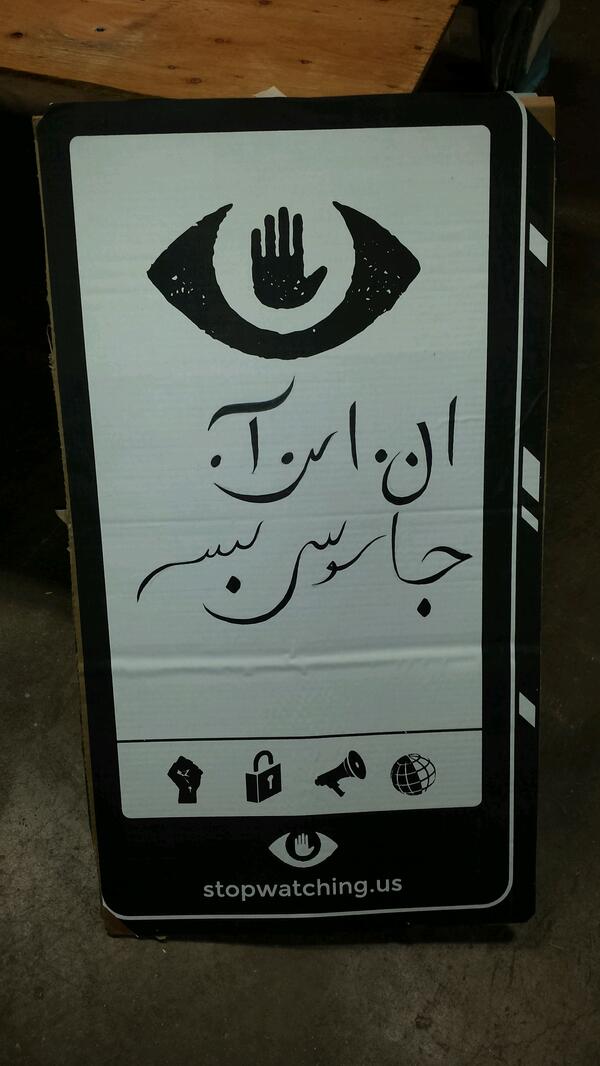
'Stop Watching Us': Snowden Reaches Out to Endorse DC Rally


'Stop Watching Us': Snowden Reaches Out to Endorse DC Rally

'Stop Watching Us' coalition rally, planned for Saturday, receives endorsement from NSA whistleblower

- Jon Queally, staff writer

'Stop Watching Us' coalition rally, planned for Saturday, receives endorsement from NSA whistleblowerAmid yet another round of explosive revelations about the activities of the National Security Agency and ahead of a large rally organized by a large coalition of social justice and privacy advocates planned for Saturday, whistleblower Edward Snowden urged his fellow U.S. citizens to speak out against NSA surveillance by telling Congress and the Obama administration: 'Stop Watching Us.'

In a rare public statement, released through the ACLU, Snowden said:
In the last four months, we've learned a lot about our government.
We've learned that the U.S. intelligence community secretly built a system of pervasive surveillance. Today, no telephone in America makes a call without leaving a record with the NSA. Today, no internet transaction enters or leaves America without passing through the NSA's hands. Our representatives in Congress tell us this is not surveillance. They're wrong.
Now it's time for the government to learn from us. On Saturday, the ACLU, EFF, and the rest of the StopWatching.Us coalition are going to D.C. Join us in sending the message: Stop Watching Us.
A large rally is planned for Washington, DC on Saturday with satellite events taking place in cities across the country.
The protests, which coincide with the 12th anniversary of the signing of the Patriot Act into law, are designed to bring together diverse groups from across the political spectrum to demand surveillance law reform.
"The NSA is spying on everyone's personal communications," says the coalition, and argues the massive agency is "operating without any meaningful oversight" from Congress, the courts, or the public at large.
The groups—which include the Electronic Frontier Foundation, ACLU, Public Citizen, Restore the Fourth, Free Press, Demand Progress and nearly a hundred others—released this video to promote the event:.........


...........

And updates and information on the day of action against NSA spying were being listed under #StopWatchingUs on Twitter:

6 new results
  1. Photos · View all
  2. 'Stop Watching Us': Snowden Reaches Out to Endorse DC Rally | Common Dreams
  3. Tomorrow, over 100 groups, companies, speakers descend on D.C. to tell the gov't: . See you there:


Enhanced by Zemanta