Turkey 'temporarily' suspends Syria air strikes after Russia spat
AFP
NATO
member Turkey has "temporarily" suspended air strikes against Islamic
State targets in Syria after the downing of a Russian warplane on the
Syrian border sparked a major row with Moscow, local media reported on
Friday.Turkish F-16 jets on Tuesday shot down a Russian warplane which
Ankara said had breached its air space. Russia on Thursday vowed to
carry out broad retaliatory measures against Turkey's economy.
Turkey,
a member of a US-led coalition fighting IS, has halted air raids
against the group in Syria in order to avoid any further crises, the
Hurriyet newspaper reported.
Turkey denies suspending Syria air strikes after Russia crisis
Turkey
denied Friday it had suspended air strikes against Islamic State
targets in Syria after the downing of a Russian warplane on the Syrian
border.
Turkish F-16 jets on Tuesday shot down a Russian warplane which Ankara said had breached its air space.
The
Hurriyet newspaper said Turkey, a member of a US-led coalition fighting
IS, had "temporarily" halted air raids against the group in Syria in
order to avoid any further crises.
"Both sides
agreed to act cautiously until they re-establish dialogue channels to
reduce tensions," the paper said, citing security sources.
But a government official denied that strikes had been halted.
USN - U.S. Naval Air Warfare Center Wikimedia.org
..........................................................................................................
French warplanes pounded Islamic State positions in Syria on Sunday as police in Europe widened their investigations into coordinated attacks in Paris that killed more than 130 people.
Islamic
State has claimed responsibility for Friday's suicide bombings and
shootings, which have re-ignited a row over Europe's refugee crisis and
drawn calls to block a huge influx of Muslim asylum-seekers.
French
police have launched an international hunt for a Belgian-born man they
believe helped organize the assaults with two of his brothers. One of
the brothers died in the attacks, while the second one is under arrest
in Belgium, a judicial source said.
A further two French suicide
attackers have been identified, police said, while the identity of four
other assailants, who all died in the violence, was still under review.
France
has been bombing Islamic State positions in Iraq and Syria for months
as part of a U.S.-led operation. Following Friday's mayhem, Paris vowed
to destroy the group. Underlining its resolve, French jets on Sunday
launched their biggest raids in Syria to date, hitting its stronghold in
Raqqa.
"The raid ... including 10 fighter jets, was launched
simultaneously from the United Arab Emirates and Jordan. Twenty bombs
were dropped," the Defence Ministry said. Among the targets were a
munitions depot and training camp, it said.
IS fighters said they carried out the gun and bomb massacre - calling Paris "the capital of prostitution and obscenity".
Sky's
Sam Kiley, in northern Iraq, said the French airstrikes should not be
seen as a "wanton act of revenge" or carpet-bombing campaign.
"I
think it's very clear that the French and the wider coalition have
decided in a sense to give France the iron fist at least for the next 24
hours or so," he said.
PARIS — French warplanes struck Islamic State militants
in Syria on Sunday, a French government official said, two days after
attackers linked to the terrorist group carried out a coordinated assault on Paris that killed 129 people.
Prior to the attack on Paris, France had been sparing in its strikes against targets in Syria.
News
reports in France said the airstrikes were focused on Raqqa, the city
in northern Syria that is the self-proclaimed capital of the Islamic
State.
The attackers in
Friday’s terrorist assault in Paris communicated at some point
beforehand with known members of the Islamic State in Syria, officials
on both sides of the Atlantic say, adding evidence to the assertions
that the radical group coordinated or helped carry out the attacks
rather than simply inspired them.
President François Hollande of France has characterized the attacks as “an act of war” carried out by the Islamic State, also known as ISIS
or ISIL. He provided no specific information, but the Islamic State
released statements on Saturday claiming responsibility for the attacks,
part of increasing indications that the group is becoming more capable
of extending its reach far beyond its base in Syria and Iraq.
A
manhunt is under way for Saleh Abdeslam after he was reportedly
questioned and released despite being identified by authorities.
21:29, UK, Sunday 15November 2015
A man wanted over the Paris terror attacks had been questioned and released by police hours after the massacres, it is claimed.
Salah
Abdeslam, 26, reportedly helped with logistics and rented a black
Volkswagen Polo used by the gunmen who stormed the Bataclan concert hall
and killed at least 89 people on Friday night.
He was apparently
spoken to by officers on Saturday morning when they pulled over a car
carrying three people near the Belgian border.
Police then checked Abdeslam's ID and subsequently let him go, officials told the Associated Press.
The
incident came just hours after authorities had identified him as the
person who rented the Polo which was abandoned at the scene of the
attack.
One
of his brothers, Ibrahim Abdeslam, was reportedly among the seven
suicide bombers in the co-ordinated assaults targeting six sites across
the French capital.
A third brother was apparently arrested in Belgium and questioned before being released.
Salah Abdeslam, who was born in Brussels, is described as 1m 75cm (5ft 8in) tall and has brown eyes.
Police
released a photo of him and warned the public he is dangerous and said
"do not intervene yourself". There are reports he may have fled to
Spain.
Another man, Bilal Hadfi, has been named as among the
attackers and he also lived in Belgium as did Salah and Ibrahim
Abdeslam, said the Washington Post.
If
investigators determine that the Islamic State is responsible for the
catastrophic attacks in Paris, as the group claims and France alleges,
the assaults represent a major leap in the group’s abilities.
Until
now, the Islamic State, also known as ISIS or ISIL, has relied mainly
on “lone wolf” followers to attack the West, with relatively low-tech
assaults — shootings, the taking of hostages, hit-and-runs — that draw
wide attention but do not cause mass casualties.
“This is much
different than a normal lone wolf inspired attack,” said Patrick M.
Skinner, a former C.I.A. operations officer now with the Soufan Group, a
security consultancy. “This was choreographed.”
“The fact that
they could do this, especially in Paris, where the intelligence service
is really good, clearly there’s a hole somewhere,” Mr. Skinner said.
The
Islamic State has been expanding beyond its base in Iraq and Syria
since it declared a caliphate, or Islamic state, in June 2014. The group
is focused on three parallel tracks, according to Harleen Gambhir, an
analyst at the Institute for the Study of War:
inciting regional conflict with attacks in Iraq and Syria;
building relationships with jihadist groups that can carry out military operations across the Middle East and North Africa;
and inspiring, and sometimes helping, ISIS sympathizers to conduct attacks in the West.
“The
goal,” Ms. Gambhir said, “is that through these regional affiliates and
through efforts to create chaos in the wider world, the organization
will be able to expand, and perhaps incite a global apocalyptic war.”
An Israeli F-16 during an exercise on November 25, 2013. (Ofer Zidon/Flash90)
Israel
reportedly carried out an airstrike Wednesday near the airport in the
Syrian capital Damascus, according to Israel’s Channel 2 TV, which cited
Syrian media reports.
The
reports were unconfirmed but according to Syrian opposition groups, the
target was a weapons shipments likely intended for Lebanese terror
group Hezbollah, Israeli Channel 10 said.
Israel is reported to
have been behind a series of air raids on Syrian soil, since the Syrian
civil war began in March 2011, aimed at preventing advanced weapons
shipments from Iran from reaching arch-enemy Hezbollah via Syria.
Jerusalem
has not openly admitted to being behind such operations. It has,
however, warned that it will not permit the Lebanon-based terror group
to obtain what it calls “game-changing” advanced weaponry.
Israeli airstrikes hit near Damascus airport – Syrian state TV
Israeli
airstrikes have hit targets near Damascus International Airport and in
the town of Dimas near the Lebanon border, Syrian state TV reports.
"The
Israeli enemy committed aggression against Syria by targeting two safe
areas in Damascus province, in all of Dimas and near the Damascus
International Airport," the report said, adding that there were no casualties.
A
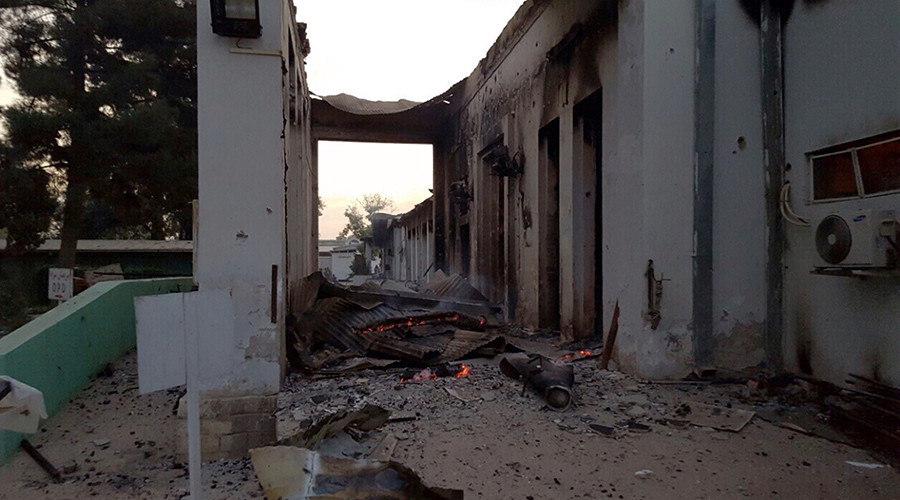
Médecins Sans Frontières investigation into the Afghan hospital bombing
by US forces has found that there were no armed combatants or weapons
within the compound, and no fighting in the direct vicinity of the
hospital at the time of the airstrikes.
In its report released on Thursday, Médecins Sans Frontières (MSF/Doctors Without Borders) addressed the “relentless and brutal aerial attack by US forces” which took place in Kunduz on October 3 and killed at least 30 people, including MSF staff.
“The
MSF rules in the hospital were implemented and respected, including the
'no weapon' policy and MSF was in full control of the hospital at the
time of the airstrikes,” the organization stated.
The document also said there were “no armed combatants within the hospital compound and there was no fighting from or in the direct vicinity” of the trauma center at the time of the strikes.
The hospital was “fully functioning”
at the time of the airstrikes, with 105 patients admitted and surgeries
taking place, according to the findings of the investigation.
In addition, MSF said the “agreement
to respect the neutrality of our medical facility based on the
applicable sections of International Humanitarian Law was fully in place
and agreed with all parties to the conflict prior to the attack.”
“The
question remains as to whether our hospital lost its protected status
in the eyes of the military forces engaged in this attack – and if so,
why,” MSF said in its statement.
MSF Report: Afghan Hospital Attack Had No Military Purpose
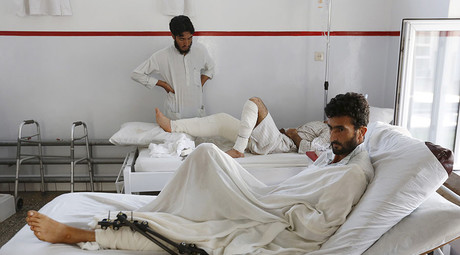
FILE
- Hospital hit by a U.S. airstrike killed at least 30 people, including
three children, according to officials with the international medical
charity Doctors Without Borders, Kunduz, Afghanistan.
Last updated on: November 05, 2015 2:33 PM
The
international humanitarian group Doctors Without Borders says an
internal review of last month's airstrikes by U.S. forces on its
hospital in northern Afghanistan shows no reason why the facility should
have come under attack.
The organization, also known as Médecins Sans Frontières (MSF),
released a report Thursday documenting events surrounding the
airstrikes. The report says there were no armed combatants fighting
within or from the hospital grounds.
In response, a U.S. Defense
Department spokesman said the top U.S. commander in Afghanistan, Army
General John Campbell, has "met personally with MSF representatives."
Spokesman
Jeff Davis said the United States is working closely with MSF to
identify the dead and wounded, conclude its own investigation and move
ahead with condolence payments.
Last month, Campbell said the U.S.
accepted full responsibility for the bombing, which, according to the
Pentagon, came after Afghan forces called in U.S. airstrikes against
Taliban fighters thought to be firing from inside the medical compound.
The MSF document,
part of an ongoing review of events undertaken by the group, is based
upon 60 debriefings of MSF national and international employees who
worked at the 140-bed trauma center; internal and public information;
before and after photographs of the hospital; email correspondence; and
telephone records.
US forces in Afghanistan knew Kunduz site was hospital - report
New
information suggests the US deliberately targeted the Kunduz hospital,
killing 22 patients and staff, despite knowing it was a protected
medical site.
US special
operations analysts investigated the hospital for days prior to the
deadly October 3 attack, describing the hospital as a base of operations
for a Pakistani agent coordinating Taliban activities, AP has learned from a former intelligence official familiar with the documents.
The
site, operated by Doctors Without Borders (Medecins Sans Frontieres,
MSF), was attacked five times in the span of an hour by a C-130 gunship,
despite repeated pleas by the MSF to US forces. MSF officials described
repeated strafing runs against the main hospital building, which housed
the emergency room and the intensive care unit. No surrounding
buildings were hit, they say.
The new details suggest "that the hospital was intentionally targeted,” Meinie Nicolai of MSF told the AP by email. “This would amount to a premeditated massacre,” she added.
Commander
of war in Afghanistan tells Senate panel that US forces had called in
airstrike at Afghan request – ‘an admission of a war crime’ says MSF
chief
General John Campbell says the airstrike was the result of a ‘US decision’.
US
special operations forces – not their Afghan allies – called in the
deadly airstrike on the Doctors Without Borders hospital in Kunduz, the
US commander has conceded.
Shortly before General John
Campbell, the commander of the US and Nato war in Afghanistan, testified
to a Senate panel, the president of Doctors Without Borders – also
known as Médecins sans Frontières (MSF) – said the US and Afghanistan had made an “admission of a war crime”.
Shifting
the US account of the Saturday morning airstrike for the fourth time in
as many days, Campbell reiterated that Afghan forces had requested US
air cover after being engaged in a “tenacious fight” to retake the
northern city of Kunduz from the Taliban. But, modifying the account he
gave at a press conference on Monday, Campbell said those Afghan forces had not directly communicated with the US pilots of an AC-130 gunship overhead.
“Even
though the Afghans request that support, it still has to go through a
rigorous US procedure to enable fires to go on the ground. We had a
special operations unit that was in close vicinity that was talking to
the aircraft that delivered those fires,” Campbell told the Senate armed
services committee on Tuesday morning.
Seen
through a night-vision device, U.S. Marines conduct a combat logistics
patrol in Helmand province, Afghanistan, April 21, 2013. (U.S. Marine
Corps photo by Sgt. Anthony L. Ortiz)
The
apparent U.S. slaughter of at least 22 people at an Afghan hospital,
including Doctors Without Borders medical staff, is part of the grim
reality of indiscriminate death when U.S. Special Forces undertake their
secret raids and often toss aside the rules of warfare, reports Nicolas
J S Davies.
By Nicolas J S Davies
On Dec. 26, 2009, a U.S.
Special Operations team flew from Kabul to Ghazi Khan village in the
Narang district of Kunar province. They attacked three houses, where they killed two adults and eight children. Seven
of the children were handcuffed before they were shot. The youngest was
11 or 12, three more were 12, and one was 15. Both the United Nations
and the Afghan government conducted investigations and confirmed all the
details of the attack.
U.S.
officials conducted their own inquiry, but no report was published and
no U.S. military or civilian officials were held accountable. Finally,
more than five years later, a New York Times report on
Joint Special Operations Command’s (JSOC) Seal Team 6 named it as the
U.S. force involved. But JSOC operations are officially secret and, to
all practical purposes, immune from accountability. As a senior U.S.
officer told the Times, “JSOC investigates JSOC, that’s part of the problem.”
Accountability
for the U.S. attack on the Doctors Without Borders hospital in Kunduz
on Saturday, killing at least 22 people, is likely to be just as
elusive. The bilateral security agreement that President Karzai refused
to sign, but which President Ghani signed in September 2014, provides total immunity from Afghan law
for U.S. forces and officials. So whoever should be held legally
responsible for the massacre at the hospital will only be subject to
accountability under U.S. military and civilian legal systems, which
routinely fail to prosecute anyone for similar war crimes.
Doctors Without Borders pulls out of Kunduz after apparent U.S. airstrike
Humanitarian group calls bombing that killed 22 a war crime
CBC NewsPosted: Oct 04, 2015 9:29 AM ETLast Updated: Oct 05, 2015 8:50 AM ET
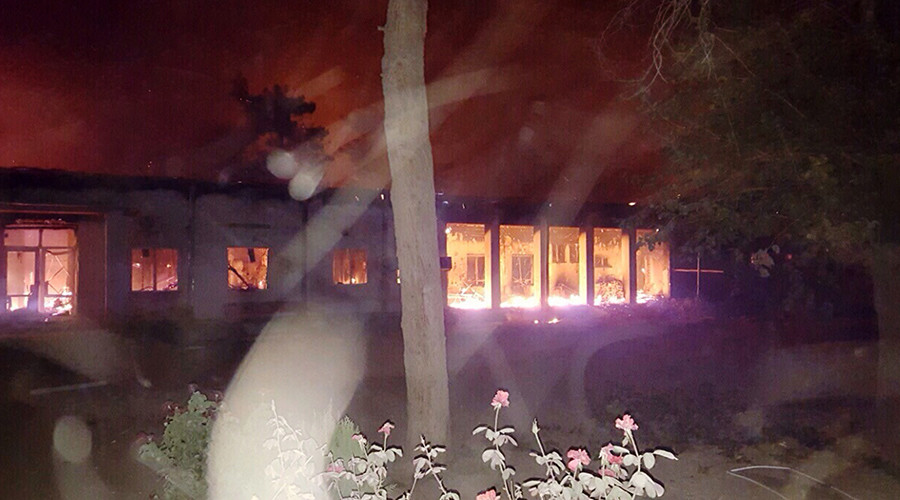
A
hospital run by Médecins Sans Frontières in the Afghan city of Kunduz
is seen in flames, after explosions in the city on Saturday, Oct. 3,
2015. (Médecins Sans Frontières/AP)
The
international humanitarian group Médecins Sans Frontières said Sunday
it had withdrawn from the northern Afghan city of Kunduz after a deadly
airstrike destroyed its hospital and killed 22 people.
The
humanitarian crisis in the city, which briefly fell to the Taliban last
week before the government launched a counteroffensive, has grown
increasingly dire, with shops shuttered because of ongoing fighting and
roads made impassable by mines planted by insurgents.
The
medical group, also known by its English name Doctors Without
Borders, blames the 22 deaths on a U.S. airstrike. Afghan officials said
helicopter gunships were returning fire from Taliban fighters who were
hiding in the hospital.
But the organization is calling the
bombing a war crime, with the executive director of its Canadian
division telling CBC News that staff contacted both the U.S. and Afghan
forces throughout, but the airstrike continued for another 35 minutes.
"Such
attacks against medical facilities are grave breaches of humanitarian
law," Stephen Cornish told CBC News on Sunday. "At the time of this
attack our surgery team were operating on a patient on the operating
table who [then] died on that operating table.
A
hospital in the Afghan city of Kunduz has been hit and partially
destroyed in an overnight “aerial attack” that killed at least nine
Medecins Sans Frontieres staff. NATO has admitted a US airstrike may
have caused accidental “collateral damage.”
03 October 2015
21:25 GMT
Ivan
Eland from the Center on Peace and Liberty at The Independent Institute
told RT that the tragedy in Kanduz should show the US that it needs to
pull out all its troops from Afghanistan “once and for all.”
20:25 GMT
UN
Secretary-General Ban Ki-moon strongly condemned the airstrikes in
Kunduz that resulted in the death and injury of medical workers and
patients at a MSF hospital. He called for a thorough and impartial
investigation into the attack in order to ensure accountability. “The
Secretary-General recalls that hospitals and medical personnel are
explicitly protected under international humanitarian law,” the statement attributed to Ban said.
He
commended the courageous and dedicated staff of the organization and
extended his deepest sympathies to the families of the victims.
Tragic news. @MSF please accept our condolences for the killing of your colleagues & patients in #Kunduz.
Yves Daccord added,
MSF International@MSF
Deeply shocked at bombing of MSF hospital in #Kunduz. Staff and patients killed. MSF urges fighting parties to respect health facilities
11:55 PM - 2 Oct 2015
19:56 GMT
The
World Health Organization (WHO) released a statement extending
condolences to the families and colleges of those killed and injured in
the bombing.
‘Inexcusable, possibly even criminal’: UN rights chief says Kunduz bombing may be war crime
An
air strike on a hospital in the Afghan city of Kunduz that killed at
least 19 people is “utterly tragic, inexcusable, and possibly even
criminal,” said the UN High Commissioner for Human Rights, calling for a
transparent investigation.
"This deeply shocking event should be promptly, thoroughly and independently investigated and the results should be made public," Zeid Ra'ad al-Hussein said in a statement on Saturday. "The
seriousness of the incident is underlined by the fact that, if
established as deliberate in a court of law, an airstrike on a hospital
may amount to a war crime."
He described the bombing as "utterly tragic, inexcusable, and possibly even criminal."
"International
and Afghan military planners have an obligation to respect and protect
civilians at all times, and medical facilities and personnel are the
object of a special protection. These obligations apply no matter whose
air force is involved, and irrespective of the location."
The
Kunduz attack constitutes a grave violation of International
Humanitarian Law.We demand a full & transparent account from the
Coalition
UN
Secretary-General Ban Ki-moon strongly condemned the airstrikes and
called for a thorough and impartial investigation into the attack in
order to ensure accountability.
“The Secretary-General recalls
that hospitals and medical personnel are explicitly protected under
international humanitarian law,” the statement attributed to Ban
said.He commended the courageous and dedicated staff of the organization
and extended his deepest sympathies to the families of the victims.
Medecins Sans Frontieres (MSF) condemned “in the strongest possible terms” the bombing of its hospital full of staff and patients in a statement on Saturday.
“The
bombing in Kunduz continued for more than 30 minutes after American and
Afghan military officials in Kabul and Washington were first informed
by MSF that its hospital was struck. MSF urgently seeks clarity on
exactly what took place and how this terrible event could have happened,” it said.
Saudi air raids kill dozens of Yemeni civilians amid humanitarian crisis
1.6K293
The
latest Saudi-led airstrikes in Yemen have left dozens of civilians dead
and nearly 160 injured at a time that sees medical facilities
struggling to provide even the most basic services. The country is
suffering from a shortage of vital supplies due to the ongoing blockade.
The
coalition air raids against Houthi forces in Sanaa overnight on Friday
killed at least 40 civilians and injured at least another 130 people,
Yemen News Agency (SABA) reported.
One
strike leveled an apartment building in the center of the city killing a
family of nine, while another strike killed a man who had been
searching for his family in the rubble, AP reported. The coalition has
even managed to attack Yemen’s interior ministry in the capital,
launching about 10 strikes at the building as well as at a police camp
and a military building close to it.
The airstrikes also hit the residence of Oman’s ambassador in Sanaa.
The
particular cluster munition systems HRW said were used are CBU-105
Sensor Fuzed Weapons, which are guided bombs intended to take out tanks
and other armored vehicles with a flurry of explosions spread out over
an area.
If the cluster bombs fail to
detect their target, they are designed to self-destruct in the air, or
if that fails, to deactivate themselves after a short time. But
sometimes those mechanisms don't work, posing a lethal danger for those
who later encounter them.
UN condemns ‘virtual silence’ on civilian casualties in Yemeni conflict
248317.
UN
officials have openly criticized the “the virtual silence” with regards
to civilian suffering in the Yemeni conflict from the world community,
warning that unless violence on the ground is stopped via political
compromise more people will suffer.
Adama
Dieng, the Special Adviser on the Prevention of Genocide, and Jennifer
Welsh, the Special Adviser on the Responsibility to Protect, “expressed
concern at the ever increasing impact on civilians of the ongoing
conflict in Yemen, and the virtual silence of the international
community about the threat to populations.”




 Yves Daccord