In
April of this year, the Australian federal government officially joined
the state Queensland and Victoria governments and declared war on our
children and our community.
A choice of whether to become homeless . . . or vaccinate?
A choice of being able to feed and clothe their families . . . or vaccinate?
I don’t know about you, but if that is a “choice” then so is blackmail.
Add
this to the Victorian government’s law that all unvaccinated children
must be banned from early childhood education and you will see that. for
some governments in Australia, the idea of segregating children is a
good thing. So much for the government’s commitment to Universal Access to Early Childhood Education?
Australia vessels to join Chinese navy in exercises
Thu Oct 29, 2015 7:30AM
Australia’s Defense Minister Marise Payne
Two
Australian warships will join the Chinese Navy in the South China Sea
to hold naval exercises in disputed waters there, Australia’s Defense
Minister Marise Payne says.
Anzac-class HMAS Stuart and
HMAS Arunta frigates of the Royal Australian Navy will soon arrive at
China’s main base of Zhanjiang in a port call ahead of the drills
scheduled for early next week, Payne said on Thursday.
“The Royal
Australian Navy has a long history of engagement with regional navies
and regularly conducts port visits and exercises – including in China,”
she said.
The development comes just days after a US Navy
guided-missile destroyer entered waters close to islands where China is
said to be doing construction work in the sea.
Payne dismissed any
changes or delays to the schedule of the drills “since the United
States activity” in the South China Sea. She, however, stopped short of
providing any information about the exact location of the exercises.
This file photo shows the Anzac-class HMAS Stuart frigate of the Royal Australian Navy.
On
October 27, the USS Lassen sailed near what is referred to in the West
as the Spratly Islands archipelago, a disputed group of hundreds of
reefs, islets, atolls and islands in the South China.
The American Dream Is Becoming A Nightmare And Life As We Know It Is About To Change
The Trans-Pacific Partnership: Permanently Locking In The Obama Agenda For 40 Percent Of The Global Economy
By Michael Snyder, on October 5th, 2015
We
have just witnessed one of the most significant steps toward a one
world economic system that we have ever seen. Negotiations for the
Trans-Pacific Partnership have been completed, and if approved it will
create the largest trading bloc on the planet. But this is not just a
trade agreement. In this treaty, Barack Obama has thrown in all sorts
of things that he never would have been able to get through Congress
otherwise. And once this treaty is approved, it will be exceedingly
difficult to ever make changes to it. So essentially what is happening
is that the Obama agenda is being permanently locked in for 40 percent
of the global economy.
The United States, Canada, Japan, Mexico,
Australia, Brunei, Chile, Malaysia, New Zealand, Peru, Singapore and
Vietnam all intend to sign on to this insidious plan. Collectively,
these nations have a total population of about 800 million people and a
combined GDP of approximately 28 trillion dollars.
In
hailing the agreement, Obama said, “Congress and the American people
will have months to read every word” before he signs the deal that he
described as a win for all sides.
“If we can get this agreement to
my desk, then we can help our businesses sell more Made in America
goods and services around the world, and we can help more American
workers compete and win,” Obama said.
Sadly, just
like with every other “free trade” agreement that the U.S. has entered
into since World War II, the exact opposite is what will actually
happen. Our trade deficit will get even larger, and we will see even
more jobs and even more businesses go overseas.
Trans-Pacific Partnership Deal Struck As "Corporate Secrecy" Wins Again
Submitted by Tyler Durden on 10/05/2015 17:46 -0400
Once again the corporatocracy wins as the so-called "Trojan horse" Trans-Pacific Partnership (TPP) trade agreement has been finalized. As WSJ reports,
the U.S., Japan and 10 countries around the Pacific reached a historic
accord Monday to lower trade barriers to goods and services and set commercial rules of the road for two-fifths of the global economy, officials said.
For the U.S., the TPP (reportedly)
opens agricultural markets in Japan and Canada, tightens intellectual
property rules to benefit drug and technology companies, and establishes
a tightknit economic bloc to challenge China’s influence in the region (likely forcing their hand into separate trade agreements).
However, Obama is likely to face a tough fight to get the deal through Congress(especially in light of presidential candidates' opposition).
The
US, Japan and 10 other Pacific Rim economies have reached agreement to
strike the largest trade pact seen anywhere in two decades, in what is a huge strategic and political win for US President Barack Obama and Japan’s Shinzo Abe.
It
is amazing how the elite media can be dragged along by their noses into
accepting that the Trans-Pacific Partnership (TPP) can have a big
impact on trade and growth. If I had a dollar for every time the deal
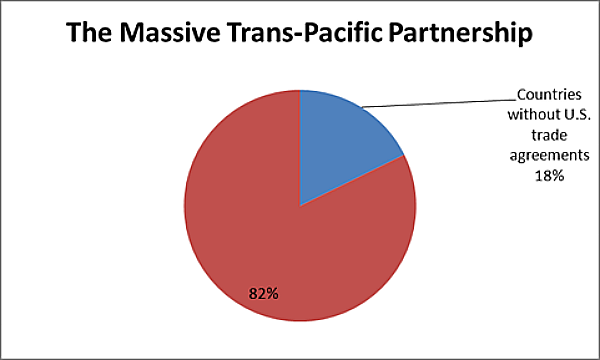
was described as “massive,” or that we were told what share of world trade
will be covered by the TPP, I would be richer than Bill Gates. The
reality is that the vast majority of the trade between the countries in
the TPP is already covered by trade agreements, as can be seen:
We continue to hear superlatives even as the evidence suggests the trade impact will be trivial. For example, the New York Timesreported that US tariffs on Japanese cars will be phased out over 30 years. Wow! The most optimistic growth estimates show a cumulative gain by 2027 of less than 0.4 percent, roughly two months of normal GDP growth.
This doesn’t mean that the TPP can’t have an impact. It will lock in a regulatory structure,
the exact parameters of which are yet to be seen. We do know that the
folks at the table came from places like General Electric and Monsanto,
not the AFL-CIO and the Sierra Club. We also know that it will mean
paying more for drugs and other patent and copyright-protected material
(forms of protection, whose negative impact is never included in growth projections), but we don’t yet know how much.
We also know that the Obama administration gave up an opportunity to include currency rules.
This means that trade deficit is likely to persist long into the
future. This deficit has been a persistent source of gap in demand,
leading to millions of lost jobs. We filled this demand in the 1990s
with the stock bubble and in the last decade in the housing bubble. It
seems the latest plan from the Fed is that we simply won’t fill the gap
in this decade.
Economist Dean Baker is co-director of the
Center for Economic and Policy Research in Washington, DC. A version of
this post originally appeared on CEPR’s blog Beat the Press (10/6/15).
This work is licensed under a Creative Commons Attribution-NonCommercial-NoDerivs 3.0 Unported License.
MH370 search to be most costly ever at $100 mln: analysts
by Staff Writers Sydney (AFP) April 18, 2014
Malaysia warns of 'huge' cost in MH370 search Kuala
Lumpur (AFP) April 17, 2014 - Malaysia warned Thursday that the cost of
the search for flight MH370's wreckage in the vast depths of the Indian
Ocean will be "huge", the latest sobering assessment by authorities
involved in the challenging effort."When we look at
salvaging (wreckage) at a depth of 4.5 kilometres (2.8 miles), no
military out there has the capacity to do it," Transport and Defence
Minister Hishammuddin Hussein told reporters in Kuala Lumpur."We have to look at contractors, and the cost of that will be huge."
The
search in a remote stretch of ocean far off western Australia was
enlivened in the past two weeks by the detection of signals believed to
be from the Malaysia Airlines plane's flight data recorders on the
seabed.
But the transmissions have gone silent before they could
be pinpointed, raising the spectre of a costly and extensive search of a
large swathe of ocean floor at extreme depths.
Prime Minister
Tony Abbott of Australia, which is leading the multi-national search,
had earlier warned in an interview published Thursday that an autonomous
US Navy sonar device that began scanning the seabed for wreckage on
Monday would be given one more week.
If nothing is found,
authorities would reassess how next to proceed in the unprecedented
mission to find the plane, Abbott said in the Wall Street Journal.
The Bluefin-21 completed its first full scanning mission early Thursday.
An
initial attempt was aborted when the sub hit its maximum depth at 4.5
kilometres. A second was cut short by unspecified "technical" troubles.
Hishammuddin said he agreed with Abbott, saying "there will come a time when we need to regroup and reconsider".
"But
in any event, the search will always continue. It's just a matter of
approach," said Hishammuddin, who did not specify what any alternative
approach would be.
Australia's search chief Angus Houston said
earlier this week that authorities already were looking at possible
alternative methods, including undersea devices that can go deeper than
the Bluefin-21, but he also gave no specifics.
The Beijing-bound
Malaysia Airlines flight with 239 people aboard inexplicably veered off
its Kuala Lumpur-Beijing course on March 8, and is believed to have
crashed in the Indian Ocean.
The
search for missing Malaysia Airlines Flight MH370 is set to be the most
expensive in aviation history, analysts say, as efforts to find the
aircraft deep under the Indian Ocean show no signs of slowing.
The
Boeing 777 vanished on March 8 with 239 people on board, after veering
dramatically off course en route from Kuala Lumpur to Beijing and is
believed to have crashed in the sea off Australia.
Australia,
which is leading the search in a remote patch of water described as
"unknown to man", has not put a figure on spending, but Malaysia has
warned that costs will be "huge".
"When we look at salvaging
(wreckage) at a depth of 4.5 kilometres (2.8 miles), no military out
there has the capacity to do it," Transport and Defence Minister
Hishammuddin Hussein said Thursday.
"We have to look at contractors, and the cost of that will be huge."
Ravikumar
Madavaram, an aviation expert at Frost & Sullivan Asia Pacific,
said Malaysia, Australia and China, which had the most nationals onboard
the flight, were the biggest spenders and estimated the total cost up
to now at about US$100 million (72 million euros).
"It's difficult
to say how much is the cost of this operation ... but, yes, this is
definitely the biggest operation ever (in aviation history).
"In terms of costs this would be the highest," he told AFP.
- Hopes rest on submersible -
In
the first month of the search -- in which the South China Sea and
Malacca Strait were also scoured by the US, Malaysia, Singapore and
Vietnam -- the Pentagon said the United States military had committed
US$7.3 million to efforts to find the plane.
Meanwhile the Indian
Ocean search, in which assets have also been deployed by Australia,
Britain, China, South Korea, Japan and New Zealand, has failed to find
anything conclusive.
Hopes rest on a torpedo-shaped US Navy
submersible, which is searching the ocean floor at depths of more than
4,500 metres (15,000 feet) in the vicinity of where four signals
believed to have come from black box recorders were detected.
David
Gleave, an aviation safety researcher at Britain's Loughborough
University, said the costs "will be of the order of a hundred million
dollars by the time we're finished, if we have found it (the plane)
now".
But he said the longer it took to find any wreckage, the
more costs would mount because scanning the vast ocean floor "will take a
lot of money because you can only search about 50 square kilometres (19
square miles) a day".
by Staff Writers Perth, Australia (AFP) April 18, 2014
The
mini-sub searching for missing flight MH370 has reached record depths
well beyond its normal operating limits, officials said Friday as it
dived on its fifth seabed mission.
With no results to show since
the Boeing 777 carrying 239 people disappeared on March 8, Australia's
Prime Minister Tony Abbott has set a one-week deadline to locate the
plane which is believed to have crashed in a remote area of the Indian
Ocean west of Perth.
Searchers have extended the hunt beyond the
normal 4,500 metre (15,000 feet) depth range of the US Navy's Autonomous
Underwater Vehicle (AUV) called Bluefin-21.
"The AUV reached a
record depth of 4,695 meters during mission four," the US Navy said.
"This is the first time the Bluefin-21 has descended to this depth.
"Diving
to such depths does carry with it some residual risk to the equipment
and this is being carefully monitored," a statement said.
Australia's
Joint Agency Coordination Centre (JACC) announced that the mini-sub had
been deployed on a new mission as operations run round the clock.
"Data analysis from the fourth mission did not provide any contacts of interest," it added.
The
unmanned Bluefin-21 which maps the seafloor by sonar, has searched 110
square kilometres (43 square miles) to date, JACC said.
The UAV,
which hit a technical snag on Tuesday had also re-surfaced Monday after
breaching a pre-programmed maximum depth of 4.5 kilometres (2.8 miles).
JACC said Thursday night that the US manufacturer of the UAV, Phoenix International, had advised the risk was "acceptable".
"This
expansion of the operating parameters allows the Bluefin-21 to search
the sea floor within the predicted limits of the current search area,"
it said.
The Malaysia Airlines jet is believed to have crashed in
the ocean after mysteriously vanishing while en route between Kuala
Lumpur and Beijing.
Hopes for finding the plane have focused on
the Bluefin-21 after signals believed to be from the plane's flight data
recorders on the seabed fell silent in recent days.
The
submersible is being deployed from an Australian vessel to scan an
uncharted seafloor at extreme depths, but Abbott said the Bluefin-21
would be given about a week as questions are asked about the massive
costs.
Dismayed families of missing MH370 passengers have vowed to ‘get noisier’
Network Writers
News Corp Australia
April 22, 20149:33AM
Malaysia to issue death certificates in missing plane
The
Malaysian government prepares to issue death certificates for
passengers of missing flight MH370 but some families cling to the hope
their loved ones are alive. Mana Rabiee reports.
Shock ... relatives of the missing MH370 passengers at the Metro Park Hotel in Beijing on April 21, 2014. Picture: Wang ZhaoSource: AFP
FAMILY members of passengers lost on missing Malaysia Airlines 370 have
criticised the Malaysian government for an investigation they say has
been mismanaged.
Appearing on US morning television, Sarah Bajc, the girlfriend of Flight 370 American passenger Philip Wood, told Today host Matt Lauer passengers’ loved ones all just “wanted to go back to square one”.
“We
just don’t believe they’re using proper evaluative techniques to check
the data,” she said. “It’s day 45 and we’re basically on the same
position we were on on the first day.”
We don’t know anything for
sure,” she said. “We want to go back and start over again, but with new
people looking at the information.”
Ms Bajc sent an email to the media, on behalf of “the united families of MH370”, detailing their complaints and concerns.
Despair ... Sarah Bajc with her boyfriend Philip Wood, who was a passenger on missing Malaysian flight MH370. Picture: FacebookSource: Supplied
Among
their grievances is the suggestion by the government it issues death
certificates or pay compensation before the plane is found.
“Until
they have proof, they have an obligation to make regular prepayments to
the families in need, and they have an obligation to exert themselves
beyond dozing and snickering in resolving this case,” the email says.
The
families say they are gaining strength and prepared to get noisier in
their criticisms. The letter signs of “WE ARE IN UTTER OUTRAGE, DESPAIR
AND SHOCK!”
The Acting Minister of Transport in Malaysia has
posted a comment to Twitter that he hopes to discuss with Angus Houston
the status of the remaining third of the search area being combed by the
Bluefin-21 unmanned submersible.
I personally hope 2 discuss with Angus Houston on status of remaining 1/3 of area covered by the Blue Fin 21 soon @aikmalismail@mykamarul
— Hishammuddin Hussein (@HishammuddinH2O) April 21, 2014
DETAILS OF TODAY’S SEARCH
Bluefin-21 is still scouring the ocean depths on its ninth mission trying to locate wreckage from MH370.
So far it has searched about two thirds of the underwater area, with no contacts of interest found to date.
Up to 10 military aircraft and 10 ships will be part of today’s visual search approximately 1500 kilometres north west of Perth.
Scattered showers are predicted to continue with south easterly winds and sea swells of up to three metres.
by Staff Writers Kuala Lumpur (AFP) April 18, 2014
Malaysia
and Australia will sign a deal specifying who handles any wreckage from
missing flight MH370 that may be recovered, including the crucial
"black box" flight data recorders, local media reported Friday.
Malaysia
is drafting the agreement "to safeguard both nations from any legal
pitfalls that may surface during that (recovery) phase," the New Straits
Times reported.
The government hopes the deal can be finalised
soon and endorsed in a Cabinet meeting next week. Canberra is studying
the memorandum of understanding, it said.
"The MoU spells out
exactly who does what and the areas of responsibility," civil aviation
chief Azharuddin Abdul Rahman was quoted as saying.
Azharuddin
added that Malaysia would lead most of the investigation, with Australia
and others helping. Details of the MoU will not be made public, the
report said.
Azharuddin and other officials could not immediately be reached by AFP.
The
Malaysia Airlines flight carrying 239 people inexplicably veered off
course en route from Kuala Lumpur to Beijing on March 8 and is believed
to have crashed in the southern Indian Ocean far off western Australia.
But a massive international search has failed to turn up any wreckage so far.
The list of those caught up in the global surveillance net cast by the National Security Agency and its overseas partners, from social media users to foreign heads of state, now includes another entry: American lawyers.
A
top-secret document, obtained by the former N.S.A. contractor Edward J.
Snowden, shows that an American law firm was monitored while
representing a foreign government in trade disputes with the United
States. The disclosure offers a rare glimpse of a specific instance in
which Americans were ensnared by the eavesdroppers, and is of particular
interest because lawyers in the United States with clients overseas
have expressed growing concern that their confidential communications
could be compromised by such surveillance.
The government of Indonesia
had retained the law firm for help in trade talks, according to the
February 2013 document. It reports that the N.S.A.’s Australian
counterpart, the Australian Signals Directorate,
notified the agency that it was conducting surveillance of the talks,
including communications between Indonesian officials and the American
law firm, and offered to share the information.
Launch media viewer
The
Indonesian Embassy in Washington, left, and the building where Mayer
Brown has an office. Indonesia retained the American law firm for help
in trade talks.Stephen Crowley/The New York Times
The
Australians told officials at an N.S.A. liaison office in Canberra,
Australia, that “information covered by attorney-client privilege may be
included” in the intelligence gathering, according to the document, a
monthly bulletin from the Canberra office. The law firm was not
identified, but Mayer Brown, a Chicago-based firm with a global
practice, was then advising the Indonesian government on trade issues.
On
behalf of the Australians, the liaison officials asked the N.S.A.
general counsel’s office for guidance about the spying. The bulletin
notes only that the counsel’s office “provided clear guidance” and that
the Australian agency “has been able to continue to cover the talks,
providing highly useful intelligence for interested US customers.”
The
N.S.A. declined to answer questions about the reported surveillance,
including whether information involving the American law firm was shared
with United States trade officials or negotiators.
Duane
Layton, a Mayer Brown lawyer involved in the trade talks, said he did
not have any evidence that he or his firm had been under scrutiny by
Australian or American intelligence agencies. “I always wonder if
someone is listening, because you would have to be an idiot not to
wonder in this day and age,” he said in an interview. “But I’ve never
really thought I was being spied on.”
A Rising Concern for Lawyers
Most
attorney-client conversations do not get special protections under
American law from N.S.A. eavesdropping. Amid growing concerns about
surveillance and hacking, the American Bar Association in 2012 revised
its ethics rules to explicitly require lawyers to “make reasonable efforts” to protect confidential information from unauthorized disclosure to outsiders.
Last year, the Supreme Court, in a 5-to-4 decision, rebuffed a legal challenge
to a 2008 law allowing warrantless wiretapping that was brought in part
by lawyers with foreign clients they believed were likely targets of
N.S.A. monitoring. The lawyers contended that the law raised risks that
required them to take costly measures, like traveling overseas to meet
clients, to protect sensitive communications. But the Supreme Court
dismissed their fears as “speculative.”
The
N.S.A. is prohibited from targeting Americans, including businesses,
law firms and other organizations based in the United States, for
surveillance without warrants, and intelligence officials have
repeatedly said the N.S.A. does not use the spy services of its partners
in the so-called Five Eyes alliance — Australia, Britain, Canada and
New Zealand — to skirt the law.
Still, the N.S.A.can
intercept the communications of Americans if they are in contact with a
foreign intelligence target abroad, such as Indonesian officials. The
N.S.A. is then required to follow so-called minimization rules
to protect their privacy, such as deleting the identity of Americans or
information that is not deemed necessary to understand or assess the
foreign intelligence, before sharing it with other agencies.
An
N.S.A. spokeswoman said the agency’s Office of the General Counsel was
consulted when issues of potential attorney-client privilege arose and
could recommend steps to protect such information.
“Such
steps could include requesting that collection or reporting by a
foreign partner be limited, that intelligence reports be written so as
to limit the inclusion of privileged material and to exclude U.S.
identities, and that dissemination of such reports be limited and
subject to appropriate warnings or restrictions on their use,” said
Vanee M. Vines, the spokeswoman.
The
Australian government declined to comment about the surveillance. In a
statement, the Australian Defense Force public affairs office said that
in gathering information to support Australia’s national interests, its
intelligence agencies adhered strictly to their legal obligations,
including when they engaged with foreign counterparts.Several newly
disclosed documents provide details of the cooperation between the United States and Australia, which share facilitiesand
highly sensitive intelligence, including efforts to break encryption
and collect phone call data in Indonesia. Both nations have trade and
security interests in Indonesia, where Islamic terrorist groups that
threaten the West have bases.
The
2013 N.S.A. bulletin did not identify which trade case was being
monitored by Australian intelligence, but Indonesia has been embroiled
in several disputes with the United States in recent years. One involves clove cigarettes,
an Indonesian export. The Indonesian government has protested to the
World Trade Organization a United States ban on their sale, arguing that
similar menthol cigaretteshave not been subject to the same restrictions
under American antismoking laws. The trade organization, ruling that
the United States prohibition violated international trade laws, referred the case to arbitration to determine potential remedies for Indonesia.
Another dispute involved Indonesia’s exports of shrimp, which the United States claimed were being sold at below-market prices.
The
Indonesian government retained Mayer Brown to help in the cases
concerning cigarettes and shrimp, said Ni Made Ayu Marthini, attaché for
trade and industry at the Indonesian Embassy in Washington. She said no
American law firm had been formally retained yet to help in a third
case, involving horticultural and animal products.
Mr.
Layton, a lawyer in the Washington office of Mayer Brown, said that
since 2010 he had led a team from the firm in the clove cigarette
dispute. He said Matthew McConkey, another lawyer in the firm’s
Washington office, had taken the lead on the shrimp issue until the
United States dropped its claims in August. Both cases were underway a
year ago when the Australians reported that their surveillance included
an American law firm.
Mr.
Layton said that if his emails and calls with Indonesian officials had
been monitored, the spies would have been bored. “None of this stuff is
very sexy,” he said. “It’s just run of the mill.”
NSA, Australian liaison office monitored U.S. law firm
A
top-secret document obtained by former NSA contractor Edward Snowden
shows that a U.S. law firm was monitored while representing a foreign
government in trade disputes with the United States, The New York Times
reports.
The Associated Press
WASHINGTON
— The National Security Agency (NSA) was involved in the surveillance
of a U.S. law firm while it represented a foreign government in trade
disputes with the United States, The New York Times reported in a story
based on a top-secret document obtained by former NSA contractor Edward
Snowden.
The February 2013 document shows that the Indonesian
government had retained the law firm for help in trade talks, The Times
reported in a story posted on its website Saturday. The law firm was not
identified in the document, but the Chicago-based firm Mayer Brown was
advising the Indonesian government on trade issues at the time,
according to the newspaper.
The document itself is a monthly
bulletin from an NSA liaison office in Canberra, the capital of
Australia. The NSA’s Australian counterpart, the Australian Signals
Directorate, had notified the NSA that it was conducting surveillance of
the talks, including communications between Indonesian officials and
the U.S. law firm, and offered to share the information, The Times
reported.
Liaison officials asked the NSA general counsel’s
office, on behalf of the Australians, for guidance about the spying. The
bulletin notes only that the counsel’s office “provided clear guidance”
and that the Australian eavesdropping agency “has been able to continue
to cover the talks, providing highly useful intelligence for interested
U.S. customers,” according to the article.
The NSA and the
Australian government declined to answer questions about the
surveillance. In statements to the newspaper and The Associated Press,
the NSA said it “does not ask its foreign partners to undertake any
intelligence activity that the U.S. government would be legally
prohibited from undertaking itself.”
In the wake of a crushing defeat last week for the climate alarmism-promoting Australian Labor Party, which imposed the deeply unpopular and expensive “carbon tax”
credited by analysts for the conservative coalition’s victory,
authorities in Australia are preparing to dismantle and consolidate the
myriad global-warming schemes spawned under the previous government.
However, while legislation is already being drafted, major hurdles
remain before the tax on CO2 can be scrapped, sparking an outcry among businesses, state governments, and especially Australian voters, who voted overwhelmingly in favor of the new coalition and its pledge to kill the costly economic burden.
According to Australian news reports,
the government’s vast anti-carbon “climate” apparatus currently
consists of more than 30 programs under seven departments and eight
agencies. Under the newly elected center-right coalition, the sprawling
machine is set to be reined in significantly, saving taxpayers over $40
million in four years by “collapsing” the various schemes into just
three entities run by two departments. The restructuring of the federal
climate regime was announced to government employees before the election
— widely viewed as a referendum on the carbon tax — and a spokesman for
the new coalition confirmed that the plan was still on track.
“What
we've said is we will commence the merger as soon as the process of
appointing the ministry and swearing in the ministry has been complete,”
climate-action spokesman Greg Hunt for the new Liberal-National
coalition was quoted as saying in
a radio interview. “To be frank, during the course of the pre-election
period, when we were allowed to consult with departments, we laid out
the fact that there would be a merger. We were express and clear and
absolute about that, and we indicated we would like it to begin right
from the outset. I imagine that the public servants are preparing to do
that. Our agenda was clear and open, and that is an official process
we'll go through as soon as possible."
Climate realists say that the entire global-warming behemoth ought to be axed entirely — especially considering recentdevelopments that
experts say have thoroughly debunked the United Nations' warming
theories and wildly inaccurate computer models. Indeed, numerous experts
say the 15-year “pause” in warming may actually be the start of a global cooling period. However, as The New Americanreported this week
after the Australian election, there are a number of obstacles to
shutting down the costly climate schemes, including incoming Prime
Minister Tony Abbott’s waffling on “climate issues” and resistance to
scrapping the carbon tax in the Senate.
Analysts virtually all
agree that Abbott and his more liberty-oriented coalition were elected
by voters mostly to abolish carbon taxes and restrain the “green”
machine, which has contributed to record business failures and
soaring costs even for essentials. However, while the carbon tax looks
almost certain to be abolished eventually and some of the climate regime
will be reined in, the new government is also working on its own
global-warming schemes. Perhaps the most important is the so-called
“Direct Action” ploy. In a nutshell, the plan calls for squandering vast
sums of taxpayer money to buy dubious “emission reductions” from other
countries.




 By Michael Snyder, on October 5th, 2015