Showing posts with label Hunger. Show all posts

Tuesday, October 15, 2013

ALERT! USDA Puts EBT On HOLD For November, Pending Further Notice!

DAHBOO77


Published on Oct 15, 2013

 
THIS WHOLE THING WAS A 100% TEST RUN! Congress has 2 weeks to get this mess fixed , or Chaos will unfold come the first week of November!


http://fox13now.com/2013/10/14/utah-f...
https://www.facebook.com/photo.php?fb...


****************************************************

ALERT: Government Freezes EBT Funds: Orders States to Withhold Transfers to Food Stamp Recipients


Author: Mac Slavo
Date: October 15th, 2013
Website: www.SHTFplan.com

welfare-stateThis weekend America witnessed a limited crash in the computer systems that manage electronic benefit transfers across the country. Within hours of the crash panicked food stamp recipients who were left with no way to feed their families rushed grocery store shelves to obtain everything they could while the system was down.
The outage lasted less than a day, but it proved what many already knew, that America had become a nation so dependent on government subsidies that any glitch in the system could lead to total pandemonium.
But if you thought that isolated incident was bad, imagine what could happen next month.
We say next month because the USDA, which oversees the Supplemental Nutritional Assistance Program (SNAP), has just issued an order to SNAP agency directors calling for their respective States to implement an emergency contingency program because of government funding issues. In a letter obtained by the Crossroads Urban Center food pantry, the USDA is directing state agencies to, “delay their November issuance files and delay transmission to State Electronic Benefit Transfer (EBT) vendors until further notice.”
What this means is that should Congress fail to increase the debt ceiling this week, come November there will literally be millions of people in the United States who will have exactly zero dollars transferred to their EBT cards.
What will happen to the nearly 50 million people who depend on these benefits to survive?
Think this past weekend and multiply it across the entirety of the United States of America.
In the State of Utah the immediate effect of the USDA’s contingency plan will be a freeze in benefits for 100,000 people. Richard Phillips, a homeless man who depends on the government’s monthly distributions, warned what would happen next:
It’s going to cause problems… because then you’re going to come to find out that you’re going to have people starting to steal and do what they have to do to survive.
Video Report via The Daily Sheeple:


Here is the USDA letter in full:
ebt-funds-freeze


****************************************************
Enhanced by Zemanta

Saturday, August 3, 2013

House GOP takes another stab at food stamps bill

POLITICO

Eric Cantor is pictured. | AP Photo
Cantor's goal is to have legislation in hand for a House vote by September. | AP Photo
House Republicans are proposing to double their food stamp savings to nearly $40 billion by rolling back waivers for able-bodied adults and targeting funds to states that are willing to impose greater work requirements on the parents of young children.
The prime mover is Majority Leader Eric Cantor (R-Va.) who helped jettison the nutrition title from the House farm bill last month and is now trying to write his own version before the House goes to conference with the Senate.
Cantor has used a select working group of conservatives to help shape the package but shows signs now of reaching out to party moderates as well. And his goal is to have legislation in hand which the House can vote on in early September when it returns from the August recess.
The prime target appears to be able-bodied beneficiaries under 50 years old and without dependents — a population that has grown significantly since 2008 because of the bad economy and increased state waivers of a 20-hour-a-week work requirement.
By rolling back these waivers, large savings are possible, essentially by forcing millions off the rolls if they don’t find work after three months. Unless approached with some care, the impact could be severe in areas of chronically high-unemployment, such as the Rio Grande Valley, poor urban areas and Indian reservations, for example. And the final details of the bill have not been made public.
A second area of more modest but still controversial savings would come from using federal funds to pressure states to take a more aggressive welfare reform-like approach imposing work requirements on able-bodied parents with young children.
Currently Washington provides a 50 percent match for states that spend their own funds for employment and training programs for food stamp recipients. As proposed now, the bill would only provide this aid if the state is willing to operate welfare reform-like work activities for mothers with children over 1- years-old.
This is a significant expansion of the current food stamps work rules, which exempt mothers with children under 6.


Read More Here


Enhanced by Zemanta

Monday, July 29, 2013

A Fading American Dream : Four out of 5 U.S. adults struggle with joblessness, near-poverty or reliance on welfare for at least parts of their lives.

Four out of five American adults experience poverty at some point during their lifetime

  • Some rural areas have poverty rates approaching 99 per cent
  • Poverty among whites is inching higher, with 63 per cent of whites saying the economy is 'poor'
  • By 2030, close to 85 percent of all working-age adults in the U.S. will experience bouts of economic insecurity
By Associated Press Reporter
|
Four out of 5 U.S. adults struggle with joblessness, near-poverty or reliance on welfare for at least parts of their lives, a sign of deteriorating economic security and an elusive American dream.

Survey data exclusive to The Associated Press points to an increasingly globalized U.S. economy, the widening gap between rich and poor, and the loss of good-paying manufacturing jobs as reasons for the trend.

The findings come as President Barack Obama tries to renew his administration's emphasis on the economy, saying in recent speeches that his highest priority is to "rebuild ladders of opportunity" and reverse income inequality.

Destitute: Salyers produce stand in Council, VA, doesn't generate enough income to support its owners
As nonwhites approach a numerical majority in the U.S., one question is how public programs to lift the disadvantaged should be best focused - on the affirmative action that historically has tried to eliminate the racial barriers seen as the major impediment to economic equality, or simply on improving socioeconomic status for all, regardless of race.

Hardship is particularly growing among whites, based on several measures. Pessimism among that racial group about their families' economic futures has climbed to the highest point since at least 1987. In the most recent AP-GfK poll, 63 percent of whites called the economy "poor."

'I think it's going to get worse,' said Irene Salyers, 52, of Buchanan County, Va., a declining coal region in Appalachia. Married and divorced three times, Salyers now helps run a fruit and vegetable stand with her boyfriend but it doesn't generate much income. They live mostly off government disability checks.

'If you do try to go apply for a job, they're not hiring people, and they're not paying that much to even go to work,' she said. Children, she said, have 'nothing better to do than to get on drugs.'

While racial and ethnic minorities are more likely to live in poverty, race disparities in the poverty rate have narrowed substantially since the 1970s, census data show. Economic insecurity among whites also is more pervasive than is shown in the government's poverty data, engulfing more than 76 percent of white adults by the time they turn 60, according to a new economic gauge being published next year by the Oxford University Press.

The gauge defines 'economic insecurity' as a year or more of periodic joblessness, reliance on government aid such as food stamps or income below 150 percent of the poverty line. Measured across all races, the risk of economic insecurity rises to 79 percent.

Struggling: Renee Adams, left, posing with her mother Irene Salyers and son Joseph, 4, at their produce stand in Council, Va.
Marriage rates are in decline across all races, and the number of white mother-headed households living in poverty has risen to the level of black ones.

'It's time that America comes to understand that many of the nation's biggest disparities, from education and life expectancy to poverty, are increasingly due to economic class position,' said William Julius Wilson, a Harvard professor who specializes in race and poverty. He noted that despite continuing economic difficulties, minorities have more optimism about the future after Obama's election, while struggling whites do not.

'There is the real possibility that white alienation will increase if steps are not taken to highlight and address inequality on a broad front,' Wilson said.

Nationwide, the count of America's poor remains stuck at a record number: 46.2 million, or 15 percent of the population, due in part to lingering high unemployment following the recession. While poverty rates for blacks and Hispanics are nearly three times higher, by absolute numbers the predominant face of the poor is white.

More than 19 million whites fall below the poverty line of $23,021 for a family of four, accounting for more than 41 percent of the nation's destitute, nearly double the number of poor blacks.

Sometimes termed 'the invisible poor' by demographers, lower-income whites generally are dispersed in suburbs as well as small rural towns, where more than 60 percent of the poor are white. Concentrated in Appalachia in the East, they are numerous in the industrial Midwest and spread across America's heartland, from Missouri, Arkansas and Oklahoma up through the Great Plains.

Desperate: People appearing to be homeless increasingly roam the streets of New York City
Buchanan County, in southwest Virginia, is among the nation's most destitute based on median income, with poverty hovering at 24 percent. The county is mostly white, as are 99 percent of its poor.

More than 90 percent of Buchanan County's inhabitants are working-class whites who lack a college degree. Higher education long has been seen there as nonessential to land a job because well-paying mining and related jobs were once in plentiful supply. These days many residents get by on odd jobs and government checks.

Salyers' daughter, Renee Adams, 28, who grew up in the region, has two children. A jobless single mother, she relies on her live-in boyfriend's disability checks to get by. Salyers says it was tough raising her own children as it is for her daughter now, and doesn't even try to speculate what awaits her grandchildren, ages 4 and 5.
Smoking a cigarette in front of the produce stand, Adams later expresses a wish that employers will look past her conviction a few years ago for distributing prescription painkillers, so she can get a job and have money to 'buy the kids everything they need.'

'It's pretty hard,' she said. 'Once the bills are paid, we might have $10 to our name.'

Census figures provide an official measure of poverty, but they're only a temporary snapshot that doesn't capture the makeup of those who cycle in and out of poverty at different points in their lives. They may be suburbanites, for example, or the working poor or the laid off.


Read More Here


Enhanced by Zemanta

Saturday, July 27, 2013

UK's Universal Credit : The welfare revolution may have bitten off more than it could chew ......


Too much, too fast: the government's 'welfare revolution' starts to unwind

Poor results for universal credit, work programme and youth contract
Labour employment plans
Liam Byrne the shadow work and pensions secretary said: 'The welfare revolution we were promised has fallen apart.' Photograph: Lewis Whyld/PA Wire/Press Association Images
Buried beneath the news of Prince George's arrival on Monday was an announcement from the Department for Work and Pensions that staff working for the private IT firm Atos, delivering the controversial fitness-for-work assessments, were all to be retrained, owing to "unacceptably poor" standards of work.
Similarly, long awaited statistics showed Nick Clegg's £1bn youth contract scheme had helped little more than 2,000 people find long-term work. The numbers covered the first year of what was planned to be a three year scheme. It was dismissed by the shadow work and pensions secretary Liam Byrne as a scheme with a 95% failure rate.
These were bleak indications that all was not well within two of the government's previously much trumpeted welfare reform programmes – drowned amid royal baby hysteria. It was a significant moment for a department that is rapidly getting used to making uncomfortable admissions.
Over the past few months, the DWP has had to make disappointing announcements in at least four significant policy areas: as well as the work capability assessment announcement and the youth contract figures, the department has indicated that the timetable for implementation of its main benefits reform, universal credit, is slipping back, and has released results from the much-hyped work programme that are best described as mixed.
The DWP has been successful in making the political argument for welfare changes, and polls continue to show support for cuts to benefits across all parties. A poll by Lord Ashcroft suggested that 86% of Unite members support the government's £26,000 benefit cap – but it has repeatedly stumbled on the implementation side.
Whitehall analysts wonder if the department has bitten off more than it can chew by announcing and attempting to implement a range of ambitious new policies, affecting vast numbers of people, in one term.
Officials have come under huge strain as they struggle to push forward with reform, at a time when the departmental headcount has been cut radically. The Institute for Fiscal Studies calculated recently that between 2011 and 2016 the department will have lost 40% of its workforce. The Public and Commercial Services union said the DWP had cut 20,000 jobs since May 2010.
Labour has been struggling to marry its fervent belief that social security is a cornerstone of social democracy with a public increasingly intolerant of "benefit culture". Its spokesmen attack specific reforms, but cannot say if they will be repealed.
Labour's own tough proposals for welfare, such as the requirement to work after two years on the dole, are either not known or little understood. Its best hope may lie in the claim Tory welfare is not working. Incompetence rather than ideology becomes the battleground.
Shadow work and pensions secretary Liam Byrne is moving in that direction. He said: "The welfare revolution we were promised has fallen apart. The work programme doesn't work, universal credit is disappearing into the sunset, and now we know that the youth contract has been a disaster and Atos is spinning out of control. Iain Duncan Smith has presided over the worst delivery failure seen in any government department for years."
Several policy analysts agree that part of the problem lies with the department's determination to introduce several major reforms simultaneously, focusing on getting them running, and less on how well they work once they have been launched.
Tom Gash, research director at the Institute for Government, which last week published a report questioning the government's skills at outsourcing and commissioning private companies to take on complex and risky government contracts, said: "The government's capacity to manage these programmes is not yet up there with their ambition."
Dave Simmonds, chief executive for the employment thinktank Inclusion, said: "Politicians are running too hard, pushing diminishing numbers of civil servants."
Anne Begg, Labour MP and chair of the work and pensions select committee, which scrutinises the work of the DWP, said: "Any one of these major reforms would be a big reform for a department to undertake in a parliamentary cycle and they have five on at once, including pension reform. The volumes of people affected are huge. It would be a miracle if everything worked instantly.Citizens Advice says the scale of reform has made this a difficult period for claimants. "Delivering complex reforms can lead to big problems, as shown by the fact that last year Citizens Advice Bureaus dealt with almost half a million problems with employment and support allowance, 54% higher than the previous year," the charity's chief executive, Gillian Guy, said, referring to the new incapacity benefit, granted to those who pass Atos-administered fitness for work tests. "Nine out of ten of our clients that we spoke to in a recent study said they are not ready for universal credit."
The DWP said: "There is no doubt that this department is pursuing and delivering an aggressive reform agenda. We've already successfully launched the benefit cap, universal credit and the new personal independence payment, and the work programme has got over 320,000 of the hardest to help into jobs. We're bringing in our reforms safely and responsibly, and our ability to deliver these changes cannot be questioned following our well proven track record for delivery."
The key areas of difficulty for the department are currently the work programme, universal credit, the youth contract and the employment and support allowance tests.

Universal credit

Something has gone wrong with universal credit, the centrepiece of the welfare revolution. It may well be rectifiable and in October 2017 everyone on benefit in and out of work will be on universal credit, as Duncan Smith had always planned and insists will still happen.
But with the changes to the speed with which universal credit will be introduced, and to the kind of caseload that will be put into the system, it is difficult to be confident.
Aware of the potential political damage, ministers are often unclear in public about the source of delay, repeatedly offering reassurance, insisting they had always planned to road-test ideas, and denying they were ever wedded to an artificial timetable set out in 2011.
The potential for disaster is evident. Universal credit merges six different benefits together and the claimant receives a single monthly household payment. It requires different payments to landlords, more online claims, and merges in- and out-of-work benefits, requiring a new benefit condition regime for those in work. It also requires close co-operation between the DWP systems and tax officials at HMRC.
The first steps have been baby steps. Universal credit went live on 29 April with just one jobcentre – Ashton under Lyne – accepting clams for universal credit and three other jobcentres, Wigan, Warrington and Oldham, testing the system before taking claims for universal credit in July. It had been intended that all four jobcentres would go live in April.
The aim was to start with the most simple caseload, such as a single unemployed claimant, to see how universal credit changes the claimant's behaviour and how the IT systems work.
It had been intended that from October that all new claimants receiving out of work benefits would move to universal credit, but earlier this month Duncan Smith told the work and pensions select committee that the credit would be introduced for new claimants in just six additional "hub jobcentres" – Hammersmith, Rugby, Inverness, Harrogate, Bath and Shotton, alongside the existing four "pathfinders".


Read More Here


Enhanced by Zemanta

Rising food prices, climate change and global 'unrest'


I don't mean to put a damper on the everyone's summer holidays, but the current heatwaves in the U.S. and Europe has me thinking back to numerous warnings issued during last summer's major drought and "record-breaking heatwave" in the U.S.
Analysts at Rabobank, a Netherlands-based bank specialising in food and agri-business financing, were crunching the numbers and predicted at the time that food prices, specifically meat prices, would soar in 2013 as a result of the U.S. drought.
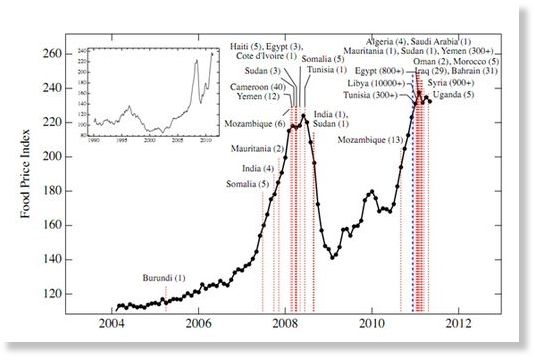
Back in 2011, the New England Complex Systems Institute (NECSI), a research body of academics from Harvard and MIT, using data from the UN Food and Agriculture Organization's (FAO) Food Price Index, published a paper that correlated "outbreaks of unrest" in 2008 and 2011 with increases in food prices. They claimed to have identified the precise threshold for global food prices that leads to worldwide unrest: 210 points...
"high global food prices are a precipitating condition for social unrest. More specifically, food riots occur above a threshold of the FAO price index of 210."
Yaneer Bar-Yam, president of NECSI and one of the paper's authors, said:
"When people are unable to feed themselves and their families, widespread social disruption occurs. We are on the verge of another crisis, the third in five years, and likely to be the worst yet, capable of causing new food riots and turmoil on a par with the Arab Spring."
The aggregated FAO Food Price Index averaged 211.3 points in June this year, but more telling indicators might be their June 2013 Cereal Price Index, which averaged 236.5 points, and their Sugar Price Index, which averaged 242.6 points. Dairy prices are also riding above this 210 threshold, so when we consider that most people's diets are substantially based on sugar, cereals and dairy, followed by meats from cattle raised on grains, it seems pretty clear that we're very much in the danger zone.
Enhanced by Zemanta