Are You Prepared For The Coming Economic Collapse And The Next Great Depression?
JP Morgan And Citigroup Agree That The U.S. Economy Is Steamrolling Toward A Recession
By Michael Snyder, on December 6th, 2015
As
we approach the end of 2015, researchers at both JP Morgan and
Citigroup agree that the probability that the U.S. economy will soon
plunge into recession is rising. Just last week, a member of the U.S.
House of Representatives asked Janet Yellen about Citigroup’s assessment
that there is a 65 percent chance that the United States will
experience an economic recession in 2016. You can read her answer
below. And just a few days ago, JP Morgan economists Michael Feroli,
Daniel Silver, Jesse Edgerton, and Robert Mellman released a report in
which they declared that “the probability of recession within three
years” has risen to “an eye-catching 76%”…
“Our
longer-run indicators, however, continue to suggest an elevated risk
that the expansion is nearing its end, and our preferred model now puts
the probability of recession within three years at an eye-catching 76%.”
The
good news is that the economists at JP Morgan believe that a recession
will probably not hit us within the next six months. But due to
steadily weakening economic conditions, they are convinced that one is
almost certain to strike within the next few years…
“When
we first wrote, only manufacturing sentiment was signaling an
above-average probability of imminent recession,” they said. “But recent
weakening in the Richmond Fed services survey and the ISM
nonmanufacturing index have now pushed the nonmanufacturing sentiment
probability up somewhat as well.”
In the short term, the note says
that the 6-month likelihood is only 5%, but within a year it stands at
23%, in two years 48%, and in three years the “eye-popping” 76%.
To
be honest, I believe that this assessment is far too optimistic, and it
appears that researchers at Citigroup agree with me. According to
them, there is a 65 percent chance that the U.S. economy will plunge into recession by the end of next year. Last week, Janet Yellen was asked about this during testimony before Congress…
In
testimony before Congress’ Joint Economic Committee, Yellen was asked
by Rep. Pat Tiberi about a piece of research released by Citigroup’s
rates strategy team Monday.
Specifically, Tiberi, an Ohio
Republican, wanted to know what Yellen made of Citi’s conclusion that
there is a 65 percent chance of a U.S. recession in 2016.
“The
economists said that they would assign about a 65 percent likelihood of a
recession in the United States in 2016. Now, 65 percent sounds high to
me, but I’m not an economist and I’m not the Fed chair. But zero risk
might be too low as well. So what would you assign a risk level of a
recession next year?” Tiberi asked.
Though
he ran for the White House as a “change” candidate, President Obama has
mostly favored continuity, including bending to the usual pressure from
the Military-Industrial Complex to keep the Pentagon spending flowing,
as budget watchdog Chuck Spinney explains.
By Chuck Spinney
The
Pentagon just won another small skirmish in its long war with Social
Security and Medicare. That is the unstated message of the budget deal
just announced gleefully by congressional leaders and President Barack
Obama. To understand why, let’s take a quick trip down memory lane.
Last January, President Obama submitted Fiscal Year (FY) 2016 budget
to Congress, and he proposed to break the spending limits on both
defense and domestic programs. These limits are set by the long-term
sequester provisions of the Budget Control Act of 2011 (BCA), which, for better or worse, is the law of the land, and Obama was asking Congress to change the law.
Mr.
Obama wanted to finance his ramped up spending proposals by increasing
taxes. Of course, he knew that the Republican-controlled Congress
lusted for defense increases but hated domestic spending, particularly
entitlements, such as Social Security and Medicare.
Moreover, he
knew increasing taxes was like waving the red cape in front of the
Republican budget bulls. So, he knew his budget would be dead on
arrival. Obama’s budget, nevertheless, had one virtue: it was up-front
about the intractable nature of the budget problem. In effect, whether
deliberately or not, Obama laid a trap that the Republicans merrily
walked into during the ensuing spring and summer.
Fed's Williams says low neutral interest rates a 'warning sign'
WASHINGTON
John Williams, president of the Federal Reserve Bank of San Francisco, speaks in San Francisco, California March 27, 2015.
Reuters/Robert Galbraith - RTR4V7IP
San
Francisco Federal Reserve President John Williams said on Friday that
low neutral interest rates are a warning sign of possible changes in the
U.S. economy that the central bank does not fully understand.
"I
see this as more of a warning, a red flag that there's something going
on here that isn't in the models, that we maybe don't understand as well
as we think, and we should dig down deep deeper and try to figure this
out better," he said during a panel discussion at the Brookings
Institute in Washington.
Williams, who is a voting member of the
Fed's policy-setting panel through the end of the year, has said the
central bank should begin to raise interest rates soon but thereafter go
at a gradual pace.
He
added that the low neutral interest rate had "pretty significant"
implications for monetary policy, and put more focus on fiscal policy as
a response.
"If we could come up with better fiscal policy, find a
way to have the economy grow faster or have a stronger natural rate of
interest, then that takes the pressure off of us to try to come up with
other ways to do it, like through a large balance sheet or having a
higher inflation target," Williams said. "It also means we don't have to
turn to quantitative easing and other policies as much."
Bankers
who are found guilty of market rigging, fraud and irresponsible lending
should be imprisoned, a member of the Scottish Parliament has said.
Scottish
Government Cabinet Secretary Keith Brown said the UK should follow
Iceland’s example of jailing corrupt financiers, rather than merely
imposing fines, which is the current punishment for rogue bankers in
Britain.
Speaking to the BBC on Thursday, Brown praised the
actions of Iceland, which jailed its top banking chiefs for criminal
behavior.
Iceland, which suffered a deep recession after the 2008
crash, set up a prosecuting team to investigate 21 alleged reports of
illegal banking practice.
This resulted in the chiefs of Iceland’s three biggest banks – Glitnir, Kaupthing and Landsbanki – being convicted.
Hopes are dimming that Congress will intervene to block a hugeMedicare
premium increase of over 50 percent for nearly a third of the 50
million elderly Americans who receive their physician care and other
health services through Medicare Part D.
Republicans and Democrats
are deadlocked over how to come up with roughly $10.5 billion to
prevent Medicare premiums from skyrocketing for millions of seniors
beginning next January. The looming increase is the result of a quirk in
the law that drives up premiums for wealthier Americans and poor people
with chronic medical problems in years when the Social Security
Administration doesn’t approve a cost-of-living adjustment for
beneficiaries.
Related: Millions Face a 50 % Medicare Premium Hike If Obama and Congress Don’t Act
While
both parties are interested in doing something to reduce or avert the
premium hikes, Republicans are demanding that the cost of any bailout be
offset by cuts in other areas of the Medicare program, while Democrats
are resisting that approach. Moreover, there is a division between House
Minority Leader Nancy Pelosi (D-CA) – a major champion of a bailout –
and some Senate Democratic leaders who are less enthusiastic about the
effort and how to pay for it.
“It’s a big mess,” said one Washington health care expert who is following the negotiations closely.
Negotiations
may pick up later this month once the Centers for Medicare and Medicaid
Services formally releases its official 2016 premium rates, according
to a report on Thursday by the Morning Consult.
Empty
coal gondolas in a rail yard in Danville, W.Va. Patrick Morrisey, West
Virginia's attorney general, said President Obama's climate change
regulations would have "devastating impacts" on families in his state.Credit Luke Sharrett for The New York Times
WASHINGTON — As many as 25 states will join some of the nation’s most influential business groups in legal action to block President Obama’s climate change regulations when they are formally published Friday, trying to stop his signature environmental policy.
In August, the president announced in a White House ceremony that the Environmental Protection Agency rules had been completed, but they had not yet been published in the government’s Federal Register.
Within hours of the rules’ official publication on Friday, a legal
battle will begin, pitting the states against the federal government. It
is widely expected to end up before the Supreme Court.
“I
predict there will be a very long line of people at the federal
courthouse tomorrow morning, eagerly waiting to file their suits on this
case,” said Jeffrey R. Holmstead, a lawyer for the firm Bracewell &
Giuliani who represents several companies that are expected to file
such suits.
While
the legal brawls could drag on for years, many states and companies,
including those that are suing the administration, have also started
drafting plans to comply with the rules. That strategy reflects the
uncertainty of the ultimate legal outcome — and also means that many
states could be well on the way to implementing Mr. Obama’s climate plan
by the time the case reaches the Supreme Court.
A store damaged from riots after the death of Freddie Gray is seen in Baltimore, Maryland, May 13, 2015. REUTERS/Carlos Barria
Silent But Expensive: An Anti-Poverty Program’s Mysterious Achievements
Ethan Barton
An
obscure Department of Housing and Urban Development (HUD) program
grants millions of dollars every year to only three eligible
organizations, but a government official won’t say how the money
actually combats poverty.
More than $429 million has been granted
through Section 4 of the HUD Demonstration Act of 1993 to help local
organizations – called community development corporations – combat
poverty through “capacity building” – a vague phrase that essentially
means building their size and expertise, according to a HUD document.
“Capacity
building develops core skills that strengthen the ability of local
community based organizations to implement HUD programs, raise capital
for community development and affordable housing, coordinate on
cross-programmatic place-based approaches and facilitate knowledge
sharing,” the agency’s 2015 request for funding says.
The
funds pass through one of three eligible groups, known as
intermediaries, which then either redistribute Section 4 funds to local
groups or provides them with direct assistance through trained staff.
Those three groups defined by law are Enterprise Community Partners,
Habitat for Humanity International and Local Initiatives Support
Corporation.
According to HUD’s 2015 funding request, $20 million
will “result in: approximately 5,000 housing units newly constructed
renovated, or preserved; 600 training opportunities; and an estimate of
more than $200 million in total development costs channeled to
low-income communities in more than 250 communities nationwide.”
But
HUD officials won’t say how indirectly backing local groups after funds
pass through an intermediary will achieve those claims, and the
intermediaries can still receive grant dollars without providing
evidence of successful urban renewal.
But
10 months after the first phase of the mandate took effect, covering
companies with 100 or more workers, many business owners say they are
finding very few employees willing to buy the health insurance that they
are now compelled to offer. The trend is especially pronounced among
smaller and midsize businesses in fields filled with low-wage hourly
workers, like restaurants, retailing and hospitality. (Companies with 50
to 99 workers are not required to comply with the mandate until next
year.)
President Obama seated next to the U.S. Trade Representative Michael Froman. (Photo: USTR)
The negotiations and the sales push behind Washington's latest (and biggest) "free trade" agreement amounts to Kabuki theater.
What
theater? Kabuki. It's a 17th-century form of Japanese drama, featuring
elaborate sets and costuming, rhythmic dialogue and stylized acting and
dancing. That does, indeed, nicely sum up the White House's production
of the Trans-Pacific Partnership: Its negotiations have been set in
luxury resorts around the world, covered by elaborate secrecy; insiders
wear the costumes of global corporate power; trade officials parrot
rhythmic dialogue about high standards and incredible benefits for all.
And the president himself is the main actor, dramatically proclaiming
that TPP is "the most progressive" trade deal ever, and now he's doing a
stylized political dance in hopes of winning congressional approval.
What a phenomenal show!
But
it doesn't seem to be selling. Recent polls show broad public
opposition to any more of these same old trade schemes, not only among
Democrats, but independents and Republicans, too. Ten of the 2016
presidential candidates are against the deal. The counter movement is
led by Democratic contender Bernie Sanders, who calls it flat-out
"disastrous," and by GOP frontrunner Donnie Trump who dubs it "a
horrible deal." Even corporate darling Carly Fiorina is "very
uncomfortable with this deal." Congressional opposition is strong, and
even Ford Motor Company — which was one of the corporate giants allowed
inside the negotiations — has blasted it, calling on Congress to vote
no.
A
school district in Tennessee voted to cancel classes and shut down its
schools as a result of a budget problem that has left the government
unable to fund the facilities. The school director blamed Obamacare for
its problems.
Clay County,
Tennessee operates three schools total – one high school and two that
cover pre-kindergarten through eighth grade – on a $9.5 million budget.
However, now more than 1,100 students are sitting at home while
officials try to figure out how to reopen the doors. A school board
meeting last week saw the board voting 6-4 to close the schools. A
separate vote to keep them open failed.
Notably, the county’s financial issues are not new. Clay County Director of Schools Jerry Strong told Associated Press that
officials have been struggling with the budget for three years, and
blamed county obligations such as state and government mandates,
particularly the Affordable Care Act, for the monetary hole.
"Clay County's inability to generate the revenue to offset the mandates is what's caused this to come to a head," he said.
The debt ceiling issue is returning to the forefront in American politics, again threatening a government shutdown.
Last
time, the shutdown resulted in sequester for many agencies that
suspended work for many government employees; a great deal of political
theater dominated the news cycle; but ultimately, things returned to a
basic normalcy.
This time may be different, as a number of
critical factors face Americans in 2015. Last week, Congress passed
“procedural martial law” to address stop-gap spending as it faces the
debt ceiling crisis again.
Meanwhile,
this quietly announced martial law forced a vote on bills the same day,
preventing members from even reading the legislation they were voting
on, to avert an October 1 government shutdown. The move, which was done
just a few weeks prior, shows how desperate things have become.
For
the second time in a month, the House on Tuesday invoked “martial law”
to allow more expeditious consideration of a stopgap spending bill to
avoid a government shutdown on Oct. 1.
The use of martial
law refers to bypassing the typical procedure that requires the House
to wait a day after the Rules Committee produces a rule establishing
floor debate parameters before voting.
[…]House GOP leaders
invoked martial law earlier this month to fast-track a spending bill.
But they ultimately never had to use it after the Senate opted to go
first with the spending bill.
Crisis is averted – for now.
But
the dollar is now an unwanted export commodity. As the U.S. rattles
sabers with Russia in its proxy wars, the basis for American power
overseas is rapidly collapsing.
China is ready to move forward
with a “global reset” that would include the yuan in a global basket of
currencies, and knock the dollar out of its reserve currency status.
Increasing troubles of U.S. and government financial institutions gives a sharp warning that things are coming to a head.
SGT Report issues a critical and under reported warning: “We are living in the last days of this Republic.”
The U.S. national debt grows at a rate of 45.486 dollar per second!
20,517,497,500,000
10/05/15 6:28pm CDT
$ 65.903
Debt per citizen
$ 113.353
Debt per taxpayer
Year
x billion U.S dollar
2004
7.379
2005
7.933
2006
8.507
2007
9.008
2008
10.025
2009
11.910
2010
13.562
2011
14.781
2012
16.059
2013
16.732
2014
17.810
For Real Time National Debt Numbers Visit The US Debt Clock
..........
Since our worlds collided on that fated day in 2008 when the
American dream became even more elusive for the majority of us there
has been some time to reflect on our mistakes. Some of us have learned
from what we have lived and experienced. Others, however, are still
stuck in the partisan la la land of Rabid Conservatism or Rabid
Liberalism. Each side pulling for its own without taking pause to
understand the long-range consequences of their actions.
Politicians
will do what politicians do best, protect their pockets and those
who keep them full. What excuse do the common folk (non-corporate or
lobbyist) have? You vote Republican or Democrat because they hold the
best future for our country? Or do you vote because it is all you
know and you cannot fathom the fact that both sides of the aisle
serve the same master? It has gone way beyond the scope of
political party or leanings. It is time to put those patriotic
gestures, slogans and mindsets to actual use by truly putting
your country first. We must put a stop to the criminal
Washington/Corporate agenda that is killing us.
Until we truly
and seriously address the criminals who are selling our Nation
and our children's future to the highest bidder we are doomed.
Are you ready to face the truth or will you just sit back and
blame another while you do nothing to change the problem?
The
only answer to the putrefaction that is taking place all across
this nation is in the hands of the people. Many laughed at the
Occupy movement. Some vilified those who wanted to make a
difference and voice their displeasure with the status quo. How
many of you have done anything to make a change? How many of you
have cared enough to even consider what role you may have to play?
Truly,
I do not see a way out of this unless people stop seeing right or
left and start seeing stars and stripes. This nation depends on it's People,
not its politicians. Why have we become so complacent that we are
no longer willing to fight the good fight for our freedom and
our way of life? When did this nation become the home of the
lazy and the weak? It is time the strong and the brave stood up,
if there are any left.
What will it take to make
you see that politics is a trap? An illusion to make us believe we
have a choice when in reality we have none. They have both
evolved to serve the same masters and fulfill the same agenda. An
agenda that serves neither you nor me. When will you wake up
from your blue and red slumber to see that we have all been
lied to ?
When do we take America back as a People not a political party?
The
time is growing short people! Unless you open your eyes and
understand what is truly at stake. You will never live in America
the Land of the Free and the Brave again. We will simply exist
in a land run by petty politics and corrupt corporations willing to
do whatever it takes to maximize their bottom line. Even if it means
exploiting our children's lives and futures.
Just
in case you still don't have a clue what I am talking about.
Here is a very short list of examples of the Corporate Assault on
Our Lives And Our Health that our politicians have allowed to take
place for a price.
GMO's in our food supply
Digestive disorders, Obesity,Endocrine disorders on the rise
Glyphosate in our foods, our water and our breast milk
Kidney and Liver damage on the rise
Fracking chemicals in the water supply
Cancers on the rise
Fluoride in the water supply
Vaccines causing deadly reactions in children and adults
Autism on the rise
Heavy metals in our food supply
Alzheimer's on the rise
Deadly chemicals being pawned off as sugar substitutes from saccharine to splenda
all have been found to cause cancer in animal studies. The
biggest culprit and most dangerous thus far being Aspartame.
Life saving drugs monopolized by Big Pharma to bloat prices beyond most people's reach. Daraprim being the latest going from $13.50 per pill to $750.00. Basically condemning those who cannot afford them to die.
There are so many more examples you just need to open your eyes and want to see the truth
When
we get our story wrong, we get our future wrong. Much like the
Trans-Pacific Partnership "trade deal", everything we are told about
capitalism and our economy is a pack of lies. Time for a new story,
says preeminent scholar and critic of corporate globalization, David
Korten, the best-selling author of When Corporations Rule the World and
The Great Turning. David has a brand new book, Change the Story, Change
the Future - a Living Economy for a Living Earth. He is the co-founder
and board chair of YES! Magazine, co-chair of the New Economy Working
Group, founder and president of the Living Economies Forum (formerly the
People-Centered Development Forum), a member of the Club of Rome, and a
former board member of the Business Alliance for Local Living Economies
(BALLE) and associate of the International Forum on Globalization.
This Earth Day address was recorded April 22, 2015 at Seattle University Pigott Auditorium.
Community
Rights educator Paul Cienfuegos explains how "We The People" are
exercising the authority to govern ourselves and dismantle corporate
rule. When small farmers in rural Pennsylvania wanted to say "no" to a
corporate factory farm coming into their community, they learned they
couldn't, because it would violate the corporation's "rights" and state
pre-emption laws. So they did something technically illegal - their town
passed an innovative ordinance banning corporate factory farming. It
worked! The corporation left town. Pittsburgh upshifted the approach:
Rather than define what we don't want, define what we DO want. Their
"Right to Water" stopped natural gas fracking in the city. Ordinances
like this have been passed in over 150 communities in 9 states. Tune in
to learn how this works. Episode 258. [paulcienfuegos.com, celdf.org,
YouTube channel "Community Rights TV" and communityrightspdx.org]
Peak Moment TV exists because of viewers like you. Subscribe to news and donate at http://www.peakmoment.tv, right side. Thanks for being in the Peak Moment community.
Have
we forgotten about the national debt? Congressional Republican leaders
and the Obama administration have begun private talks about a new
two-year spending plan that would keep the government operating beyond
the 2016 election but would do little to address more fundamental
structural problems, including entitlement and health care spending for
an aging population.
Even before Congress completed work on a
short-term spending measure to avert a government shutdown at least
until early December, Senate Majority Leader Mitch McConnell (R-KY),
outgoing House Speaker John Boehner (R-OH) and President Obama held
preliminary talks on a possible multi-year budget agreement to increase
spending for both defense and domestic programs by lifting fiscal 2016
discretionary spending caps imposed by the 2011 Budget Control Act. Related: New CBO Director Renews Warning on Long-Term Debt
The
agreement would be similar in scope to a two-year mini-budget agreement
that was struck by Sen. Patty Murray (D-WA) and Rep. Paul Ryan (R-WI)
following a 16-day government shutdown in late 2013 that temporarily put
an end to inter-party budget warfare. That agreement allowed for $45
billion more in spending above the caps in 2014 and $20 billion more in
2015, as well as $20 billion of deficit reduction.
USS
Ronald Reagan and its embarked air wing, Carrier Air Wing (CVW) 5,
provide a combat-ready force that protects and defends the collective
maritime interests of the U.S. and its allies and partners in the
Indo-Asia-Pacific region. (Photo: U.S. Navy Specialist 2nd Class Paolo
Bayas)
The
Russians are bombing CIA-backed rebels in Syria and continuing to hold
parts of Ukraine. ISIS continues to spread in the Middle East and
inspire attacks around the world. Iran is receiving hundreds of billions
in sanctions relief, some of which will likely go to destabilizing the
Middle East. China is building illegal islands in the South China Sea.
Hundreds of thousands of refugees are streaming across Europe. The
Taliban is on the rise in Afghanistan. And our national secrets are
being vacuumed up by Chinese hackers.
At the same time, our national defense budget is being slashed.
Since 2011, the defense budget has been cut by 15 percent
in real terms. If you include the war budget, which has been going down
as we reduce troops in Afghanistan, the national defense has been cut
25 percent in four years.
As a result of these budget cuts, the
U.S. military is smaller than it was on 9/11 and in many cases the
smallest it has been in recent history.
The
world is a mess, our military is being slashed, and now President Obama
is going to veto a bipartisan bill that would increase the national
defense budget by 6 percent in real terms.
The House of
Representatives just passed the National Defense Authorization Act for
Fiscal Year 2016 (NDAA), and it is headed to the Senate. This is a
bipartisan bill that has been signed into law every year for 53 straight
years, but Obama plans to veto it for one simple reason: it doesn’t
increase non-defense spending. The president believes that defense and
non-defense spending should be increased, and, according to the White
House, “he will not fix defense without fixing non-defense spending.”
John Boehner Admits Republicans are Willing to Put U.S. at Risk to Play Partisan Politics
February 16, 2015 By Allen Clifton
Republicans
are anything if not predictable. The moment they gained power back in
the Senate it was obvious that they were going to use that power to play
petty partisan politics. The truth is, controlling Congress means very
little as long as the person in the White House has veto power.
So
no matter what sort of propaganda Republicans spew about the nonsense
they’re going to undoubtedly shove through Congress, it’s still on them
to send the president legislation that they know he will sign, otherwise
they’re essentially just wasting time.
The
president is the one person who’s voted into office on a national scale,
meaning that they’re the one individual who truly “represents the
majority of the people.” So no matter what anyone in Congress says, it’s
beholden upon them to make sure whatever bills they’re sending to the
president’s desk actually have a chance at being signed. It’s extremely
rare for both the House and Senate to have the two-thirds majority
needed to override a presidential veto.
All
that being said, as many already know the Department of Homeland
Security is set to run out of funding fairly soon. Normally this
wouldn’t be a huge deal; all it would take is for Congress to pass a
bill funding the department, which would almost certainly be signed by
President Obama.
It has been a long time since the Bureau of Labor Statistics (BLS) published the real unemployment
numbers for all Americans who fit the criteria of being able to work in
the economy, but have not been able to find a job for one reason or
another. Instead, the BLS has simply changed their data models
numerous times since 1980, and now we have reached the point where
there are actually more people between the ages of 16-54 who don't have a
job versus those in that same age range who do.
And with the Federal Reserve using these BLS numbers as the catalyst for whether to raise interest rates
after nine years of them being pushed down to near zero, one regional
central bank on Oct. 2 laid the blame for there being over 94 million Americans out of work and not counted in the unemployment models as simply 'not wanting to get a job'.
The
especially poor September jobs report reinforces what many economists
have been saying for months: The six-year recovery from the Great
Recession has been too weak to create enough jobs for America's growing
population, let alone restore significant wage growth.
Domestic
fiscal austerity, not recent global volatility, is primarily to blame
for the inadequate job growth, these economists argue.
The U.S. economy created 142,000 jobs
in September, bringing average monthly job growth to 198,000 this year
-- way down from the monthly rate of 260,000 in 2014. Average hourly
wages decreased slightly in September, meaning pay has risen just 2.2
percent in the past 12 months.
In
addition, the percentage of the population working or looking for work
has dropped to 62.4 percent, the lowest it has been during the Obama
presidency. The progressive Economic Policy Institute estimates that we
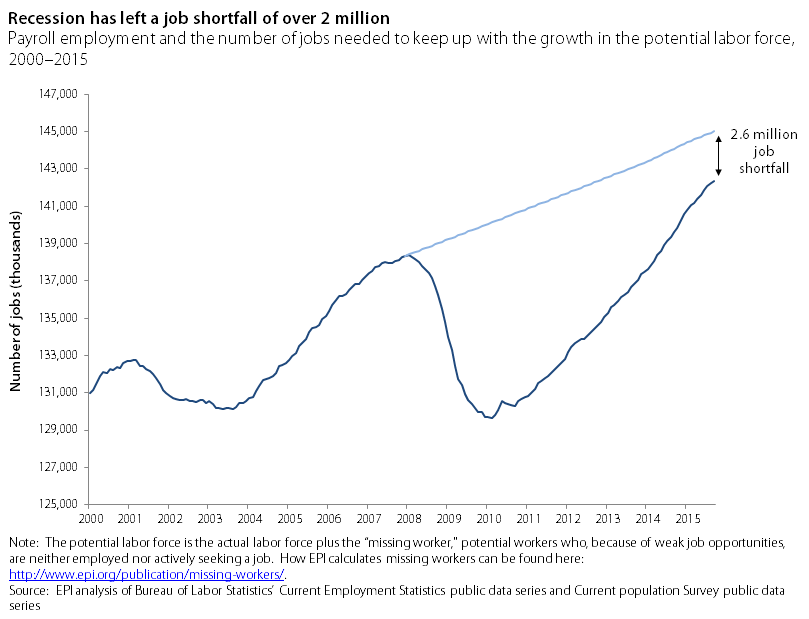
need 2.6 million more jobs to keep up with population growth.
Responding
to a New York Post report stating that more than 300 New York City
municipal employees didn’t earn enough to be able to afford a place to
live, the mayor has offered to find them permanent housing.
During
a press conference on Monday, New York Mayor Bill de Blasio admitted
there were people working for the city that were homeless, though he
disputed the number initially reported.
“What we’re facing
now, this is becoming more and more of an economic problem. Meaning
people have been displaced from their homes by the high cost of housing,
even if they’re working,” de Blasio said at City Hall.
“We’re
going to make sure in every case, particularly with working folks, that
we look for every opportunity to get them to permanent housing. “
The
mayor questioned whether the number of homeless city employees was over
300, with his spokeswoman Ishanee Parikh saying records showed that
only 83 shelter residents have identified themselves as city employees.
Municipal
union leaders told the Post, however, that the actual number is over
300, but many don’t report their employment status to shelters out of
shame.
“There’s a social taboo that they believe comes with being homeless,” Joseph Puleo, president of Local 983 of District Council 37, the city’s largest blue-collar municipal-workers union, told the Post.

 The Economic Collapse
 By Michael Snyder, on December 6th, 2015






 Economic Policy Inst