Showing posts with label Citigroup. Show all posts

Tuesday, December 8, 2015

Researchers at both JP Morgan and Citigroup agree that the probability that the U.S. economy will soon plunge into recession is rising.


The Economic Collapse
Are You Prepared For The Coming Economic Collapse And The Next Great Depression?

JP Morgan And Citigroup Agree That The U.S. Economy Is Steamrolling Toward A Recession

Locomotive - Public Domain


As we approach the end of 2015, researchers at both JP Morgan and Citigroup agree that the probability that the U.S. economy will soon plunge into recession is rising.  Just last week, a member of the U.S. House of Representatives asked Janet Yellen about Citigroup’s assessment that there is a 65 percent chance that the United States will experience an economic recession in 2016.  You can read her answer below.  And just a few days ago, JP Morgan economists Michael Feroli, Daniel Silver, Jesse Edgerton, and Robert Mellman released a report in which they declared that “the probability of recession within three years” has risen to “an eye-catching 76%”
“Our longer-run indicators, however, continue to suggest an elevated risk that the expansion is nearing its end, and our preferred model now puts the probability of recession within three years at an eye-catching 76%.”
The good news is that the economists at JP Morgan believe that a recession will probably not hit us within the next six months.  But due to steadily weakening economic conditions, they are convinced that one is almost certain to strike within the next few years
“When we first wrote, only manufacturing sentiment was signaling an above-average probability of imminent recession,” they said. “But recent weakening in the Richmond Fed services survey and the ISM nonmanufacturing index have now pushed the nonmanufacturing sentiment probability up somewhat as well.”
In the short term, the note says that the 6-month likelihood is only 5%, but within a year it stands at 23%, in two years 48%, and in three years the “eye-popping” 76%.
To be honest, I believe that this assessment is far too optimistic, and it appears that researchers at Citigroup agree with me.  According to them, there is a 65 percent chance that the U.S. economy will plunge into recession by the end of next year.  Last week, Janet Yellen was asked about this during testimony before Congress
In testimony before Congress’ Joint Economic Committee, Yellen was asked by Rep. Pat Tiberi about a piece of research released by Citigroup’s rates strategy team Monday.
Specifically, Tiberi, an Ohio Republican, wanted to know what Yellen made of Citi’s conclusion that there is a 65 percent chance of a U.S. recession in 2016.
“The economists said that they would assign about a 65 percent likelihood of a recession in the United States in 2016. Now, 65 percent sounds high to me, but I’m not an economist and I’m not the Fed chair. But zero risk might be too low as well. So what would you assign a risk level of a recession next year?” Tiberi asked.
So how did Yellen respond?


Read More Here

Friday, May 2, 2014

Hmmmm Factor : In the last 5 months five highly educated JPMorgan male employees ,30 and under, have died under suspicious circumstances. Incidents now classified as "Trade Secrets".

Wall Street On Parade

Suspicious Deaths of Bankers Are Now Classified as “Trade Secrets” by Federal Regulator

By Pam Martens and Russ Martens: April 28, 2014

It doesn’t get any more Orwellian than this: Wall Street mega banks crash the U.S. financial system in 2008. Hundreds of thousands of financial industry workers lose their jobs. Then, beginning late last year, a rash of suspicious deaths start to occur among current and former bank employees.  Next we learn that four of the Wall Street mega banks likely hold over $680 billion face amount of life insurance on their workers, payable to the banks, not the families. We ask their Federal regulator for the details of this life insurance under a Freedom of Information Act request and we’re told the information constitutes “trade secrets.”

According to the Centers for Disease Control and Prevention, the life expectancy of a 25 year old male with a Bachelor’s degree or higher as of 2006 was 81 years of age. But in the past five months, five highly educated JPMorgan male employees in their 30s and one former employee aged 28, have died under suspicious circumstances, including three of whom allegedly leaped off buildings – a statistical rarity even during the height of the financial crisis in 2008.

There is one other major obstacle to brushing away these deaths as random occurrences – they are not happening at JPMorgan’s closest peer bank – Citigroup. Both JPMorgan and Citigroup are global financial institutions with both commercial banking and investment banking operations. Their employee counts are similar – 260,000 employees for JPMorgan versus 251,000 for Citigroup.
Both JPMorgan and Citigroup also own massive amounts of bank-owned life insurance (BOLI), a controversial practice that pays the corporation when a current or former employee dies. (In the case of former employees, the banks conduct regular “death sweeps” of public records using former employees’ Social Security numbers to learn if a former employee has died and then submits a request for payment of the death benefit to the insurance company.)

Wall Street On Parade carefully researched public death announcements over the past 12 months which named the decedent as a current or former employee of Citigroup or its commercial banking unit, Citibank. We found no data suggesting Citigroup was experiencing the same rash of deaths of young men in their 30s as JPMorgan Chase. Nor did we discover any press reports of leaps from buildings among Citigroup’s workers.

Given the above set of facts, on March 21 of this year, we wrote to the regulator of national banks, the Office of the Comptroller of the Currency (OCC), seeking the following information under the Freedom of Information Act (See OCC Response to Wall Street On Parade’s Request for Banker Death Information):

The number of deaths from 2008 through March 21, 2014 on which JPMorgan Chase collected death benefits; the total face amount of BOLI life insurance in force at JPMorgan; the total number of former and current employees of JPMorgan Chase who are insured under these policies; any peer studies showing the same data comparing JPMorgan Chase with Bank of America, Wells Fargo and Citigroup.
The OCC responded politely by letter dated April 18, after first calling a few days earlier to inform us that we would be getting nothing under the sunshine law request. (On Wall Street, sunshine routinely means dark curtain.) The OCC letter advised that documents relevant to our request were being withheld on the basis that they are “privileged or contains trade secrets, or commercial or financial information, furnished in confidence, that relates to the business, personal, or financial affairs of any person,” or  relate to “a record contained in or related to an examination.”
The ironic reality is that the documents do not pertain to the personal financial affairs of individuals who have a privacy right. Individuals are not going to receive the proceeds of this life insurance for the most part. In many cases, they do not even know that multi-million dollar policies that pay upon their death have been taken out by their employer or former employer. Equally important, JPMorgan is a publicly traded company whose shareholders have a right under securities laws to understand the quality of its earnings – are those earnings coming from traditional banking and investment banking operations or is this ghoulish practice of profiting from the death of workers now a major contributor to profits on Wall Street?

As it turns out, one aspect of the information cavalierly denied to us by the OCC is publicly available to those willing to hunt for it. On March 24 of this year, we reported that JPMorgan Chase held $10.4 billion in BOLI assets at its insured depository bank as of December 31, 2013.

We reached out to BOLI expert, Michael D. Myers, to understand what JPMorgan’s $10.4 billion in BOLI assets at its commercial bank might represent in terms of face amount of life insurance on its workers. Myers said: “Without knowing the length of the investment or its rate of return, it is difficult to estimate the face amount of the insurance coverage.  However, a cash value of $10.4 billion could easily translate into more than $100 billion in actual insurance coverage and possibly two or three times that amount” said Myers, a partner in the Houston, Texas law firm McClanahan Myers Espey, L.L.P.


Read More Here

.....

Insurance policies pertaining to bankers’ suicides classified as containing ‘trade secrets’

Published time: April 29, 2014 19:09

AFP Photo / John Moore
After a recent rash of mysterious apparent suicides shook the financial world, researchers are scrambling to find answers about what really is the reason behind these multiple deaths. Some observers have now come to a rather shocking conclusion.
Wall Street on Parade bloggers Pam and Russ Martens wrote this week that something seems awry regarding the bank-owned life insurance (BOLI) policies held by JPMorgan Chase. Traditional life insurance policies ensure that the loved ones of the deceased are compensated fairly in the event of a death, but banks are investing billions in policies that let them receive untaxed payment with the passing of each employee. While it’s not unusual for major banks to take out policies that compensate companies in the event of an employee death, the Martens wrote, attempts to find out more about that practice have been peculiarly hard and have raised a red flag among bloggers like those at Wall Street on Parade.

Four of the biggest banks on Wall Street combined hold over $680 billion in BOLI policies, the bloggers reported, but JPMorgan held around $17.9 billion in BOLI assets at the end of last year to Citigroup’s comparably meager $8.8 billion.

Both banks are global financial institutions with commercial and investment banking operations, the Martens wrote, and each employs close to a quarter-of-a-million employees. Nevertheless, they say that JPMorgan has experienced a far greater rate of suicide among employees in recent months, particularly in the midst of a series of news reports documenting unusual leaps off buildings and other bizarre deaths that have taken the lives of JPMorgan staffers.


Read More Here

.....
Enhanced by Zemanta

Thursday, February 20, 2014

Obama's TPP negotiators received huge bonuses from big banks. Shocker ? Not Really.....


Published time: February 18, 2014 17:12

Stefan Selig.( Reuters / Mike Segar )


A controversial trade deal being touted by the White House is expected to give American corporations broad new authority if approved. Now according to newly released documents, big banks gave millions to the execs that are now orchestrating the agreement.

Investigative journalist Lee Fang wrote for Republic Report on Tuesday this week that two former well-placed individuals within the ranks of Bank of America and CitiGroup were awarded millions of dollars in bonuses before jumping ship to work on the Trans-Pacific Partnership on behalf of the White House.
The Trans-Pacific Partnership, or TPP, is a widely-contested trade deal between the US and 11 other nations adjacent to the Pacific Rim, and has been negotiated by representatives for those countries in utmost secrecy. According to leaked excerpts of the TPP and remarks from experts following the news closely, though, it’s believed that the arrangement would allow corporations to oppose foreign laws while at the same time limiting the abilities for governments to regulate those entities.
On Tuesday, Fang wrote that two major United States-based financial firms have significantly awarded former executives who have since attracted the attention of President Barack Obama and subsequently been offered positions that put them directly involved in TPP talks.
Former Bank of America investment banker Stefan Selig, Fang acknowledged, received more than $9 million in bonus pay after he was nominated to join the Obama administration in November. And Michael Froman, the current US trade representative, was awarded over $4 million from Citigroup when he left them in 2009 in order to go work for the White House. Republic Report were provided those statistics through financial disclosures included in Fang’s article.
When Selig was asked to head the International Trade Administration by the White House last November — a Commerce Department job — the New York Times considered it “a rare appointment of a Wall Street banker by the Obama administration.” If he is confirmed by the Senate as expected, he will work directly with US trade officials on hammering out final arrangements for the TPP. Froman has been the US trade representative since last June, and according to his biography on that department’s official website, is directly overseeing TPP discussions.

Read More Here

Obama trade officials received huge bank bonuses - Salon.com

Obama trade officials received huge bank bonuses
www.salon.com/.../obama...received_huge_bank_bonuses

Obama's TPP trade officials took bonus money from big banks

www.allvoices.com/contributed-news/16564785-obamas...

Obama Trade Officials Received Hefty Bonuses From Big Banks

Obama Trade Officials Received Hefty Bonuses From Big Banks
www.huffingtonpost.com/2014/02/17/obama-trade-banks...


Enhanced by Zemanta

Thursday, February 6, 2014

Ten banks turned over evidence to the U.K. Financial Conduct Authority as part of an investigation into the manipulation of foreign-exchange benchmarks

Ten Banks in FX Trading Probe Have Handed Evidence to FCA

Feb 4, 2014 9:55 AM CT


Photographer: Simon Dawson/Bloomberg
The allegations are “as bad as Libor,” Wheatley told lawmakers in London today,... Read More
Ten banks turned over evidence to the U.K. Financial Conduct Authority as part of an investigation into the manipulation of foreign-exchange benchmarks, its chief executive officer told lawmakers.
The allegations are “as bad as Libor,” FCA CEO Martin Wheatley said in London today, referring to the global probe into rigging of the London interbank offered rate. Those investigations have resulted in global fines of about $6 billion and led to reviews of other benchmarks, including currency rates.
The regulator is investigating “a number of benchmarks that operate in London,” Wheatley said. The foreign-exchange probe is unlikely to be concluded this year, he said, without identifying any banks under investigation.
The regulator said in October it was opening a formal probe into currency-rate trading, joining regulators in the U.S. and Switzerland in reviewing the $5.3 trillion-a-day market. The world’s seven biggest foreign-exchange dealers have now all taken action against their employees, with at least 17 traders suspended, put on leave or fired.
Royal Bank of Scotland Group Plc has handed over records of instant messages to the FCA after concluding a former currency trader’s communications with counterparts at other firms may have been inappropriate, according to two people with knowledge of the matter.

Read More Here

.....

WRAPUP 2-Forex probe widens as New York banking regulator steps in

Emily Flitter and Jamie McGeever
Feb 5 (Reuters) - New York banking regulator Benjamin Lawsky is seeking documents from some of the biggest banks in foreign exchange trading, including Deutsche Bank, Goldman Sachs and Barclays, a source familiar with the matter said Wednesday, as a global probe into possible market manipulation widens.
At least seven other law enforcement offices and regulators internationally are investigating whether banks rigged the $5.3 trillion-a-day currency markets. Martin Wheatley, chief executive officer of Britain's Financial Conduct Authority, said on Tuesday that his watchdog group's probe could extend into 2015, and that the allegations it is looking into are "every bit as bad" as the Libor manipulation scandal.
Read More Here
.....

UPDATE 1 -Citi's global head of foreign exchange to leave bank -memo

LONDON Wed Feb 5, 2014 2:59pm GMT

Feb 5 (Reuters) - The global head of foreign exchange at Citigroup, the world's second largest currency trader, is leaving the bank, according to an internal bank memo seen by Reuters on Wednesday.
London-based Anil Prasad's departure, however, is not related to the global investigation into allegations of currency market manipulation, a source familiar with the matter said.
"Anil's decision is his own and entirely unrelated to the on-going FX investigations," the source said.
Citi sees 14.9 percent of the average $5.3 trillion that flows through the world currency markets every day, according to the last annual poll by Euromoney, just behind market leader Deutsche Bank AG which sees 15.2 percent.
Prasad joined Citi in India in 1986 and relocated to New York two years later. In 1996, he moved to London but left the bank the following year to join Natwest Capital Markets.
He returned to Citi in 2000, and was appointed Global Head of Foreign Exchange & Local Markets in February 2007. His successor will be announced in the coming weeks.

Read More Here

.....
Enhanced by Zemanta

Monday, January 13, 2014

The Economy Is A Complete Illusion And It's Ready To Collapse

-- Episode 259

X22Report X22Report


Published on Jan 10, 2014
Get economic collapse news throughout the day visit http://x22report.com
More economic collapse news visit http://thepeoplesnewz.com
The Greek people cannot pay their taxes. In Cyprus housing sales fell 23% in 2013. The central bankers/US government/corporate media have released the propaganda that the economy is recovering. This is false and retail sales tanked this holiday season. The central bankers US government are losing control of the middle east and the US dollar is on the brink of collapsing.
.....

The Economic Collapse

If You Are Waiting For An “Economic Collapse”, Just Look At What Is Happening To Europe

European UnionIf you are anxiously awaiting the arrival of the "economic collapse", just open up your eyes and look at what is happening in Europe.  The entire continent is a giant economic mess right now.  Unemployment and poverty levels are setting record highs, car sales are setting record lows, and there is an ocean of bad loans and red ink everywhere you look.  Over the past several years, most of the attention has been on the economic struggles of Greece, Spain and Portugal and without a doubt things continue to get even worse in those nations.  But in 2014 and 2015, Italy and France will start to take center stage.  France has the 5th largest economy on the planet, and Italy has the 9th largest economy on the planet, and at this point both of those economies are rapidly falling to pieces.  Expect both France and Italy to make major headlines throughout the rest of 2014.  I have always maintained that the next major wave of the economic collapse would begin in Europe, and that is exactly what is happening.  The following are just a few of the statistics that show that an "economic collapse" is happening in Europe right now...
-The unemployment rate in the eurozone as a whole is still sitting at an all-time record high of 12.1 percent.
-It Italy, the unemployment rate has soared to a brand new all-time record high of 12.7 percent.
-The youth unemployment rate in Italy has jumped up to 41.6 percent.
-The level of poverty in Italy is now the highest that has ever been recorded.
-Many analysts expect major economic trouble in Italy over the next couple of years.  The President of Italy is openly warning of "widespread social tension and unrest" in his nation in 2014.
-Citigroup is projecting that Italy's debt to GDP ratio will surpass 140 percent by the year 2016.
-Citigroup is projecting that Greece's debt to GDP ratio will surpass 200 percent by the year 2016.
-Citigroup is projecting that the unemployment rate in Greece will reach 32 percent in 2015.
-The unemployment rate in Spain is still sitting at an all-time record high of 26.7 percent.
-The youth unemployment rate in Spain is now up to 57.7 percent - even higher than in Greece.
-The percentage of bad loans in Spain has risen for eight straight months and recently hit a brand new all-time record high of 13 percent.
-The number of mortgage applications in Spain has fallen by 90 percent since the peak of the housing boom.
-The unemployment rate in France has risen for 9 quarters in a row and recently soared to a new 16 year high.
-For 2013, car sales in Europe were on pace to hit the lowest yearly level ever recorded.
-Deutsche Bank, probably the most important bank in Germany, is the most highly leveraged bank in Europe (60 to 1) and it has approximately 70 trillion dollars worth of exposure to derivatives.
Europe truly is experiencing an economic nightmare, and it is only going to get worse.
Read More Here
.....

The Economic Collapse

Why Is Goldman Sachs Warning That The Stock Market Could Decline By 10 Percent Or More?

Time Is Running OutWhy has Goldman Sachs chosen this moment to publicly declare that stocks are overpriced?  Why has Goldman Sachs suddenly decided to warn all of us that the stock market could decline by 10 percent or more in the coming months?  Goldman Sachs has to know that when they release a report like this that it will move the market.  And that is precisely what happened on Monday.  U.S. stocks dropped precipitously.  So is Goldman Sachs just honestly trying to warn their clients that stocks may have become overvalued at this point, or is another agenda at work here?  To be fair, the truth is that all of the big banks should be warning their clients about the stock market bubble.  Personally, I have stated that the stock market has officially entered "crazytown territory".  So it would be hard to blame Goldman Sachs for trying to tell the truth.  But Goldman Sachs also had to know that a warning that the stock market could potentially fall by more than 10 percent would rattle nerves on Wall Street.
This report that has just been released by Goldman Sachs has gotten a lot of attention.  In fact, an article about this report was featured at the top of the CNBC website for quite a while on Monday.  Needless to say, news of this report spread on Wall Street like wildfire.  The following is a short excerpt from the CNBC article...
A stock market correction is approaching the level of near certainty as Wall Street faces a major paradigm shift in how to achieve price gains, according to a Goldman Sachs analysis.
In a market outlook that garnered significant attention from traders Monday, the firm's strategists called the S&P 500 valuation "lofty by almost any measure" and attached a 67 percent probability to the chance that the market would fall by 10 percent or more, which is the technical yardstick for a correction.
Of course Goldman Sachs is quite correct to be warning about an imminent stock market correction.  Right now stocks are overvalued according to just about any measure that you could imagine...
The current valuation of the S&P 500 is lofty by almost any measure, both for the aggregate market as well as the median stock: (1) The P/E ratio; (2) the current P/E expansion cycle; (3) EV/Sales; (4) EV/EBITDA; (5) Free Cash Flow yield; (6) Price/Book as well as the ROE and P/B relationship; and compared with the levels of (6) inflation; (7) nominal 10-year Treasury yields; and (8) real interest rates. Furthermore, the cyclically-adjusted P/E ratio suggests the S&P 500 is currently 30% overvalued in terms of (9) Operating EPS and (10) about 45% overvalued using As Reported earnings.
There is a lot of technical jargon in the paragraph above, but essentially what it is saying is that stock prices are unusually high right now according to a whole host of key indicators.
And in case you were wondering, stocks did fall dramatically on Monday.  The Dow fell by 179 points, which was the biggest decline of the year by far.
So is Goldman Sachs correct about what could be coming?
Well, the truth is that there are many other analysts that are far more pessimistic than Goldman Sachs is.  For example, David Stockman, the Director of the Office of Management and Budget under President Reagan, believes that the U.S. stock market is heading for "a pretty rude day of awakening"...
Read More Here
.....
Enhanced by Zemanta

Wednesday, January 8, 2014

As Citigroup Spun Toward Insolvency in ’07- ’08, Its Regulator Was Dining and Schmoozing With Citi Execs


By Pam Martens and Russ Martens: January 7, 2014

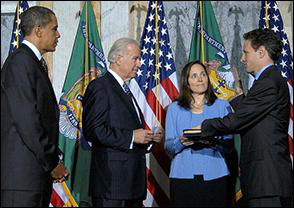
Timothy Geithner Is Sworn in as 75th U.S. Treasury Secretary As His Wife, Carole, Looks On
Before Timothy Geithner became the 75th Secretary of the U.S. Treasury in 2009, he served as the President of the Federal Reserve Bank of New York for five years. The New York Fed is one of Wall Street’s primary regulators. But after leaving his post at the New York Fed, Geithner testified before the U.S. House of Representatives’ Committee on Financial Services on March 26, 2009 that he was not regulating Wall Street as he earned his $400,000 a year with car, driver and private dining room.
At the 2009 hearing, in response to a question from Congressman Ron Paul, Geithner said:
“That was a very thoughtful set of questions. I just want to correct one thing. I have never been a regulator, for better or worse. And I think you are right to say that we have to be very skeptical that regulation can solve all these problems. We have parts of the system which are overwhelmed by regulation…It wasn’t the absence of regulation that was a problem. It was, despite the presence of regulation, you got huge risks built up.”
When Geithner says, “for better or worse,” I think most Americans would agree that Geithner’s failure to know that he was a regulator at an institution he headed for half a decade that employed hundreds of bank examiners was probably worse for the country, not better, given that he oversaw the greatest financial collapse since the Great Depression and the most expensive taxpayer bailout in the history of finance.
In written testimony before the same hearing, Geithner added that “We can’t allow institutions to cherry pick among competing regulators, and shift risk to where it faces the lowest standards and constraints.” And yet, Geithner’s appointment calendar suggests that this is exactly what Citigroup did as Geithner accommodated it as willingly as a concierge at one of those exclusive Manhattan hotels.
According to Geithner’s appointment calendar for 2007 and 2008 (available online courtesy of an article the New York Times published in 2009), Geithner excelled in hobnobbing, despite the appearance of outrageous conflicts of interest. He was the Relationship Manager In Chief as he managed his own relationship with Citigroup into a job offer to be its CEO.
During 2007 and 2008, Citigroup entered an intractable death spiral owing to a decade of obscene executive pay, off balance sheet debt, toxic assets and mismanagement of its unwieldy disparate business lines. Instead of functioning as the tough cop on the beat in regulating Citigroup, Geithner hobnobbed, holding 29 breakfasts, lunches, dinners and other meetings with Citigroup executives.
When Sandy Weill stepped down from Citigroup in 2006, SEC filings show he still owned over 16.5 million shares of the company’s stock, in addition to the $264 million he had sold back to the company in 2003. As the company teetered toward insolvency in the 2007-2008 period, Weill had a vested interest not to see his stock position wiped out by a government receivership of Citigroup. The very last thing Geithner, as Citigroup’s regulator, should have been doing was meeting privately with Weill.
On January 25, 2007, Geithner not only hosted Weill to lunch at the New York Fed, but Geithner brought his teenage daughter to the lunch. Geithner’s appointment calendar shows Elise Geithner, his daughter, sharing his chauffeured car to work with her father and then joining him at lunch with Sandy Weill. In case you’re wondering, Take Your Daughters and Sons to Work Day was April 26 that year, not the day of this luncheon. A few months later, on May 17, 2007, Geithner joined Weill for breakfast at the expensive Four Seasons.
Read More Here
Enhanced by Zemanta