Showing posts with label Lakhdar Brahimi. Show all posts

Tuesday, February 11, 2014

Damascus confirms it will attend next round of peace talks

WAR REPORT

by Staff Writers
Damascus (AFP) Feb 07, 2014

Syria's deputy foreign minister, Faisal Muqdad, said on Friday that Damascus will take part in a second round of peace talks in Geneva due to start on February 10.
"It has been decided that the delegation of the Syrian republic will take part in the second round of negotiations in Geneva," state news agency SANA quoted Muqdad as saying.
"The Syrian delegation wishes to pursue the efforts it deployed during the first round in Geneva, and insists that the discussions focus on all clauses in the Geneva I communique, beginning with the first clause," he said.
Ten days of talks in Switzerland last month between government and opposition delegations yielded no tangible results, and Damascus had said it was unsure whether it would return to the negotiating table.
Despite persistent pressure from UN-Arab League envoy Lakhdar Brahimi, and cosponsors Russia and the United States, the two sides failed to agree on a single point.
Read More Here
Enhanced by Zemanta

Monday, January 27, 2014

Syria Government Says Women, Children Can Leave Homs. Mediator presses for deal to allow aid into Homs

Syria Government Says Women, Children Can Leave Homs


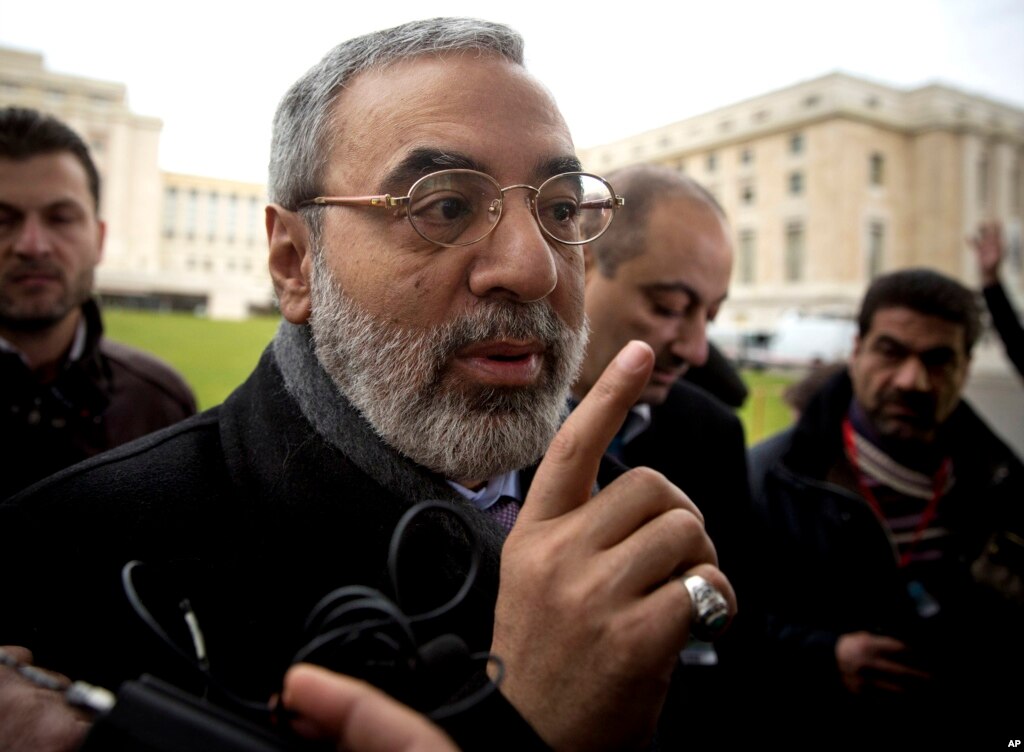
Syrian Information Minister Omran al-Zoubi gives a short press briefing upon his arrival to the UN headquarters in Geneva, Switzerland, Jan. 26, 2014, as Syria's government and opposition met for UN-mediated talks.


U.N. mediator Lakhdar Brahimi says Syrian government delegates, at peace talks in Geneva, have agreed to allow women and children to immediately leave a besieged district in the central city of Homs.

Homs is one of Syria's largest cities and has been pounded by government assaults to reclaim control from rebel forces.

The breakthrough followed two rounds of talks Sunday between the U.N. mediator and representatives of Syria's government and the opposition.

The early talks in Geneva, Switzerland, focused on the release of thousands of prisoners, including women, children and the elderly, from Syrian prisons. 

Brahimi told a press conference later Sunday the opposition has agreed to a government request for a list of detainees held by armed rebel groups.

Brahimi said he will meet the two sides jointly on Monday. The idea of forming a transitional governing body might come up then.

Read More Here

.....


Syria talks: Civilians to be allowed out of Homs old city


Man walk through damaged buildings in the besieged area of Homs The old city of Homs has been under siege by government forces

Syria will allow women and children to leave the besieged area of Homs "from now", the UN mediator at the Geneva peace talks has told reporters.

Syrian Deputy Foreign Minister Faisal Mekdad said women and children were free to leave. He said armed groups were preventing them from leaving.

Mr Brahimi said that the opposition had agreed to give the government lists of detainees held by armed groups.

He said it was "too early" to assess the prospects of a comprehensive deal.

Mr Brahimi said he hoped a humanitarian convoy from the UN and the Red Cross would be able to go to Homs on Monday.

Mr Mekdad said he hoped arrangements could be made with local officials to allow the convoy access but that the aid must not fall into "the hands of terrorists", the term Syrian officials for all armed opposition.

Lakhdar Brahimi said that the government would allow women and children to leave immediately but had asked for a list of adult male civilians who wanted to leave to ensure they were not fighters.

.....

Related Articles

.....

Syria talks mediator presses for deal to allow aid into Homs

Government and opposition negotiators struggling to agree on local ceasefire sought by Lakhdar Brahimi at Geneva talks
Lakhdar Brahimi
Lakhdar Brahimi is representing the UN and Arab League at the Syria talks in Geneva. Photograph: Salvatore Di Nolfi/EPA
Syrian government and opposition negotiators are struggling to agree on a local ceasefire to allow humanitarian relief supplies into Homs, on the second day of UN-mediated talks about confidence-building measures.
Lakhdar Brahimi, the Algerian diplomat representing the UN and Arab League, is trying to nail down an agreement allowing aid through to a rebel-held area of the central Syrian town. But government officials said the talks in Geneva did not need to deal with the issue, underlying their unhappiness with the conference, which is seeking to end a war that has claimed 130,000 lives and made two million people refugees.
Brahimi said on Saturday that the negotiations had got off to a "good beginning", but said the two sides were speaking only through him and not directly to each other.
In Sunday's first session the format was the same. In the afternoon the teams convened in separate rooms at the UN HQ, with the veteran mediator shuttling between them.
In the morning, opposition delegates placed on an empty chair a photograph of Abdel-Aziz al-Khayr, of the moderate Damascus-based National Co-ordination Bureau, who was detained in 2012, probably by the regime. The point was to demonstrate how Bashar al-Assad's repression targeted even his mildest critics.
Munzer Aqbiq, spokesman for the western-backed Syrian Opposition Coalition (SOC), accused Assad of stalling on the Homs aid convoy. Buthaina Shaaban, the president's media adviser, said the matter was being dealt with in Damascus. Western diplomats said the official Syrian delegation had denied knowing about the relief plan – which was drawn up with input from the US and Russia, as well as the UN and Red Cross – when it was raised.

Read More Here

.....

Enhanced by Zemanta

Sunday, January 26, 2014

Syria foes 'to meet face-to-face' at Geneva II talks


UN envoy Lakhdar Brahimi: "The huge ambition of this project is to save Syria, no less than that"


Syria's opposition and government will meet "in the same room" in Geneva on Saturday after the first day of a peace conference ended with no direct talks.

UN envoy Lakhdar Brahimi, who held talks with both sides on Friday, said they all understood that the conference was trying to "save Syria".

The two sides have blamed each other for a lack of progress.

Diplomats say they are now aiming at small concessions such as local truces rather than an overall peace deal.

An unnamed source at the talks told Reuters news agency that the two sides had agreed to spend the next 48 hours discussing humanitarian access to the besieged city of Homs.
Lakhdar Brahimi's announcement that the two sides will, after all, meet face-to-face is the first genuinely positive moment since these talks began on Wednesday.
Just a few hours earlier it looked as if Geneva II would end as it started, amid rancour and accusations. The Syrian government threatened to leave, and the opposition continued to insist it did not even want to see government representatives unless they agreed that President Assad had no place in a future transitional government.
Somehow, in separate talks, Mr Brahimi managed to persuade them to stay. The first face-to-face meeting is now scheduled for Saturday morning. If it goes well, there may be further meetings in the afternoon.
Exactly what will be discussed remains unclear: if the two sides focus on better access for aid agencies, or even some temporary local ceasefires, then progress may be made. If they continue to make President Assad's future their starting point, they may get nowhere. As Mr Brahimi said, no-one expected these talks to be easy.

"The practical aspects have been worked on, things are ready and if the government doesn't put a block on it then it could happen quickly," said the source.

Supporters of President Bashar al-Assad have surrounded rebels in Homs, besieging the central areas of the city for more than a year.
'Encouraging discussions'
The delegates are reportedly still not prepared to talk to each other directly, but are expected to communicate via Mr Brahimi.

"Tomorrow everybody will be in the same room but everybody will address Mr Lakhdar Brahimi," Louay Safi, a spokesman for the opposition Syrian National Coalition, told reporters late on Friday.

Preliminary talks began on Wednesday in Montreux, and Mr Brahimi spent Thursday and Friday attempting to persuade both sides to agree to meet face-to-face.

Friday was supposed to be the first day of official talks, but neither side would meet the other.

Read More Here

Syria conflict

.....

Syria's foreign minister threatens to walk out of peace talks

Walid Muallem says he will leave Geneva unless 'serious' talks begin by Saturday, as UN mediator meets both sides separately
Syria's foreign minister Walid Muallem arrives at the UN in Geneva to meet mediator Lakhdar Brahimi
Syria's foreign minister and head of the government negotiating team, Walid Muallem (centre), arrives at the UN in Geneva to meet mediator Lakhdar Brahimi. Photograph: Philippe Desmazes/AFP/Getty Images
Long-awaited direct peace talks between the Syrian government and rebels fighting to overthrow President Bashar al-Assad failed to get under way as expected on Friday morning after Damascus insisted on ending "terrorism" before seeking a political solution to end nearly three years of war and misery.
The UN mediator Lakhdar Brahimi was meeting both sides separately in Geneva for the second consecutive day to iron out procedural and agenda issues before a first round of negotiations at the Palais des Nations.
But Walid Muallem, Syria's foreign minister and head of its delegation, raised the stakes by warning that he would return to Damascus unless serious talks began by Saturday, Syrian state TV reported.
Face-to-face talks were due to follow on from where Wednesday's 40-nation international conference in nearby Montreux left off. It would be the first direct contact between the opposing parties since the anti-Assad uprising began in March 2011. An estimated 130,000 people have been killed since then, 2 million Syrians have fled abroad and a total of 9 million are in urgent need of humanitarian assistance.
Angry remarks in Montreux by Muallem left the western-backed Syrian Opposition Coalition (SOC) claiming that it alone was committed to the 2012 agreement – known as Geneva I – to create a "transitional governing body". Assad, president since succeeding his father in 2000, has insisted repeatedly that he will not step down. The opposition says he must go. Brahimi's problem is how to square that circle.

Read More Here

.....
Enhanced by Zemanta

Tuesday, January 14, 2014

Syria crisis: US and Russia discuss possible ceasefires


BBC News


US Secretary of State John Kerry (C). Russian Foreign Minister Sergei Lavrov (R) and UN-Arab League envoy for Syria Lakhdar Brahimi in Paris
Mr Kerry (C) and Mr Lavrov (R) met in Paris, along with Mr Brahimi (L)
The US and Russia have discussed the possibility of "localised ceasefires" in Syria ahead of peace talks to be held in Switzerland next week.
Russia also said Syria was considering opening humanitarian access to besieged rebel areas.
A prisoner exchange is also under consideration, US Secretary of State John Kerry and Russian Foreign Minister Sergei Lavrov said.
The two men are in Paris to discuss arrangements for the Geneva talks.
"We talked today about the possibility of trying to encourage a ceasefire, maybe a localised ceasefire in Aleppo," Mr Kerry told a news conference after talks with Mr Lavrov and Lakhdar Brahimi, the UN and Arab League envoy for Syria.
Both Mr Kerry and Lavrov said they hoped ceasefires could be in place before the talks, along with plans for prisoner exchanges and the opening of humanitarian corridors.
Mr Kerry said it was up to the Syrian government to show they were serious.
"I'm pleased to say that Foreign Minister Lavrov indicated that he's had some conversations with the [Syrian] regime, that the regime may be prepared to open up a number of areas, specifically al-Gouta which we have been pushing for for some period of time, and it may be possible for convoys now to be able to access," he said.

Read More Here


.....


UPDATE 2-U.S. and Russia say Syria aid access and local ceasefire possible


Mon Jan 13, 2014 2:31pm GMT

By Warren Strobel
Jan 13 (Reuters) - Syria's government and some rebels may be willing to permit humanitarian aid to flow, enforce local ceasefires and take other confidence-building measures in the nearly three-year-old civil war, U.S. Secretary of State John Kerry said on Monday.
Kerry said that he and Russian Foreign Minister Sergei Lavrov "talked today about the possibility of trying to encourage a ceasefire. Maybe a localized ceasefire, beginning with Aleppo," Syria's largest city. "And both of us have agreed to try to work to see if that could be achieved."
Syrian rebels backed by Washington have agreed that, if the government commits to such a partial ceasefire, "they would live up to it", Kerry said.
Given the history of failed attempts to end the war, which has killed more than 100,000 people and displaced millions, it remains far from clear that even a partial ceasefire can be achieved or, if it is, can hold.
It also seems unlikely to be honored by powerful militant islamist rebel factions, some of whom are at war with both Damascus and other rebel groups backed by the West and Gulf states.
But diplomats are trying to persuade the combatants to agree to a series of steps to improve the atmosphere for Syrian peace talks planned for Switzerland on Jan. 22.
Kerry spoke at a press conference in Paris with Lavrov and Lakhdar Brahimi, the U.N. Secretary General's top Syria envoy.
Lavrov, whose government backs Assad, said the Syrian government had indicated it might provide access for humanitarian aid to reach besieged areas. He specifically cited the Damascus suburb of eastern Ghouta, where 160,000 people have been largely trapped by fighting, according to the United Nations.
"We await similar steps by the opposition," Lavrov said.
Kerry expressed some scepticism that Assad's government would follow through.
"The proof will be in the pudding, as we say," he said. "This news of a possibility is welcome."

Read More Here

.....
Enhanced by Zemanta

US, Russia Split Over Inviting Iran to Syria Talks


VOA


Syrian President Bashar al-Assad has no bigger ally than Iran.  So his government says it expects Iran will be invited to planned peace talks in Geneva "just like any other state."
The international mediator to the conflict, Lakhdar Brahimi, agrees.
"Iran is a very important country in the region and they have to be present in a conference like this," he said.
But while the United Nations is responsible for sending the invitations, Brahimi says he is working in consensus with the main organizing partners: Russia and the United States.
But the U.S. says Iran must first agree to the establishment of a transitional Syrian government by "mutual consent" which presumes that President Assad's opponents would never agree to his joining an interim government and would thus end his rule.
  •  
  •  
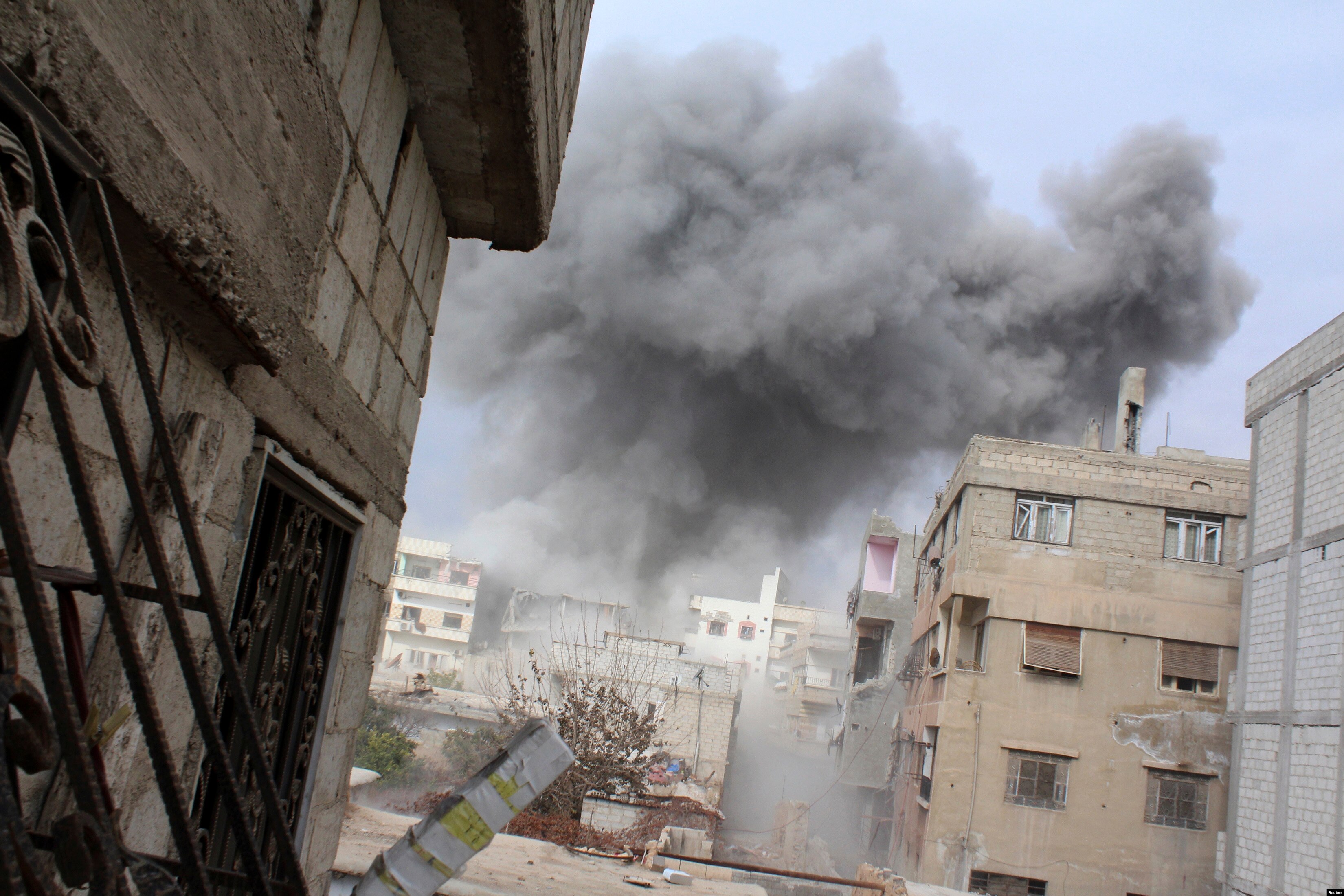
  • Smoke rises from what activists said were explosive barrels thrown from helicopters on Daria outside Damascus, Jan. 12, 2014.


Read More and Watch Video Here
Enhanced by Zemanta