Showing posts with label Geneva. Show all posts

Thursday, May 15, 2014

Torture committee dismisses Holy See's argument that its obligation to enforce UN treaty stops at boundaries of city state

File:Vaticano 34.jpg

The  Vatican  - View from Castel Sant'Angelo
By  :  Jorge Valenzuela A
wikimedia.org
.....

Vatican tries to draw line under clerical sex abuse scandals at UN hearing


The Vatican has been given another hostile interrogation by a United Nations committee over its record on clerical sex abuse.
One member after another of the committee against torture brushed aside the Holy See's argument that its obligation to enforce the UN convention against torture stopped at the boundaries of the world's smallest country, the Vatican City state. They demanded the pope's representative give answers to a long list of questions about the treatment of sex abuse claims against clergy throughout the world.
The Holy See, which long predates the city state, is a sovereign entity without territory. It is as the Holy See that the Catholic leadership maintains diplomatic relations and signs treaties such as the convention against torture.
But Archbishop Silvano Tomasi, the Vatican's UN ambassador in Geneva, told the committee: "The Holy See intends to focus exclusively on Vatican City state."
The American expert on the committee, Felice Gaer, made plain her disagreement. She said the Holy See had to "show us that, as a party to the convention, you have a system in place to prohibit torture and cruel, inhuman and degrading punishment when it is acquiesced to by anyone under the effective control of the officials of the Holy See and the institutions that operate in the Vatican City state".

Read More and  Watch Video Here

.....

Vatican faces tough questions at UN torture committee

Vatican to answer questions on past, present and future handling of clerical sex abuse

 Archbishop Silvano Tomasi, (R), Apostolic Nuncio, Permanent Observer of the Holy See  to the Office of the United Nations in Geneva, and Vincenzo Buonomo, (L), of the Secretariat of State of the Holy See   prior to the UN torture committee hearing on the Vatican, at the headquarters of the office of the High Commissioner for Human Rights  in the Palais Wilson, in Geneva, Switzerland. Photograph:  Salvatore Di Nolfi/EPAArchbishop Silvano Tomasi, (R), Apostolic Nuncio, Permanent Observer of the Holy See to the Office of the United Nations in Geneva, and Vincenzo Buonomo, (L), of the Secretariat of State of the Holy See prior to the UN torture committee hearing on the Vatican, at the headquarters of the office of the High Commissioner for Human Rights in the Palais Wilson, in Geneva, Switzerland. Photograph: Salvatore Di Nolfi/EPA
Tue, May 6, 2014, 01:00
As expected, a Holy See delegation faced tough questioning at the UN’s Committee Against Torture in Geneva yesterday. For the second time in three months, the Vatican was appearing before a UN body to answer questions about its ratification of a UN treaty, especially with regard to is past, present and future handling of clerical sex abuse.
In his opening address to the committee, Archbishop Silvano Tomasi, the Holy See’s permanent representative at the UN in Geneva, argued that while the Holy See lent “its moral support and collaboration . . . to the elimination of torture”, it had signed the torture convention in 2002 “on behalf of the Vatican city state”.

No jurisdictionArchbishop Tomasi said he intended to “focus exclusively on the Vatican city state”, the 100 -acre statelet that surrounds the Basilica of St Peter’s.
In that sense, he claimed, the Holy See had “no jurisdiction over every member of the Catholic Church”. Rather, he said, persons who “live in a particular country are under the jurisdiction of the legitimate authorities of that country and are thus subject to the domestic law [of that country]”.

Inevitably, that assertion prompted a critical reaction from the UN committee, with US human rights activist Felice Gaer accusing Archbishop Tomasi of making an “alleged distinction” between the Holy See and the Vatican city state.
She questioned the Holy See’s apparent assumption that the torture convention applied only to the “four corners of Vatican City”, saying that as far as she could see, Vatican City was simply a “sub-division” of the Holy See.

Read More Here
.....
Enhanced by Zemanta

Saturday, April 19, 2014

In Ukraine, Pro-Russia Radicals Reject Call To Leave Occupied Buildings. They claim they will comply only if the pro-Western government in Kyiv resigns.


Play Video|0:25

Pro-Russia Militant Rejects Ukraine Pact


The leader of a group of pro-Russia separatists, Denis Pushilin, said he would ignore the diplomatic pact between Russia and Ukraine to de-escalate the crisis.
Credit Sergei Grits/Associated Press

KIEV, Ukraine — An American-backed deal to settle the crisis in eastern Ukraine fell flat on Friday as pro-Russian militants vowed to stay in occupied government buildings, dashing hopes of a swift end to an insurgency that the authorities in Kiev portray as a Kremlin-orchestrated effort to put Ukraine’s industrial heartland under Russian control.
But the agreement, reached in Geneva on Thursday by diplomats from the European Union, Russia, Ukraine and the United States, appeared to arrest, at least temporarily, the momentum of separatist unrest in Ukraine’s Russian-speaking east. Armed pro-Russian militants, who have seized buildings in at least 10 towns and cities since Feb. 6, paused their efforts to purge all central government authority from the populous Donetsk region.


It was clear all along that for the pact to have a chance of success, the Kremlin would have to pressure the militants to leave the buildings they had seized. So far, it has shown no inclination to do so, blaming the Ukrainian government for the turmoil and denying that Russia has any ties to the rebels.
With militants vowing to ignore the agreement but halting what had been a daily expansion of territory under their control, officials in Kiev, the capital, voiced some hope that a settlement was still possible. They were skeptical, however, about Russia’s willingness to push the separatists to disarm and vacate occupied buildings.
“If Russia is responsible before not just Ukraine but the world community, it should prove it,” said Andrii Deshchytsia, the acting Ukrainian foreign minister, who took part in the Geneva talks.
Western officials said the United States planned to reassure Eastern European members of NATO by conducting company-size — about 150 soldiers — ground force exercises in Estonia and Poland. The exercises would last a couple of weeks and would most likely be followed by other troop rotations in the region.
In a sign of the chasm separating Russian and Ukrainian views, Russia’s Foreign Ministry issued a statement on Friday that made no mention of the pro-Russian militants driving the unrest. It said the call for militants to disarm “meant in the first place” the disarming of Ukrainian nationalist groups hostile to Russia, like Right Sector “and other pro-fascist groups which took part in the February coup in Kiev.”
The state-run Russian television channel, Rossiya, reporting from an occupied building in Horlivka in the Donetsk region, featured a masked gunman who pledged to “fight to the end for his convictions.” He displayed an armband emblazoned with a swastika-like symbol, which he said had been seized from supporters of the Ukrainian government.
Doubts about the Kremlin’s readiness to push pro-Russian militants to surrender their guns have been strengthened by its insistence that it has no hand in or control over the separatist unrest, which Washington and Kiev believe is the result of a covert Russian operation involving, in some places, the direct action of special forces.
“I don’t know Russia’s intentions,” Mr. Deshchytsia said, noting that during the negotiations, Russia’s foreign minister, Sergey V. Lavrov, had repeatedly asserted “that Russia was not involved.” He said Mr. Lavrov had been “cooperative and aggressive at the same time.”
 Russia’s denials have stirred concerns that it went along with the agreement not to curb the turmoil in eastern Ukraine, but to blunt American and European calls for tougher sanctions that could severely damage Russia’s already sickly economy. Western sanctions have so far been limited to a travel ban and asset freeze on a few dozen individuals and a Russian bank.
Secretary of State John Kerry called Mr. Lavrov on Friday and urged Russia to ensure “full and immediate compliance” with the agreement, a senior State Department official said. Mr. Kerry, the official added, “made clear that the next few days would be a pivotal period for all sides to implement the statement’s provisions, particularly that all illegal armed groups must be disarmed and all illegally seized buildings must be returned to legitimate owners.”

Read More Here

.....

In Ukraine, Pro-Russia Radicals Reject Call To Leave Occupied Buildings

By RFE/RL
Pro-Russia radicals occupying official buildings in eastern Ukraine say they will only leave if the pro-Western government in Kyiv resigns.

Denis Pushilin, the self-declared leader of the radicals in Donetsk, told reporters on April 18 that he did not consider his men bound by a compromise agreement between Russia and Ukraine to disarm and vacate occupied buildings.

The agreement was reached at four-party talks on April 17 in Geneva also involving the United States and the European Union.

Pushilin said the government in Kyiv was illegitimate and also must vacate public buildings that he said it was occupying illegally.

Local media reports on April 18 said none of the government buildings seized across eastern Ukraine had yet been vacated.

Ukrainian Prime Minister Arseniy Yatsenyuk told parliament on April 18 that the government had drafted a law that would offer an amnesty to insurgents who would lay down their arms and leave the occupied buildings.


.....
Enhanced by Zemanta

Wednesday, March 19, 2014

US criticised by UN for human rights failings on NSA, guns and drones

Geneva panel share deep concerns over US record on host of different subjects, including racial inequality and Guantánamo

Guantanamo Bay was criticised in the report
Guántanamo Bay. The head of the US delegation to Geneva said the country was ‘continually striving to improve’. Photograph: Brennan Linsley/AP
The US came under sharp criticism at the UN human rights committee in Geneva on Thursday for a long list of human rights abuses that included everything from detention without charge at Guantánamo, drone strikes and NSA surveillance, to the death penalty, rampant gun violence and endemic racial inequality.
At the start of a two-day grilling of the US delegation, the committee’s 18 experts made clear their deep concerns about the US record across a raft of human rights issues. Many related to faultlines as old as America itself, such as guns and race.
Other issues were relative newcomers. The experts raised questions about the National Security Agency’s surveillance of digital communications in the wake of Edward Snowden’s revelations. It also intervened in this week’s dispute between the CIA and US senators by calling for declassification and release of the 6,300-page report into the Bush administration’s use of torture techniques and rendition that lay behind the current CIA-Senate dispute.
The committee is charged with upholding the International Covenant on Civil and Political Rights (ICCPR), a UN treaty that the US ratified in 1992. The current exercise, repeated every five years, is a purely voluntarily review, and the US will face no penalties should it choose to ignore the committee’s recommendations, which will appear in a final report in a few weeks’ time.
But the US is clearly sensitive to suggestions that it fails to live up to the human rights obligations enshrined in the convention – as signalled by the large size of its delegation to Geneva this week. And as an act of public shaming, Thursday’s encounter was frequently uncomfortable for the US.
The US came under sustained criticism for its global counter-terrorism tactics, including the use of unmanned drones to kill al-Qaida suspects, and its transfer of detainees to third countries that might practice torture, such as Algeria. Committee members also highlighted the Obama administration’s failure to prosecute any of the officials responsible for permitting waterboarding and other “enhanced interrogation” techniques under the previous administration.
Walter Kälin, a Swiss international human rights lawyer who sits on the committee, attacked the US government’s refusal to recognise the convention’s mandate over its actions beyond its own borders. The US has asserted since 1995 that the ICCPR does not apply to US actions beyond its borders - and has used that “extra-territoriality” claim to justify its actions in Guantánamo and in conflict zones.


Read More Here
.....

US responds to Guantánamo Bay and NSA criticisms made by UN committee

• Geneva delegation defends US record
• UN human rights body checks ICCPR commitments

Guantánamo Bay
Answering UN criticisms of detentions at Guantánamo Bay, the US delegation said: ‘It is the policy of the US to support the preservation of life in a humane manner.’ Photo: John Moore/Getty Images
The US has put up its defence at the United Nations in Geneva over charges that it is guilty of widespread human rights violations, claiming that the military commissions at Guantanámo Bay meet – and exceed – fair trial standards and that agencies engaging in mass surveillance are subject to “rigorous oversight”.
The US delegation delivered its rebuttal on Friday to the strong criticism it has faced from members of the UN human rights committee. Over two days, the committee has pressed hard questions about the US human rights record, from National Security Agency data mining to racial discrimination and rampant gun violence.
The interaction between the US and the committee is part of a process, completed every five years, to review whether the country is meeting its commitments under the International Covenant on Civil and Political Rights (ICCPR), which the US ratified in 1992. At the end of the process, the committee will produce a non-binding final report that is aimed at encouraging the US at all levels of government to improve its policies in areas of perceived weakness.
US officials sought to fend off the committee’s criticisms, focusing particularly on Guantánamo and the mass dragnet of data exposed by Edward Snowden. The delegation insisted that the 154 detainees still being held in Guantánamo are there “lawfully both under international law and US law”.
Officials disputed that any of the detainees had been “cleared for release”. Rather, they were subject to review board assessments every six months to see whether “continued lawful detention is necessary to protect against a continuing threat against the US”.
Just three days after the first Guantánamo detainee lodged the first legal challenge to force feeding at the base in a US federal court, alleging he had been subjected to a form of torture known as the “water cure”, the US delegation in Geneva claimed detainees had “access to exceptional healthcare” and said: “It is the policy of the US to support the preservation of life in a humane manner.”


Read More Here
Enhanced by Zemanta

Tuesday, February 11, 2014

Damascus confirms it will attend next round of peace talks

WAR REPORT

by Staff Writers
Damascus (AFP) Feb 07, 2014

Syria's deputy foreign minister, Faisal Muqdad, said on Friday that Damascus will take part in a second round of peace talks in Geneva due to start on February 10.
"It has been decided that the delegation of the Syrian republic will take part in the second round of negotiations in Geneva," state news agency SANA quoted Muqdad as saying.
"The Syrian delegation wishes to pursue the efforts it deployed during the first round in Geneva, and insists that the discussions focus on all clauses in the Geneva I communique, beginning with the first clause," he said.
Ten days of talks in Switzerland last month between government and opposition delegations yielded no tangible results, and Damascus had said it was unsure whether it would return to the negotiating table.
Despite persistent pressure from UN-Arab League envoy Lakhdar Brahimi, and cosponsors Russia and the United States, the two sides failed to agree on a single point.
Read More Here
Enhanced by Zemanta

Tuesday, February 4, 2014

"The US has proposed to include five participants into a parallel track: Russia, the United States, Saudi Arabia, Turkey and Iran," the report says

US suggests engaging Saudi Arabia, Turkey and Iran in Syria talks – newspaper
Photo: EPA

During the Munich meeting between Russian Foreign Minister Sergei Lavrov and US Secretary of State John Kerry, the American side suggested creating an additional mechanism to promote the Syrian settlement, the Moscow-based Kommersant newspaper writes in its Tuesday edition.

The newspaper quotes a Russian diplomatic source as saying that the case in point is a regional format that should expand the number of participants in the Geneva-2 peace conference on Syria.
"The Americans have proposed to include five participants into a parallel track: Russia, the United States, Saudi Arabia, Turkey and Iran," the report says.
Russia and the US play a leading role in the Syrian settlement. Saudi Arabia and Turkey are the main sponsors of opponents of the regime, while Iran is its key ally.
"The Russian side has on the whole welcomed the proposal. Last year, Moscow itself initiated a regional negotiation format in addition to inter-Syrian dialogue, but back then the United States deemed it inexpedient. Now the US side has come up with the same idea," Kommersant reports.
The newspaper links a change in Washington's position to the results of the first round of Geneva-2.
Russian Foreign Minister Sergei Lavrov described those results as "modest but encouraging."
Moscow has hailed as positive the fact that the Syrian conflicting parties sat down at the negotiating table within the Geneva-2 framework and that none has "slammed the door" so far.
UN and Arab League special envoy for Syria Lakhdar Brahimi sounded more pessimistic. "Unfortunately, we have achieved nothing," Brahimi told reporters in Munic. He voiced hope that the next round of Geneva-2, scheduled for February 10, would take place in a more constructive atmosphere.
Washington apparently doubts that, hence its latest offer.
So far, it's not very clear whether it’s about a parallel conference involving regional players or a kind of permanent communication channel between them.
A Kommersant diplomatic source in a leading European country has described the US proposal as "useful."
"Any means that can stop the bloodshed should be used," the source said. He believes that the European Union – "Syria’s key humanitarian aid donor" – should also have a part in the future regional talks.
"It would be wrong to underestimate the positive role the Europeans could play in that process," the diplomat said.
However, considering how hard convening Geneva-2 proved to be, organizing regional talks may also be a challenge.
Voice of Russia, Interfax
Enhanced by Zemanta

Friday, January 31, 2014

US spy chiefs say number of foreign militants in Syria rises ..... Meanwhile, US arms keep flowing into Syria. Hmmmmm.....

NBC World News

US spy chiefs say number of foreign militants in Syria rises


Militant Website / AP
This undated image posted on a militant website on Tuesday, Jan. 14, 2014, shows fighters from the al Qaeda-linked Islamic State of Iraq and the Levant (ISIL) marching in Raqqa, Syria.
More than 7,000 foreign militants are fighting for the rebels in Syria's civil war and some are being trained to return home and conduct attacks, U.S. spy chiefs told lawmakers on Wednesday.
The estimate, given at a Senate intelligence hearing, was much higher than earlier figures of 3,000 to 4,000 foreign fighters in Syria, and came after news emerged this week that Congress had secretly approved more funding to send weapons to "moderate" rebels.
"We estimate, at this point, an excess of 7,000 foreign fighters have been attracted from some 50 countries, many of them in Europe and the Mideast," James Clapper, the U.S. director of national intelligence, told the hearing.
"And this is of great concern not only to us, but to those countries," he said at the Senate Intelligence Committee's annual hearing on global security threats. 
U.S. spy agencies had not previously made the figure of 7,000 public, though it has appeared in classified intelligence reports, a U.S. official said.

Read More Here

.....

US arms flow hinders Geneva II talks on Syria: Analyst


The ongoing Geneva II talks on the crisis in Syria will fail to yield “concrete” results as long as the United States continues to support the militancy in the Arab state, an analyst tells Press TV.
In a Thursday interview with Press TV, William Jones, with the Executive Intelligence Review, described Washington’s decision to send more arms to the militants in Syria as a “contradictory policy.”
According to Jones, the ongoing Geneva II conference, aimed at containing the crisis in Syria, will not “lead to anything concrete as long as there’s a policy of supporting the violence in the region.”
“They (Americans) are feeding in more guns and ammunition. The violence will increase and it’s hard to see how [Geneva II] negotiations under those circumstances can lead to a lasting peace,” added the analyst.
Jones made the statements after Reuters reported earlier this week that lawmakers in the US Congress had secretly approved the provision of US arms to the Takfiri militants fighting against the Syrian government.
Reports also say the US increased more than twice its supply of light weaponry and munitions to the militants linked to the so-called Free Syrian Army (FSA)’s Supreme Military Command in the month of January. The military command is aligned with the Western-backed opposition Syrian National Coalition (SNC).
The Geneva II meeting, which opened in Switzerland on January 22, has already hit a deadlock amid sharp differences between the Syrian government and the foreign-backed opposition.
On Wednesday, UN-Arab League Special Representative for Syria Lakhdar Brahimi said there is a “quite large” gap between the rival sides in the Geneva II meeting. He has also said that the ongoing talks have not produced much.
MKA/HJL
Watch Video Here
.....
Enhanced by Zemanta

Monday, January 27, 2014

Syria Government Says Women, Children Can Leave Homs. Mediator presses for deal to allow aid into Homs

Syria Government Says Women, Children Can Leave Homs


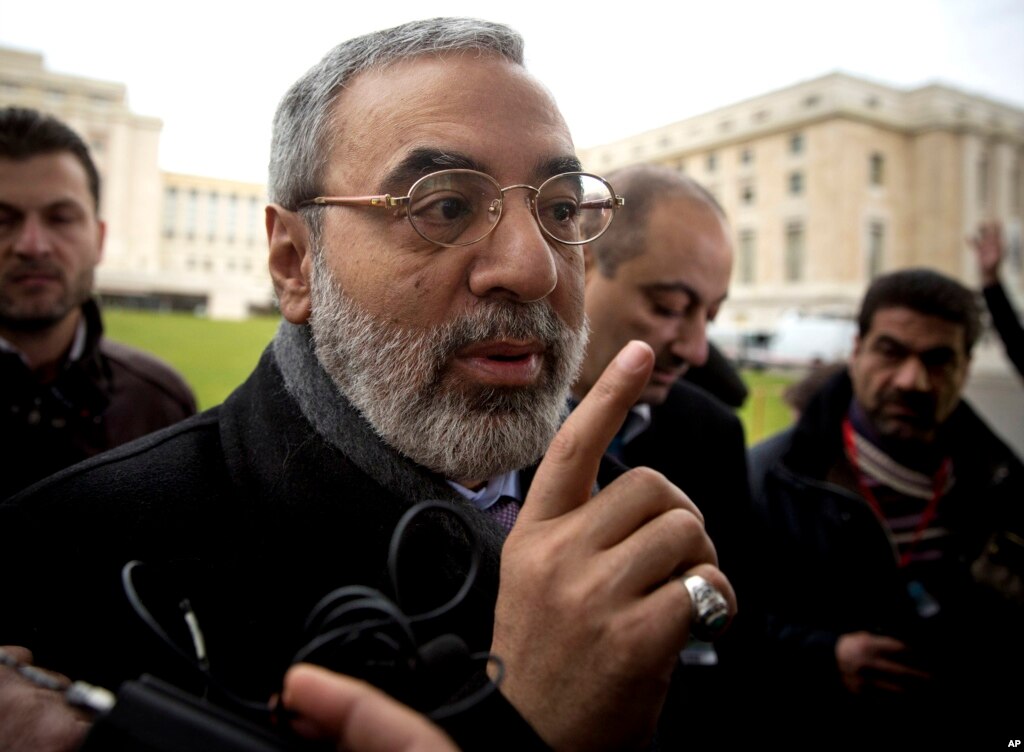
Syrian Information Minister Omran al-Zoubi gives a short press briefing upon his arrival to the UN headquarters in Geneva, Switzerland, Jan. 26, 2014, as Syria's government and opposition met for UN-mediated talks.


U.N. mediator Lakhdar Brahimi says Syrian government delegates, at peace talks in Geneva, have agreed to allow women and children to immediately leave a besieged district in the central city of Homs.

Homs is one of Syria's largest cities and has been pounded by government assaults to reclaim control from rebel forces.

The breakthrough followed two rounds of talks Sunday between the U.N. mediator and representatives of Syria's government and the opposition.

The early talks in Geneva, Switzerland, focused on the release of thousands of prisoners, including women, children and the elderly, from Syrian prisons. 

Brahimi told a press conference later Sunday the opposition has agreed to a government request for a list of detainees held by armed rebel groups.

Brahimi said he will meet the two sides jointly on Monday. The idea of forming a transitional governing body might come up then.

Read More Here

.....


Syria talks: Civilians to be allowed out of Homs old city


Man walk through damaged buildings in the besieged area of Homs The old city of Homs has been under siege by government forces

Syria will allow women and children to leave the besieged area of Homs "from now", the UN mediator at the Geneva peace talks has told reporters.

Syrian Deputy Foreign Minister Faisal Mekdad said women and children were free to leave. He said armed groups were preventing them from leaving.

Mr Brahimi said that the opposition had agreed to give the government lists of detainees held by armed groups.

He said it was "too early" to assess the prospects of a comprehensive deal.

Mr Brahimi said he hoped a humanitarian convoy from the UN and the Red Cross would be able to go to Homs on Monday.

Mr Mekdad said he hoped arrangements could be made with local officials to allow the convoy access but that the aid must not fall into "the hands of terrorists", the term Syrian officials for all armed opposition.

Lakhdar Brahimi said that the government would allow women and children to leave immediately but had asked for a list of adult male civilians who wanted to leave to ensure they were not fighters.

.....

Related Articles

.....

Syria talks mediator presses for deal to allow aid into Homs

Government and opposition negotiators struggling to agree on local ceasefire sought by Lakhdar Brahimi at Geneva talks
Lakhdar Brahimi
Lakhdar Brahimi is representing the UN and Arab League at the Syria talks in Geneva. Photograph: Salvatore Di Nolfi/EPA
Syrian government and opposition negotiators are struggling to agree on a local ceasefire to allow humanitarian relief supplies into Homs, on the second day of UN-mediated talks about confidence-building measures.
Lakhdar Brahimi, the Algerian diplomat representing the UN and Arab League, is trying to nail down an agreement allowing aid through to a rebel-held area of the central Syrian town. But government officials said the talks in Geneva did not need to deal with the issue, underlying their unhappiness with the conference, which is seeking to end a war that has claimed 130,000 lives and made two million people refugees.
Brahimi said on Saturday that the negotiations had got off to a "good beginning", but said the two sides were speaking only through him and not directly to each other.
In Sunday's first session the format was the same. In the afternoon the teams convened in separate rooms at the UN HQ, with the veteran mediator shuttling between them.
In the morning, opposition delegates placed on an empty chair a photograph of Abdel-Aziz al-Khayr, of the moderate Damascus-based National Co-ordination Bureau, who was detained in 2012, probably by the regime. The point was to demonstrate how Bashar al-Assad's repression targeted even his mildest critics.
Munzer Aqbiq, spokesman for the western-backed Syrian Opposition Coalition (SOC), accused Assad of stalling on the Homs aid convoy. Buthaina Shaaban, the president's media adviser, said the matter was being dealt with in Damascus. Western diplomats said the official Syrian delegation had denied knowing about the relief plan – which was drawn up with input from the US and Russia, as well as the UN and Red Cross – when it was raised.

Read More Here

.....

Enhanced by Zemanta