Showing posts with label Iran. Show all posts

Thursday, December 17, 2015

The EU says it may retaliate if the US goes ahead with plans to impose visas reform on members already part of the Visa Waiver Program.


EU warns of visas for US citizens if Washington implements visa waiver reforms

© Fred Greaves
The EU says it may retaliate if the US goes ahead with plans to impose visas for some members of the bloc who are currently part of the Visa Waiver Program. Brussels says it will not increase security and that US nationals may require visas to enter the EU.
A letter signed by 28 European member state ambassadors to the US was published in The Hill after Europe reacted furiously and with disbelief to plans by Washington to tighten-up the Visa Waiver Program (VWP), which currently lets millions of citizens from the bloc travel to the US each year without a visa.

OP-ED: EU warns of visas for US citizens if Washington implements visa waiver reforms

Last week, the US House of Representatives adopted a bill to reform the visa program that would ban certain EU nationals from entering the US without a visa if they had visited Iran, Iraq, Syria or Sudan after March 2011. Some US politicians want the legislation introduced to tighten security following the November 13 Paris terror attacks.

“A blanket restriction on those who have visited Syria or Iraq, for example, would most likely only affect legitimate travel by businesspeople, journalists, humanitarian or medical workers while doing little to detect those who travel by more clandestine means overland,” the letter signed by the 28 ambassadors stated.

At present, 23 of the EU’s 28 member states enjoy visa-free travel to the US, with the remaining five nations keen to join the VWP. The bloc says it is imperative to keep the visa waiver program intact for business and tourism purposes, while the current system does not mean that it is “a license to enter the US with nothing more than the wave of a passport of an allied country.”


Read More Here

Wednesday, November 11, 2015

The jig is up! Putin , promises swift response as he acknowledges US missile defense aimed at neutralizing Russia nukes. N.Korea and Iran just a cover story.

 photo FamilySurvivalProtocolColliseumBannergrayscale900x338_zpsb17c85d0.jpg
.............................................................................................

Putin: US missile defense aimed at neutralizing Russia nukes, N. Korea & Iran just a cover

Russian President Vladimir Putin. © Alexei Druzhinin
Vladimir Putin said the US is trying to “neutralize Russia’s nuclear potential” with its on-going deployment of a missile defense shield in Europe. The Russian president has promised a response.
“References to Iran and North Korea nuclear threats are just a cover for the true purpose [of NATO missile defense]. That is to neutralize the potential of other nuclear states not the US or its allies – primarily Russia,” Putin said during a meeting in Sochi dedicated to national military development. “The US is attempting to achieve strategic military superiority, with all the consequences that entails.”

Vladimir Putin has reminded that Iran reached a landmark nuclear deal with world powers in July. The agreement would remove sanctions that have crippled its economy, in exchange for severe restrictions on Tehran’s nuclear program.

Russia has been repeatedly told Iran is the main threat.

“Now, the Iranian problem is off the table – treaties have been signed and ratified. Yet, the work on missile defense continues, as before,” Putin said.

The Russian leader promised Russia would take the “necessary measures to respond by strengthening its own missile defense.”

“And at the first stage we are also going to develop strike weapons that can penetrate any missile defense shield.”


Read More Here

Sunday, November 1, 2015

Iran's Defense Minister : The Iranian Armed Forces always stand ready to respond to any malicious moves by the US and the Israeli regime.


 photo FamilySurvivalProtocolColliseumBannergrayscale900x338_zpsb17c85d0.jpg
 ............................................................................
Sat Oct 31, 2015 5:6PM
 
 
Iran's Defense Minister Brigadier General Hossein Dehqan
Iran's Defense Minister Brigadier General Hossein Dehqan says the Iranian Armed Forces always stand ready to respond to any malicious moves by the US and the Israeli regime.
The Islamic Republic of Iran will continue to “boost its defense capability” and is prepared to respond to any mischievous acts by Washington and Tel Aviv, Dehqan said on Saturday.
He said the preparedness of the Iranian Armed Forces is based on its defense doctrine and the need to counter threats and also in line with its policy to support the anti-Israeli resistance movement in all fields.


He made the remarks in response to statements made by Israel's Minister of Military Affairs Moshe Ya'alon and US Defense Minister Ashton Carter regarding a nuclear agreement reached between Iran and six world powers in mid-July and the possibility of a military action against the Islamic Republic in case of Iran’s alleged non-compliance with the agreement.

Speaking at a joint press conference in Washington on October 28, Carter claimed that the agreement between Iran and the P5+1 countries removed “just one source of uncertainty and risk.”


Read More Here

Friday, October 30, 2015

Putin Makes Obama an Offer He Can’t Refuse


CounterPunch


ap_putin_obama_looking_away_thg-130831_16x9_992

Why is John Kerry so eager to convene an emergency summit on Syria now when the war has been dragging on for four and a half years?

Is he worried that Russia’s air campaign is wiping out too many US-backed jihadis and sabotaging Washington’s plan to topple Syrian President Bashar al Assad?

You bet, he is. No one who’s been following events in Syria for the last three weeks should have any doubt about what’s really going on.  Russia has been methodically wiping
out Washington’s mercenaries on the ground while recapturing large swathes of land that had been lost to the terrorists.  That, in turn, has strengthened Assad’s position in Damascus and left the administration’s policy in tatters.  And that’s why Kerry wants another meeting with Russian Foreign Minister Sergei Lavrov pronto even though the two diplomats met less than a week ago.   The Secretary of State is hoping to cobble together some kind of makeshift deal that will stop the killing and salvage what’s left of Uncle Sam’s threadbare Syrian project.

On Tuesday, Reuters reported that Iran had been invited to the confab which will be held in Vienna on Thursday.  The announcement is bound to be ferociously criticized on Capital Hill, but it just shows to what extent Russia is currently setting the agenda. It was Lavrov who insisted that Iran be invited, and it was Kerry who reluctantly capitulated. Moscow is now in the drivers seat.

And don’t be surprised if the summit produces some pretty shocking results too, like a dramatic 180 on Washington’s “Assad must go” demand.   As Putin has pointed out many times before, Assad’s not going anywhere. He’s going to be a part of Syria’s “transitional governing body”  when the Obama team finally agrees to the Geneva Communique which is the political track that will eventually end the fighting, restore security, and allow millions of refugees to return to their homes.


Read More Here

Saturday, October 17, 2015

Iran has rejected U.S. and French allegations that its recent long-range missile test violates United Nations resolutions


Voice Of America

Iran: Missile Test Not in Violation of UN Resolution

 
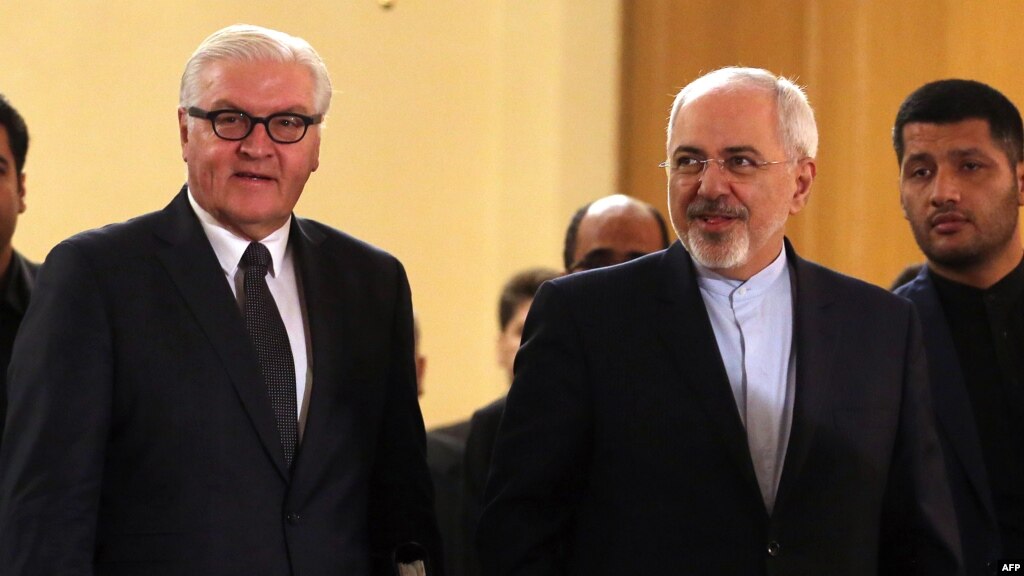
Iranian Foreign Minister Mohammad Javad Zarif (C-R) welcomes with his German counterpart Frank-Walter Steinmeier (C-L) in Tehran, Oct. 17, 2015.
 
Lou Lorscheider
 
Iran has rejected U.S. and French allegations that its recent long-range missile test violates United Nations resolutions, saying the Security Council restrictions only apply to missiles designed to carry nuclear warheads.

Speaking Saturday in Tehran, Foreign Minister Mohammad Javad Zarif said "none of the Islamic Republic of Iran's missiles have been designed for nuclear capabilities."

"The Islamic Republic of Iran has proved and shall prove again that nuclear weapons have no place in our defense doctrines and never shall have a place, therefore our missiles have never been designed for carrying nuclear warheads because we have never planned on having nuclear warheads and shall not either," said Zarif.

Zarif's comments came a day after U.S. Ambassador Samantha Power referred to the October 10 launch of a medium-range missile.  She said the missile was "inherently capable of delivering a nuclear weapon," and said Washington will respond with “appropriate action” in the U.N. Security Council.


Read More Here

Tuesday, October 13, 2015

Iraq has begun bombing Islamic State insurgents with help from a new intelligence center with staff from Russia, Iran and Syria


REUTERS

Iraq using info from new intelligence center to bomb Islamic State: official

Iraq has begun bombing Islamic State insurgents with help from a new intelligence center with staff from Russia, Iran and Syria, a senior parliamentary figure said on Tuesday about cooperation seen as a threat to U.S. interests in the region.

The center has been operational for about a week, and it provided intelligence for air strikes on a gathering of middle-level Islamic State figures, Hakim al Zamili, the head of parliament's defense and security committee, told Reuters.

The new security apparatus based in Baghdad suggests the United States is losing clout in a strategic oil-producing Middle East, where it has been heavily invested for years.

Two weeks ago Russia started bombing anti-government rebels in neighboring Syria, including the ultra hardline Islamic State, to support its ally, President Bashar al-Assad, to the consternation of the West.


Read More Here

US says missile test by Iran ‘likely’ violated UN resolution of 1929 . Not the terms of a landmark nuclear accord between Iran, the US and five other major world powers.


"[T]he administration has shown a dangerous naivety regarding who it is dealing with," Ed Royce said in a statement. (AP Photo)

GOP to Obama: See, we told you Iran would cheat


Top Republicans in Congress criticized the administration's strategy in Iran on Monday, saying recent actions prove President Obama made a mistake in securing a nuclear deal with a country that cannot be trusted.
Over the weekend, Iran tested a long-range ballistic missile, prompting some to wonder if it had already broken the newly-signed nuclear deal. Iran also announced the conviction of American reporter Jason Rezaian, who has been held in an Iranian jail for more than a year.
Rep. Ed Royce, R-Calif., said these moves demonstrate that the Obama administration has failed in its negotiations with Iran.
"[T]he administration has shown a dangerous naivety regarding who it is dealing with," Royce, the chairman of the House Foreign Relations Committee, said in a statement. "The administration didn't get Jason released when it had the leverage of the nuclear agreement. It must redouble efforts to get Jason and the other imprisoned Americans home now."

Read More Here
........................................................................................

US says missile test by Iran ‘likely’ violated UN resolution

Regime is banned from developing long-range ballistic weapons; official says Tehran not in breach of nuclear deal

October 13, 2015, 5:40 am 9
Screen capture of an the launch of a new Iranian missile, named Imad, October 11, 2015. (YouTube/PressTV News Videos)

Iran over the weekend “likely” violated a UN Security Council resolution which prohibits the Islamic Republic from carrying out any military activity related to the use of ballistic missiles, a US official said Monday.
Based on information gathered by the White House so far, the Iranian regime appeared to have violated the international body’s Resolution 1929 when it recently conducted testing on a new, long-range, surface-to-surface ballistic missile, the official told US news outlet CNN.
Nevertheless, the US believes the Islamic Republic’s illegal activity does not breach the terms of a landmark nuclear accord between Iran, the US and five other major world powers.
The official indicated that the July agreement did not place restrictions on Iran’s ballistic missile capabilities, as it was aimed at blocking the regime from acquiring nuclear weapons.

Read More Here

................................................................................................


................................................................................................


Sputnik
 
Iran Emad ballistic missile with high precision guidance and control systems till reach its target

US Suspects Iran of Violating UN Resolution by Missile Test

© Photo: Youtube/ ali javid
Politics


The test-fire of a new long-range ballistic missile by Iran likely represents violation of a UN resolution, an official from US President Obama administration told CNN.


MOSCOW (Sputnik) — On Sunday, Iran’s Defense Minister Hossein Dehghan said that the country test-fired a new surface-to-surface Emad (Pillar) missile. According to Dehghan, the rocket, indigenously designed and manufactured, represents “the first Iran's long-range missile that can be directed and controlled till it strikes the target.”

Sunday, October 11, 2015

Obama’s Two-Faced Foreign Policy


Consortium News

Exclusive: President Obama’s Syrian strategy is getting roundly denounced as incoherent, which – while true – is really a reflection of his failure to fully break with neocon-style interventionism even when he realizes the futility of the strategy, writes Robert Parry.

By Robert Parry

The mystery of the Obama administration’s foreign policy has always been whether President Barack Obama has two separate strategies: one “above the table” waving his arms and talking tough like Official Washington’s arm-chair warriors do – and another “below the table” where he behaves as a pragmatic realist, playing footsy with foreign adversaries.

From the start, Obama surrounded himself with many hawkish advisers – such as Defense Secretary Robert Gates, Secretary of State Hillary Clinton, Gen. David Petraeus, National Security Council aide Samantha Power, etc. – and mostly read the scripts that they wrote for him. But then he tended to drag his feet or fold his arms when it came to acting on their warmongering ideas.


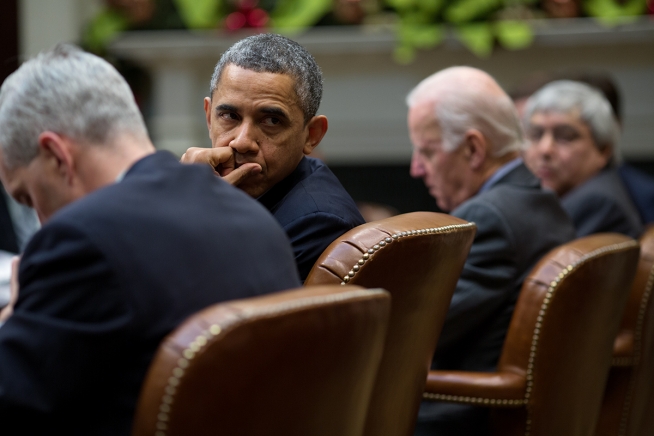
President Barack Obama, with Vice President Joe Biden, attends a meeting in the Roosevelt Room of the White House, Dec. 12, 2013. (Official White House Photo by Pete Souza)


President Barack Obama, with Vice President Joe Biden, attends a meeting in the Roosevelt Room of the White House, Dec. 12, 2013. (Official White House Photo by Pete Souza)

Friday’s decision to tank the hapless $500 million training program for “moderate” Syrian rebels is a case in point. Obama joined in the hyperbolic rhetoric against Syrian President Bashar al-Assad, lining up with the neocons and liberal interventionists demanding “Assad must go,” but Obama has remained unenthusiastic about their various wacky schemes for overthrowing Assad.


Read More Here

Wednesday, September 30, 2015

Russia, Iran, Iraq and Syria setting up ‘joint information center’ to coordinate anti-ISIS operations


© Stringer
Russia, Iran, Iraq and Syria have agreed to establish a joint information center in Baghdad to coordinate their operations against Islamic State (IS, formerly ISIL/ISIS) militants, according to sources.
 
“The main goal of the center will be gathering, processing and analyzing current information about the situation in the Middle East – primarily for fighting IS,” a military-diplomatic source told Russian news agencies on Saturday.

The information center in the Iraqi capital will be headed by an officer of one of the founding countries on a rotating basis. Rotation will take place every three months. According to the source, Iraq will run the center for the next three months.

Russia, Iran, Iraq and Syria may also use the information center to coordinate anti-IS combat plans, the source said, adding that the agreement is a milestone for uniting the region’s countries in the war on terrorism – primarily on Islamic State militants.

The Iraqi army’s joint operations command confirmed the agreement on Saturday, saying that it came with “increased Russian concern about the presence of thousands of terrorists from Russia undertaking criminal acts with Daesh [Islamic State],” Reuters reported.

READ MORE: Upper House: No request from Putin to dispatch troops in Syria
 
Meanwhile, Iraqi Foreign Minister Ibrahim Jaafari announced in New York on Friday that Iraq has not received any Russian military advisers to assist Baghdad’s operations.

On Friday, the US TV-Channel Fox News reported the four countries were establishing a “coordination cell” in Baghdad, but Dmitry Peskov, spokesman for Vladimir Putin, denied this. “We have already said there are many reports which are not true,” he told news agencies.

Recent media reports indicate Russia is boosting its cooperation with Syria and other Middle East countries in the fight against terrorism.

Read More Here

Monday, April 28, 2014

Saudi Arabia meddling in the internal affairs of Iraq and Syria. A Proxy War and terror plots fueled by the United States and their need for an axis of evil?


 .....


Watch Video Here

Saudi Arabia fears democracy in Iraq: Expert


Sun Apr 27, 2014 6:33AM GMT

Transcripts of interview with Sa’ad al-Muttalibi


Press TV has interviewed Sa’ad al-Muttalibi, State of Law Coalition from Baghdad, to discuss comments made by Iraqi Prime Minister Nouri Maliki over Saudi Arabia meddling in the internal affairs of Iraq and Syria.


What follows is a rough transcription of the interview.


Press TV: We see that Prime Minister [Nouri] Maliki has pointed the finger specifically at Saudi Arabia. Now our guest in Washington [Mr. Richard Weitz] says it’s basically countries supporting those closest in perspective but not necessarily destabilizing the country. I want your thoughts on who do you think or which entity or country do you think is destabilizing or trying to destabilize Iraq?

Muttalibi: We have to admit there is a proxy war going on in Iraq on behalf of regional powers. Now as the guest in the States mentioned not only is Saudi Arabia interfering in the Iraqi picture but as a destabilizing force and a power that is linked to ISIL and to al-Qaeda, we have definite proof of such interference.
Al-Qaeda is not fighting a proxy-war against neighboring Iran or Turkey or Kuwait or Syria, but they are actually striving to bring down the political regime and democracy in Iraq.
So, there are two agendas here. There is an interference from neighboring countries. But the agenda or the reason why there is a regional interference in Iraq and a proxy war going on -- fueled by the push from the United States into creating this theory of this axis of evil where Syria and Iran are a part of those -- then Saudi Arabia is manipulating on the picture and trying to get in, pushing for a seat as a leading Arab country or Islamic country to decide how things run in the region.
But for particularly Iraq as a destabilizing force -- as Christopher Hill, ex-Ambassador to Baghdad, very clearly mentioned and as Jeffrey Feltman also – Undersecretary – was very correct in saying that there were and there are evidence of very serious Saudi meddling in the internal affairs of Iraq and aiming at destabilizing the political regime here.
So the political picture is complicated to say the least, but that does deny or does not say that Saudi Arabia is not part of a regional important force in trying to destabilize the state of Iraq.

Press TV: Let me just expand on what you said. I want to get clarity on what you just said. Are you saying that it is the United States that is the main entity behind this destabilization in your country?

Muttalibi: Yes, definitely. It’s a side product.
What America did by claiming the theory of the axis of evil and pushing Arab states that are closely linked to the United States into creating an enemy of Iran, unfortunately Saudi Arabia misunderstood this picture and considered Iraq as part of the overall Middle Eastern picture that Iraq is a close ally of Iran, therefore Saudi Arabia by hitting at Iran are by the way attacking Iraq to destabilize Iraq on the thought that Iraq and Iran are closely linked. Therefore, by hitting the Iraqi regime or the Iraqi political system, they think they are hitting Iran at the same time.

Press TV: In general, who do you think benefits from an unstable Iraq? –Because usually in a situation, obviously, countries around a country tend to want their neighbors to be stable. You pointed the finger at the United States and Saudi Arabia. Would the Saudis not be afraid of this type of violence actually backfiring and entering into its own soil?

Muttalibi: Finally and eventually yes. Saudi Arabia will suffer from the commodity that they exported to us and to Syria. Unfortunately it takes a wise man to understand that a stable country, a stable neighbor contributes to the stability of its own country.
But we have to remember that Saudi Arabia does not have a democratic system so they don’t really understand or care about what the people say. They have a king and they have a monarchy, a non-democratic system where the royal family decides whatever they want and a jurisprudence of clerics and religious institutions backs the monarchy. They don’t really have the same democratic system where they have to answer to their own people.

Press TV: Your take, Mr. Al-Muttalibi, because we saw when the revolution took place in Egypt, we saw immediately Saudi Arabia and Qatar definitely going against what the people wanted initially. Do you think that these types of regimes fear an Arab success model of representative government?

Muttalibi: It’s natural that democracy is contagious.
Democracy is not only contagious but it does not respect sovereign borders. It’s very natural for a regime such as Saudi Arabia to fear from any success story in particular from an important regional country like Iraq, with its natural resources and its ability to be a bridge between the West and the East, and a close ally to the Arab world at the same time holding an excellent relationship with Iran and Turkey at the same time.
Iraq, you have to remember, historically is the crossroads of all civilizations. Whatever happens in Iraq definitely passes a very strong footprint in the region.
Everybody knows that democracy is contagious. Saudi Arabia will naturally feel a bit worried.
Reading the literature of Saudi Arabia in the past few months or monitoring their media we see very clearly that they highlight all the atrocities that happen in Iraq and never once mentioned a positive aspect of Iraqi life.
So, the way they present to the people that the experiment in Iraq is the biggest failure in the Middle East and democracy in Iraq is such a failure that nobody should try and copy that example. This is their internal media and internal literature that they feed to their own people, which naturally shows that there is a fear of that.

Press TV: Your take on what’s happening in the al-Anbar province. We know that Takfiri insurgents have actually taken over parts of that province. I want to know the significance of that. Are they trying to send a message to the Iraqi people and do you think with the elections -- first of all, will they be able to hold elections in that province, and the significance of this election, if it is successful, will it be a boost for security forces to get more of a stronghold or control over that region and others?

Muttalibi: We believe here in Iraq, and it’s not only me, I’m speaking on behalf of thousands and hundreds of people that I’ve actually seen and spoken to during this campaign, they talk very openly of the necessity of moving away from consensual democracy into majority democracy, and a government that should be formed on the basis of majority blocks within the government parliament, away from consensual agreement. Since the consensual agreement that was been imposed on Iraq, it definitely proved it is not working within our framework and our social structure.
Therefore, we consider this election to be a milestone election, the election that will decide the fate of the state of Iraq, the shape of Iraq. Will Iraq continue to be a federal state or centralized, decentralized? What kind of a federal state, is it confederation or federation? All these questions would be answered at this election.
Also, the upcoming elections and the political map that will be produced will be in charge of setting right the security forces and legislating laws that will allow our security forces to act more responsibly and more actively within the country.
Fallujah, what’s happening there is a big media thing. But nothing’s really been affected here in Baghdad. There is a try by al-Qaeda to move away attention from Fallujah and Anwar province into Baghdad, trying to draw attention away from Fallujah. But the war in Fallujah is between al-Qaeda, ISIS and the local tribesmen who are fighting al-Qaeda.
The Iraqi army until now is not involved in any battles with al-Qaeda or ISIS, therefore we can see how important the upcoming election is and how important the political map that it will produce.

Press TV: Your take on the same question, what will it take to reestablish security in your country?

Muttalibi: Yes, there are two issues here we have to take into consideration, the local political map from one side, and the regional events. As your guest very clearly said, what’s happening in Syria is a major factor in security in Iraq, and also the political map with the unfortunate presence of certain political entities that created a fertile ground for regional interference. That means there will always be a political group that will invite regional interference in particular from Syria and from extremist elements from Syria.
GMA/HSN

Watch Video Here

Enhanced by Zemanta

Thursday, April 17, 2014

Iran wants the U.N. Committee on Relations with the Host Country to urgently address US Refusal to Issue Envoy Visa


Iran Asks UN to Address US Refusal to Issue Envoy Visa

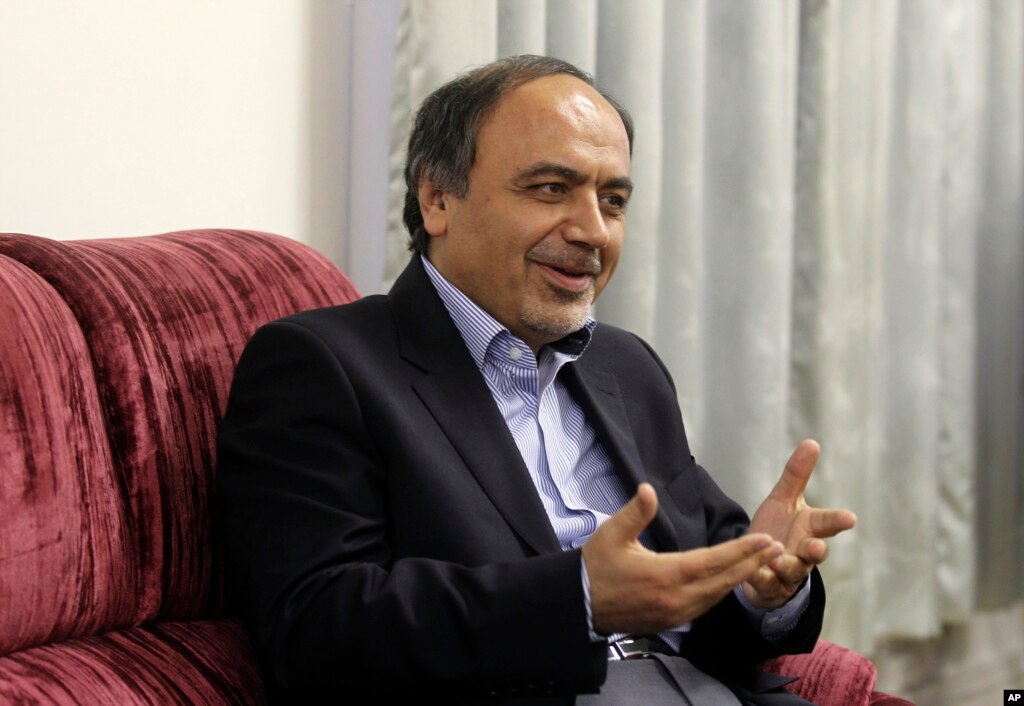
FILE - Hamid Aboutalebi, an Iranian diplomat, who was recently named as Iran's ambassador at the United Nations, speaks at his office in Tehran, Iran.


VOA News
Iran is asking a United Nations committee to hold a special meeting on the refusal of the United States to issue a visa to Iran's choice for its ambassador to the U.N.
American officials object to Iran's selection of Hamid Abutalebi because of his alleged involvement in the 1979 seizure of the U.S. Embassy in Tehran. White House spokesman Jay Carney said last week the choice is "not viable."
In a letter Monday, Iran's mission to the U.N. said that decision has "negative implications" diplomatically and creates a dangerous precedent. It says denying a visa to a U.N. member state goes against the U.N. charter and international law.
Iran wants the U.N. Committee on Relations with the Host Country to urgently address the issue.


.....


Trend .az


U.S. adopts harsher tone in U.N. envoy dispute with Iran

Photo: U.S. adopts harsher tone in U.N. envoy dispute with Iran / Iran
The United States adopted a harsher tone toward Iran's proposed U.N. ambassador on Tuesday, calling Tehran's choice of Hamid Abutalebi "unacceptable" and tying him to the 1979-1981 U.S. hostage crisis in Tehran, Reuters reported.
While it did not detail what the veteran diplomat may have done during the period, when radical Iranian students seized the U.S. embassy and held 52 U.S. hostages for 444 days, the State Department for the first time linked the U.S. decision not to issue him a visa to those events.
"He himself has said he was involved and, given his role in the events of 1979, which clearly matter profoundly to the American people, it would be unacceptable for the United States to grant this visa," State Department spokeswoman Jen Psaki told reporters at her daily briefing.
Abutalebi has said that he acted only as a translator.
Previously U.S. spokespeople used softer language, saying the choice was not "viable."


 Read More Here

.....
Enhanced by Zemanta

Saturday, March 15, 2014

As the EU prepares for sanctions, Russia threatens to put oil on a gold standard

Oil Pump
Courtesy of Atlantic Sentinel
First it was the United States, which threatened Russia with economic sanctions and even a removal from the G-8 over their intervention in Ukraine and the Crimea. And now, on March 13, Europe appears to have finally gotten on board as well as the EU officially voted to impose their own form of sanctions on the Eur-Asian Superpower for the first time since the Cold War.
However, like with the Syrian crisis of last September, Russia is quickly retaliating with their own economic threats, and one major action that they could undertake as a response is to discard the Petro-Dollar and demand physical gold as payment for energy purchases in both oil and natural gas.
Just as the Iranians did under U.S. sanctions just a few years ago.
The biggest factor driving gold prices at the moment is the increasing tension between the West and Russia over Ukraine. The EU agreed on a framework yesterday for its first sanctions on Russia since the Cold War.
Russian government officials and businessmen are bracing for sanctions resembling those applied to Iran, and should Russian foreign exchange reserves and bank assets be frozen as is being suggested, then Russia would likely respond by wholesale dumping of their dollar reserves and bonds, and could opt to only accept gold bullion for payment for their gas, oil and other commodity exports. - Silver Doctors


Read More Here

.....


Moscow won't exclude sanctions to counter US and EU - Ministry

Published time: March 13, 2014 10:31
Edited time: March 13, 2014 15:08

RIA Novosti / Aleksandr Vilf

Russia is ready to retaliate with counter sanctions against the EU and US if they go ahead with economic measures against Russia over tension in Crimea, the Russian Economic Ministry has said.
"We hope that there will only be targeted political sanctions, and not a broad package affecting economic trade,” Deputy Economic Development Minister Aleksey Likhachev said.
“Our sanctions will be, of course, similar,” he added.
One way Russia plans on shielding itself from pending sanctions is by boosting trade in other currencies, not the US dollar.
“We need to increase trade volume conducted in national currencies. Why, in relation to China, India, Turkey and other countries, should we be negotiating in dollars? Why should we do that? We should sign deals in national currencies- this applies to energy, oil, gas, and everything else,” Aleksey Ulyukaev, the Minister of Economic Development said in an interview with the Vesti 24 TV channel.
The Duma, Russia’s parliament, is drafting legislation to allow Moscow to freeze assets of Western companies and individuals in the event sanctions are imposed following the Crimea referendum vote on March 16.
The bill would give “the president and government opportunities to defend our sovereignty from threats,” according to its author, Andrey Klishas, as quoted by RIA Novosti on March 5.
The US Congress has already denounced Russia’s actions in Ukraine. On Tuesday, lawmakers passed a resolution that urges the US to “to work with our European allies and other countries to impose visa, financial, trade and other sanctions on senior Russian Federation officials, majority state-owned banks and commercial organizations, and other state agencies, as appropriate.”

 Read More here

.....

Enhanced by Zemanta

Friday, March 14, 2014

Iran seeks to allay Gulf Arab nuclear fears

NUKEWARS

by Staff Writers Muscat (AFP) March 13, 2014


Foreign Minister Mohammad Javad Zarif of Shiite Iran on Thursday sought to allay concerns among mainly Sunni Muslim Gulf Arab monarchies mistrustful of Tehran over its nuclear ambitions.
"Our message to the other countries of the Persian Gulf is a message of friendship, fraternity and cooperation," Zarif said in the Omani capital Muscat, where he is accompanying President Hassan Rouhani on a landmark visit.
The sultanate maintains strong links with Tehran, and has played an important intermediary role between Western countries and the Islamic republic.
Gulf Arab countries have expressed concern about the reliability of Iran's sole nuclear power plant at Bushehr and the risk of radioactive leaks in case of a major earthquake, as well as a possible military dimension to Iran's nuclear drive.
Iran insists that its atomic ambitions are peaceful, despite fears in Israel and the West that these mask a covert drive to acquire the bomb.
"Iran is ready for strong and fraternal relations with all the states of the region," said Zarif, who has embarked on a charm offensive towards the Gulf since Rouhani became Iran's president in August.

Read More Here

.....


NUKEWARS

Iran's Rouhani extends hand to Gulf monarchies


by Staff Writers Muscat (AFP) March 13, 2014


Iranian President Hassan Rouhani sought Thursday to mend fences between his mainly-Shiite country and Sunni-dominated Gulf monarchies distrustful of Iran's nuclear ambitions and its support of the Syrian regime.
Rouhani, winding up a two-day visit to Oman, said the Islamic republic offered "a hand of fraternity to all the countries of the region."
"Relations with one country should not grow at the expense of another. We want to see the countries of the region live in peace, understanding and friendship," Rouhani told a business gathering in Muscat.
The sultanate maintains strong links with Iran and has played an important role as mediator between Western countries and Tehran.
But other members of the Gulf Cooperation Council, which besides Oman also comprises Bahrain, Kuwait, Qatar, Saudi Arabia and the United Arab Emirates, have cool relations with Tehran.
Its Arab neighbours have expressed concern about the reliability of Iran's sole nuclear power plant at Bushehr in the southern Gulf and the risk of radioactive leaks should it be hit by a major earthquake.
Like world powers, they also fear a possible military dimension to Iran's nuclear drive, despite repeated assertions by Tehran that its atomic ambitions are peaceful.
Ties between Gulf countries and Iran have also been strained by Tehran's backing of Syrian President Bashar al-Assad's regime in its battle against rebels supported by the Arab monarchies.
"Cooperation and rapprochement would benefit the whole region," said Rouhani, adding that his country is "open to investors from the region, especially Omanis."
Oman and Iran are seeking to expand trade, which reached $1 billion last year, and bilateral investments which they expect will top $10 billion by the end of this year, Iranian Ambassador Ali Akbar Sibeveih said Monday.

Read More Here

.....

Enhanced by Zemanta