Legalization bill will become law unless McCrory vetoes
Spring Hope has one of the only hemp processing plants in the country
Supporters battle stigma: ‘We’re for rope, not dope’
Workers do final assembly of a decortification line at the Industrial
Hemp Manufacturing Company in Spring Hope, NC, on Wednesday. The
facility hopes to begin full-scale operations when a bill becomes law at
midnight Friday, without Gov. Pat McCrory's signature. The law
legalizes industrial hemp in North Carolina. Farmers are eager to grow
the crop, which can be used in textiles, oil drilling fluid and other
products. It has virtually no THC, the active ingredient in marijuana
that is smoked. This group of machines separates the outer fibers from
the inner core. The outer fibers are used in the textile industry, the
core fibers are used by the oil and gas industry. The plant currently
processes kanaf, a plant similar to hemp. It is used to make door panels
in cars and trucks. Chris Sewardcseward@newsobserver.com
Farmers
in North Carolina are likely to wake up Saturday morning with a new
option for growing crops: Industrial hemp production is expected to
become legal at the stroke of midnight.
Lawmakers passed the
legalization legislation in September, in the final days of the session.
The proposal hadn’t previously been made public, and some conservative
groups worry that questions about the plant’s connections to its cousin,
marijuana, didn’t get answered.
The bill has been on Gov. Pat
McCrory’s desk for weeks, and unless he vetoes it, it will become law
without his signature at midnight Friday.
Lee Edwards of Sugar Hill Farms in Kinston is among the farmers eager to add industrial hemp to their fields.
“Hemp
really gives us a crop during the summertime that is a viable cash crop
to us,” he said. “We’re in a perfect geographical location for the
production of hemp with our climate.”
As
Congress wrangles with whether to restore long-term unemployment
benefits, North Carolina is already experiencing the hardship likely to
unfold unless the program is restored
Theresa Whidbee-Walker first found the Food
Bank of the Albemarle as a customer and returns now to volunteer.
Photograph: James Robinson
Eight hours may seem a long time to wait for a meal. But the line of
cars that formed in a derelict parking lot in Hertford, North Carolina,
early last Thursday morning, full of people waiting for a few cans of
soup and some pasta from a local food bank, was nothing unusual. Almost
every morning now, there is a line like that somewhere in North
Carolina.
From a distance, the rows of cars look innocuous enough. But they are
a symbol of the desperation that has gotten worse in North Carolina
since July, when a swathe of cuts to unemployment benefits made it
arguably the worst state in the US to be out of work.
The cars appeared in Hertford shortly before 8am, though the truck
bringing the food was not scheduled to arrive until 4pm. Volunteers who
hand out the food said it is not uncommon for cars to start lining up
before dawn.
“I had a man the other day who said: ‘All I want is a bar of soap,’”
said Laura Williams, a volunteer at the storage depot in nearby
Elizabeth City. “Another man came in here and said: ‘Can you get me some
toilet paper? I’ve been having to use coffee filters.’”
She added: “We get that a lot – people asking for toilet paper. But
we can’t stock too much of that as we’ve got to concentrate on canned
food.”
Washington has this month been dominated by a political fight over
whether to restore a federal benefits program for the long-term
unemployed, which was allowed to expire on 28 December, cutting off a
lifeline to more than 1.4 million Americans. The White House and
Democrats want to reinstate the benefits. Republicans are reluctant.
What North Carolina is currently experiencing is a foretaste of the
economic story likely to unfold across the country unless the federal
benefits are restored.
The people in line on Thursday constituted a cross-section of
America’s poor. Of those who wound down their windows and agreed to
talk, the eldest was 77, the youngest 19. They included pensioners,
students, people working for minimum wage and some who had recently been
laid off. They were there so early, and willing to wait so long,
because they wanted to increase their chances of receiving perishable
items rather than just canned goods. Get a spot near the front of the
line, and you might get some fresh vegetables, bread, or even some
frozen chicken.
Charles Christman has been volunteering at
the Food Bank of the Albemarle in Elizabeth City, North Carolina for the
past three years. Photograph: James Robinson
By 4pm, there were more than 100 cars in the dilapidated parking lot
– once a bustling shopping mall. At the very front were Floyd Liston,
59, and his friend, Bobby Bass, 65. Their story was not atypical.
Bass is retired after years working in a cotton mill. Liston, a
diabetic, worked all his life but had to give up in 2011 after a routine
blister on his foot deteriorated. Married with two daughters, Liston
didn’t have health insurance and did not visit a doctor until it was too
late. “The infection had eaten all the bone. They told me to go to the
hospital and that night they took my leg off,” he said.
In February, in an attempt to address a $2bn debt that it owed the
federal government, North Carolina passed a law that slashed both the
number of weeks for which a job-seeker can receive state benefits and
reduced the amount that it pays out in unemployment, from $535 a week to
$350.
In doing so, North Carolina knowingly violated a contract with the
federal government, resulting in the automatic cutting off of federal
assistance for the long-term unemployed. The changes, which came into
effect in July, therefore didn’t just cut the amount of support that
people who lost their jobs received from their government by a third, it
also meant the maximum length of time they could receive such benefits
plummeted from 99 weeks to just 19.
“What happened in North Carolina was one the harshest cuts in
unemployment benefits we’ve ever seen in this country,” said Mike
Evangelist, a policy director at the National Employment Law Project.
"Nothing I know of compares to it."
The precise impact of the benefits reduction in North Carolina is
difficult to discern, said Larry Katz, a Harvard professor. But he and
other economists have recently been pointing to figures that hint at an
alarming phenomena: people have been dropping out of an already bleak
labor market, and in record numbers.
Since July, when the cuts came into force, North Carolina has
experienced the largest contraction in its labor force since
record-keeping began in 1977. Remarkably, the sharp decline in the
workforce in North Carolina, which has a population of 9.75 million, has
even altered the national picture.
Timothy Littke, 55, from Lumberton, gave up looking for work in North
Carolina in October. He was laid off from his job building hog feeders
in June, a month before the benefits cuts kicked in.
He has since relocated to live with his daughter in Pittsburgh. The
story of Littke’s departure says much about about deprivation in his old
home of Lumberton – a small city in the south of the state which, by
one measure, is the poorest in America.
Justin
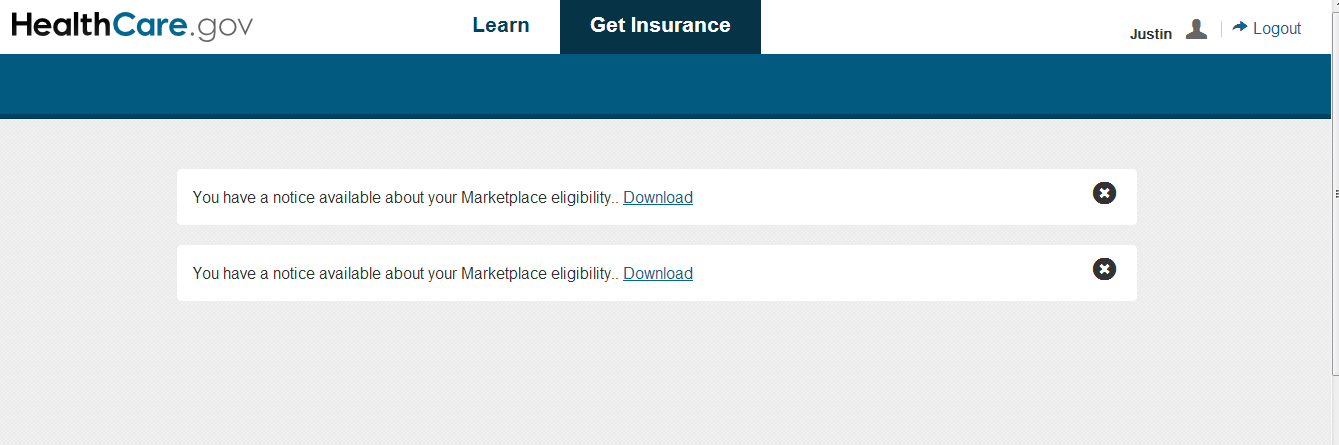
Hadley logged on to HealthCare.gov to evaluate his insurance options
after his health plan was canceled. What he discovered was an apparent
security flaw that disclosed eligibility letters addressed to
individuals from another state.
“I was in complete shock,” said Hadley, who contacted Heritage after becoming alarmed at the breach of privacy.
Hadley,
a North Carolina father, buys his insurance on the individual market.
His insurance company, Blue Cross Blue Shield of North Carolina,
directed him to HealthCare.gov in a cancellation letter he received in
September.
After multiple attempts to access the problem-plagued
website, Hadley finally made it past the registration page Thursday.
That’s when he was greeted with a downloadable letter about eligibility —
for two people in South Carolina. (Screenshot below.)
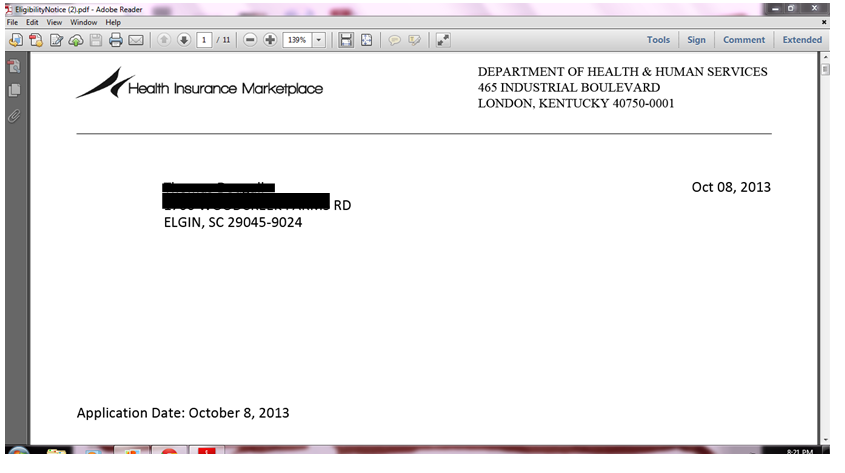
The
letter, dated October 8, acknowledges receipt of an application to the
Health Insurance Marketplace and the eligibility of family members to
purchase health coverage. The letter was addressed to Thomas Dougall, a
lawyer from Elgin, SC.
Hadley shared a screenshot and copy of the letter with redacted personal information.
Hadley
wrote to Heritage on Thursday night and also contacted the U.S.
Department of Health and Human Services, which administers
HealthCare.gov, as well as elected officials in his state. He has yet to
hear back from HHS, even though HealthCare.gov still displays the
personal information of the South Carolina residents on his account.
Hadley
reached out to Dougall on Friday to notify him of the breach. Dougall,
who spoke to Heritage this evening, said he was evaluating health care
options in early October. Dougall said he was able to register on
HealthCare.gov, but decided not to sign up for insurance.
“The plans they offered were grossly expensive and didn’t provide the level of care I have now,” he said.
Dougall said he never saw the October 8 letter until Hadley sent it to him Friday.
After
learning of the privacy breach, Dougall spent Friday evening trying to
contact representatives from HealthCare.gov to no avail; he spent an
hour waiting on the telephone and an online chat session was unhelpful.
He also wrote to Senators Lindsey Graham (R-SC) and Tim Scott (R-SC),
along with Representative Joe Wilson (R-SC).
“I want my personal information off of that website,” Dougall said. Security Risk
Last week, the Associated Press disclosed a government memo
revealing the “high” security risk for HealthCare.gov. Those concerns
surfaced at Wednesday’s hearing with HHS Secretary Kathleen Sebelius,
who claimed the system was secure.
RALEIGH, N.C.
— U.S. Rep. David Price says he has gotten no response from Gov. Pat
McCrory on why North Carolina was the only state to announce it would
end aid to low-income families, pregnant women and infants during the
recent federal government shut down.
The Democrat from Chapel Hill
said at a luncheon in Raleigh on Friday that the state's Republican
administration appeared too eager to cut off help to poor families
during the crisis.
Price suggested that North Carolina being alone
among the 50 states in announcing it would end federal welfare-to-work
assistance and food aid is a sign there is something "really wrong" with
McCrory's administration. He and two other Democratic congressmen from
North Carolina, Rep. Mel Watt of Charlotte and Rep. G.K. Butterfield of
Wilson, sent an Oct. 15 letter questioning the decisions and asking
McCrory to reverse course.
"I think it is a very troubling
episode," Price said, speaking to a group of reporters. "Seems like they
were almost too eager to cut off these benefits. That's the way it
looked. If we were one out of 20 or 30 states, that would be different.
But when you are one out of 50, that's pretty surely a sign of being an
outlier."
The
Justice Department will file suit against North Carolina on Monday,
charging that the Tar Heel State’s new law requiring voters to show
photo identification at the polls violates the Voting Rights Act by
discriminating against African Americans, according to a person familiar
with the planned litigation.
Attorney General Eric Holder is
expected to announce the lawsuit at 11 a.m. Monday at Justice Department
headquarters, flanked by the three U.S. Attorneys from North Carolina.
The
suit, set to be filed in Greensboro, N.C., will ask that the state be
barred from enforcing the new voter ID law, the source said. However,
the case will also go further, demanding that the entire state of North
Carolina be placed under a requirement to have all changes to voting
laws, procedures and polling places “precleared” by either the Justice
Department or a federal court, the source added.
Until this year,
40 North Carolina counties were under such a requirement. However, in
June, the Supreme Court declared unconstitutional the formula Congress
used to subject parts or all of 15 states to preclearance in recent
decades.
The justices’ 5-4 ruling outraged civil rights advocates,
but did not disturb a rarely-used “bail in” provision in the law that
allows judges to put states or localities under the preclearance
requirement. Civil rights groups and the Justice Department have since
seized on that provision to try to recreate part of the regime that
existed prior to the Supreme Court decision.
North Carolina Gov. Pat McCrory (R) signed the voter ID measure into law last last month.
US Attorney General Eric Holder arrives to address the Congressional
Black Caucus Annual Legislative Conference during a public policy forum
on voting rights in Washington on September 20, 2013. (Photo by Nicholas
Kamm/AFP/Getty)
This story has been updated and a correction appended.
Attorney
General Eric Holder said Friday that the Justice Department will
continue its efforts to protect voting rights in the wake of the Supreme
Court’s decision which gutted the Voting Rights Act earlier this
summer.
During remarks to the Congressional Black Caucus, Holder
explained that the lawsuits filed to stop Texas’s discriminatory
redistricting and voter ID laws are “just the beginning.”
“Thanks
to the hard work of our Civil Rights Division, we are continuing to
refine and re-focus current enforcement efforts across the country,” he
said. “And while the suits we’ve filed in Texas mark the first voting
rights enforcement actions the Justice Department has taken since the
Supreme Court ruling, they will not be the last.”
So far, the
Justice Department has filed lawsuits to block redistricting and voter
ID laws in Texas, along with pushing to see the state returned to preclearance under a different provision of the Voting Rights Act that remains intact after the Supreme Court ruling.
Earlier this week, the NAACP and Mexican American Legislative Caucus filed a lawsuit joining the DOJ in its attempt to block the voter ID law.
Texas Attorney General Greg Abbott called the Justice Department’s efforts a “scheme” to win Texas for Democrats.
Southern States Are Moving to Tighten Voting Rules
MIAMI September 28, 2013 (AP)
By MICHAEL J. MISHAK Associated Press
Emboldened by the Supreme Court decision that struck down the heart of
the Voting Rights Act, a growing number of Republican-led states are
moving aggressively to tighten voting rules. Lawsuits by the Obama
administration and voting rights activists say those efforts
disproportionately affect minorities.
At least five Southern states, no longer required to ask Washington's
permission before changing election procedures, are adopting strict
voter identification laws or toughening existing requirements.
Texas officials are battling the U.S. Justice Department to put in place
a voter ID law that a federal court has ruled was discriminatory. In
North Carolina, the GOP-controlled Legislature scaled back early voting
and ended a pre-registration program for high school students nearing
voting age.
Nowhere is the debate more heated than in Florida, where the chaotic recount in the disputed 2000 presidential race took place.
Florida election officials are set to resume an effort to remove
noncitizens from the state's voting rolls. A purge last year ended in
embarrassment after hundreds of American citizens, most of whom were
black or Hispanic, were asked to prove their citizenship or risk losing
their right to vote.
Republican leaders across the South say the new measures are needed to
prevent voter fraud, even though such crimes are rare. Democrats and
civil rights groups say the changes are political attacks aimed at
minorities and students — voting groups that tend to lean toward
Democrats — in states with legacies of poll taxes and literacy tests.
In North Carolina, for example, a state board of elections survey found
that more than 600,000 registered voters did not have a state-issued ID,
a requirement to vote under the state's new law. Many of those voters
are young, black, poor or elderly.
"We're in the middle of the biggest wave of voter suppression since the
Voting Rights Act was enacted," said Katherine Culliton-González,
director of voter protection for the Advancement Project, a
Washington-based civil rights group that has undertaken legal challenges
in several states.
For five decades, states and localities with a history of discrimination
had to submit all election laws, from new congressional district maps
to precinct locations and voting hours, to federal lawyers for approval.
That practice ended in June when the Supreme Court struck down the
provision in the Voting Rights Act as outdated.
Voting rights groups said recent actions by Southern states highlight
the need for Congress to retool the rejected sections of the landmark
1965 law that were credited with ensuring ballot access to millions of
blacks, American Indians and other minorities.
The administration is using the remaining parts of the law to bring court cases.