Showing posts with label Kathleen Sebelius. Show all posts

Friday, April 11, 2014

Health and Human Service Secretary Kathleen Sebelius is resigning, U.S. officials. Obama Said to Choose OMB's Burwell to Succeed.


...

MICHAEL REYNOLDS / EPA 

Kathleen Sebelius Resigning as Health Secretary

Health and Human Service Secretary Kathleen Sebelius is resigning, U.S. officials told NBC News on Thursday.
U.S. officials told NBC News that President Barack Obama on Friday will nominate Sylvia Mathews Burwell, currently director of the White House Office and Management and Budget, to succeed Sebelius, 65, the former governor of Kansas, who was an original member of the Cabinet that Obama appointed when he took office in January 2009.


Image: U.S. Secretary of Health and Human Services Sebelius answers a question while she testifies before the Senate Finance Committee hearing on the President's budget proposal for FY2015, on Capitol Hill in Washington
\LARRY DOWNING / Reuters
As secretary of Health and Human Services, Kathleen Sebelius was the public face of the bug-ridden rollout of President Barack Obama's health care insurance initiative..

No reason for Sebelius' departure, was immediately available, but she came under sustained criticism as head of the agency in charge of the controversial rollout of Obama's health care reform initiative.
Sebelius told Obama of her intentions in early March, a White official said, but she didn't tip her hand when she told the Senate Finance Committee earlier Thursday that 7.5 million Americans had signed up for health coverage under the new law — a figure that exceeded the original expectations despite the months of problems.
Sebelius has apologized numerous times for the glitch-prone website, which initially blocked many Americans from comparing and enrolling in health insurance plans. Testifying before a House committee in October, she conceded that the website, healthcare.gov, was "a miserably frustrating experience for way too many Americans."

....

Bloomberg

Sebelius Said to Resign as U.S. Health Secretary

 
  Photographer: Andrew Harrer/Bloomberg
Kathleen Sebelius, secretary of Health and Human Services, speaks during a Senate..
Kathleen Sebelius, the U.S. health secretary who steered the troubled rollout of President Barack Obama’s signature health-care law, will resign just as the program topped its first-year enrollment goal, according to two people familiar with the decision.
The resignation of Sebelius, 65, is expected to be announced tomorrow, said the people who asked not to be identified because the decision is still private. Sylvia Mathews Burwell, 48, director of the Office of Management and Budget, will be nominated to succeed Sebelius, one of the people said. White House officials had no immediate comment on the report.
A former Democratic governor of Kansas, Sebelius was an early backer of Obama’s campaign for the president. She spent five years running the Health and Human Services Department, presiding over the largest change to government health programs since Medicare and Medicaid began almost 50 years ago.
Sebelius’s resignation closes the first major chapter of the Patient Protection and Affordable Care Act, or Obamacare. The 2010 law is projected to eventually offer health insurance to 25 million more people in the U.S., paid for with changes to Medicare, taxes on health-care providers and a requirement that all Americans have insurance.
Sebelius’s departure was unexpected by at least one person close to her, Kansas Insurance Commissioner Sandy Praeger, a Republican who has worked with her since 1991. Praeger said she was at a dinner where the health secretary spoke last week and that “she seemed like she was in it for the long haul.”

Enrollment Goals

Assessing Sebelius’s work, the number of people who signed up for coverage through Obamacare may trump the difficulties in getting there when the new online insurance marketplaces started with flawed technology last October. In total, 7.5 million Americans signed up for private health plans through the exchanges, half a million more than the government’s most optimistic estimates.
The secretary “played a key role that enabled the Affordable Care Act to become the law of the land, and she worked tirelessly to implement it successfully,” Ron Pollack, executive director of Families USA, a Washington-based health advocacy group that supports the law, said in an e-mail. “We owe her an enormous debt of gratitude for her excellent work in improving health care for families across America.”

Sluggish Start...


Read More Here

.....
Enhanced by Zemanta

Thursday, March 20, 2014

Health industry officials say ObamaCare-related premiums will double in some parts of the country, countering claims recently made by the administration.


The New American

Huge Increases in ObamaCare Premiums Are Coming

Written by 


When Health and Human Services (HHS) Secretary Kathleen Sebelius sought to quell concerns about rising premiums under ObamaCare last week, she said: “The increases [we’re seeing] are far less significant than what they were prior to the Affordable Care Act.” This was an echo of a representative of Sebelius at HHS, Joanne Peters, who told Fox News, “Since the Affordable Care Act became law, health-care costs have been slowing and premium growth has slowed to the lowest rate in years ... making it easier for [small] businesses to offer coverage.”
These claims surprised health insurance company officials, who have been wrestling with the massive takeover by the government and trying to charge enough to stay solvent. Said one official, on conditions of anonymity: “[These comments are] pretty shortsighted … everybody knows that [ObamaCare] is going to lead to higher costs.” Privately, the same official said that his company, located in a large swing state, expects to triple its rates next year.
Another insurance company official stated: “We’re exasperated. All of these major delays on very significant portions of the law are going to change what it’s going to cost.” Bill Hoagland, a former executive at health insurance company CIGNA, agreed: “My gut tells me that, for some people, these increases will be significant.”

Analysts have been trying to estimate precisely what those cost increases are likely to be. Three economists with the Manhattan Institute made their first estimate last September, expanded it later that month, and issued a further broader report in November. Writing in Forbes, one of them said the average increase will be more than 40 percent over current premiums, with some insureds seeing their premiums double:
This nearly-complete analysis finds that the average state will face underlying premium increases of 41 percent.
Men will have the steepest increases: 77, 37, and 47 percent for 27-year-olds, 40-year-olds, and 64-year-olds, respectively….
The eight states that will face the biggest increases in underlying premiums are: Nevada (+179 percent), New Mexico (+142 percent), Arkansas (+138 percent), North Carolina (+136 percent), Vermont (+117 percent), Georgia (+92 percent), South Dakota (+77 percent) and Nebraska (+74 percent).
The reason young men will suffer the biggest increases under ObamaCare is because they are the healthiest and, under the program, will be expected to carry most of the burden for the others, including women who use more healthcare services than men. ObamaCare requires insurers to charge them the same as men. And older people, who consume up to six times the services that young people do, may not, under those rules, be charged more than three times their premiums.
There’s also the matter of subsidies, which, because oldsters pay more, will qualify them for higher subsidies. Wrote one of the authors of that study, Avik Roy:


Read More Here
.....

The Hill

O-Care premiums to skyrocket


Health industry officials say ObamaCare-related premiums will double in some parts of the country, countering claims recently made by the administration.
The expected rate hikes will be announced in the coming months amid an intense election year, when control of the Senate is up for grabs. The sticker shock would likely bolster the GOP’s prospects in November and hamper ObamaCare insurance enrollment efforts in 2015.
The industry complaints come less than a week after Health and Human Services (HHS) Secretary Kathleen Sebelius sought to downplay concerns about rising premiums in the healthcare sector. She told lawmakers rates would increase in 2015 but grow more slowly than in the past.
“The increases are far less significant than what they were prior to the Affordable Care Act,” the secretary said in testimony before the House Ways and Means Committee.
Her comment baffled insurance officials, who said it runs counter to the industry’s consensus about next year.
“It’s pretty shortsighted because I think everybody knows that the way the exchange has rolled out … is going to lead to higher costs,” said one senior insurance executive who requested anonymity.
The insurance official, who hails from a populous swing state, said his company expects to triple its rates next year on the ObamaCare exchange.
The hikes are expected to vary substantially by region, state and carrier.
Areas of the country with older, sicker or smaller populations are likely to be hit hardest, while others might not see substantial increases at all.
Several major companies have been bullish on the healthcare law as a growth opportunity. With investors, especially, the firms downplay the consequences of more older, sicker enrollees in the risk pool.
Much will depend on how firms are coping with the healthcare law’s raft of new fees and regulatory restrictions, according to another industry official.
Some insurers initially underpriced their policies to begin with, expecting to raise rates in the second year.
Others, especially in larger states, will continue to hold rates low in order to remain competitive.
After this story was published, the administration pointed to some independent analyses that have cast doubt on whether the current mix of enrollees will lead to premium hikes.
ObamaCare also includes several programs designed to ease the transition and stave off premium increases. Reinsurance, for example, will send payments to insurers to help shoulder the cost of covering sick patients.
But insurance officials are quick to emphasize that any spikes would be a consequence of delays and changes in ObamaCare’s rollout.


Read More Here
.....
Enhanced by Zemanta

Tuesday, January 14, 2014

Older People Lead Sign-Ups for Insurance

Launch media viewer
Attendees at an Affordable Care Act enrollment event in LaGrange, Ky., in October. Luke Sharrett for The New York Times

WASHINGTON — People signing up for health insurance through the Affordable Care Act’s federal and state marketplaces tend to be older and potentially less healthy, officials said Monday, a demographic mix that could threaten the law’s economic underpinnings and cause premiums to rise in the future if the pattern persists.
Questions about the law’s financial viability are likely to become the next line of attack from its critics, as lawmakers gear up for the midterm elections this fall. Republicans quickly seized on the government’s progress report on Monday as evidence that the health insurance law would not work.
But administration officials expressed optimism that more young people would sign up in the months ahead, calling the latest enrollment numbers “solid, solid news” for the health care law. They said that interest in obtaining insurance through the marketplaces was increasing sharply across all age groups and that youth outreach efforts would become more aggressive as the March 31 open enrollment deadline approached.

Graphic

Health Exchange Enrollment Picked Up in December

Nearly 2.2 million people picked a health insurance plan through the exchanges established by the Affordable Care Act through Dec. 28.
OPEN Graphic
“We’re pleased to see such a strong response and heavy demand,” said Kathleen Sebelius, the secretary of health and human services. “Among young adults, the momentum was particularly strong.”
Of those who signed up in the first three months, administration officials said, 55 percent are age 45 to 64. Only 24 percent of those choosing a health insurance plan are 18 to 34, a group that is usually healthier and needs fewer costly medical services. People 55 to 64 — the range just below the age at which people qualify for Medicare — represented the largest group, at 33 percent.
The latest figures about enrollment add pressure on the Obama administration after a disastrous rollout of the HealthCare.gov website in October. Senior officials said they understood the stakes and were working to increase sign-ups. The White House recently hired Marlon Marshall, the deputy national field director for Mr. Obama’s 2012 presidential campaign, to run a campaign-style effort aimed at increasing sign-ups, especially among young people.
Brendan Buck, a spokesman for the House speaker, John A. Boehner, Republican of Ohio, predicted that the White House would fail to meet its goals and said that insurance premiums would rise.
“There’s no way to spin it: youth enrollment has been a bust so far,” Mr. Buck said. “When they see that Obamacare offers high costs for limited access to doctors — if the enrollment goes through at all — it’s no surprise that young people aren’t rushing to sign up.”
The demographic information, which had not been broadly available until Monday, also offers the first concrete evidence about whether the national health care experiment will work the way it has in Massachusetts, where a government marketplace also offers insurance to people who do not receive it through their employers. Officials said they were optimistic because the pattern of sign-ups among young people looked similar to the one they had seen in that state, which had a surge in sign-ups as the deadline approached.

Read More Here
Enhanced by Zemanta

Saturday, November 9, 2013

Exclusive: HealthCare.gov Users Warn of Security Risk, Breach of Privacy

Obamacare (c) Desert Rose Creations / Family Survival Protocol  2013 photo obamacarelogo_zps3de31909.jpg
Obamacare (c) Desert Rose Creations / Family Survival Protocol  2013

..........

The Heritage Foundation

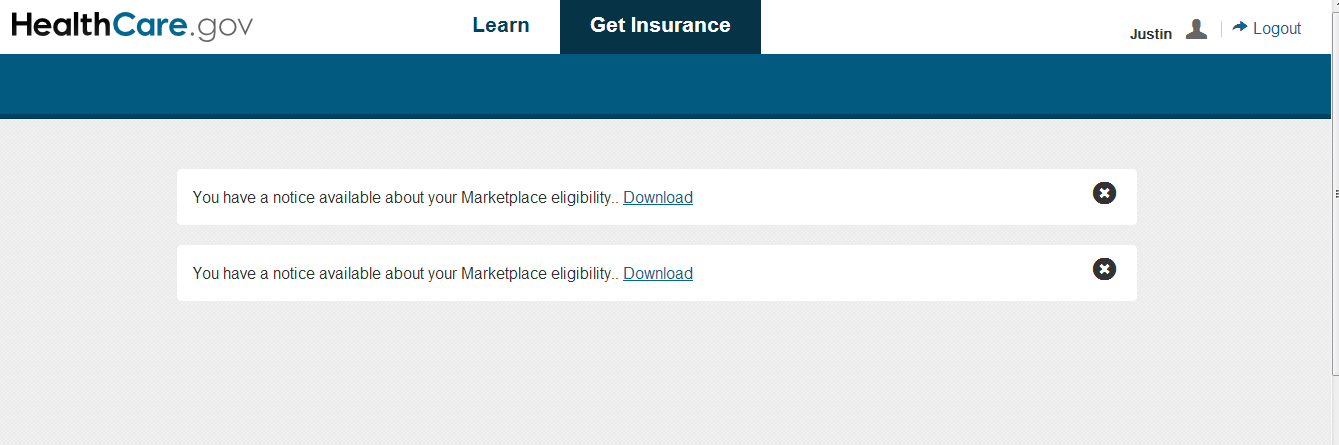
Justin Hadley logged on to HealthCare.gov to evaluate his insurance options after his health plan was canceled. What he discovered was an apparent security flaw that disclosed eligibility letters addressed to individuals from another state.
“I was in complete shock,” said Hadley, who contacted Heritage after becoming alarmed at the breach of privacy.
Hadley, a North Carolina father, buys his insurance on the individual market. His insurance company, Blue Cross Blue Shield of North Carolina, directed him to HealthCare.gov in a cancellation letter he received in September.
After multiple attempts to access the problem-plagued website, Hadley finally made it past the registration page Thursday. That’s when he was greeted with a downloadable letter about eligibility — for two people in South Carolina. (Screenshot below.)
Capture 1
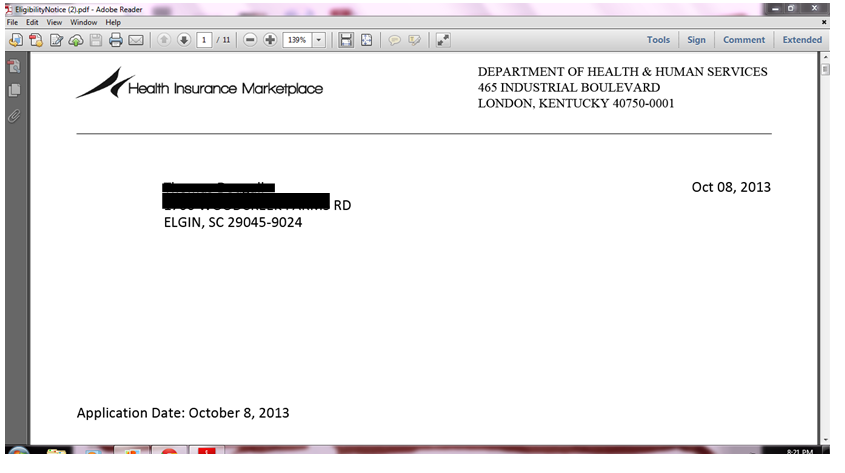
The letter, dated October 8, acknowledges receipt of an application to the Health Insurance Marketplace and the eligibility of family members to purchase health coverage. The letter was addressed to Thomas Dougall, a lawyer from Elgin, SC.
Hadley shared a screenshot and copy of the letter with redacted personal information.
Capture 2
Hadley wrote to Heritage on Thursday night and also contacted the U.S. Department of Health and Human Services, which administers HealthCare.gov, as well as elected officials in his state. He has yet to hear back from HHS, even though HealthCare.gov still displays the personal information of the South Carolina residents on his account.
Hadley reached out to Dougall on Friday to notify him of the breach. Dougall, who spoke to Heritage this evening, said he was evaluating health care options in early October. Dougall said he was able to register on HealthCare.gov, but decided not to sign up for insurance.
“The plans they offered were grossly expensive and didn’t provide the level of care I have now,” he said.
Dougall said he never saw the October 8 letter until Hadley sent it to him Friday.
After learning of the privacy breach, Dougall spent Friday evening trying to contact representatives from HealthCare.gov to no avail; he spent an hour waiting on the telephone and an online chat session was unhelpful. He also wrote to Senators Lindsey Graham (R-SC) and Tim Scott (R-SC), along with Representative Joe Wilson (R-SC).
“I want my personal information off of that website,” Dougall said.
Security Risk
Last week, the Associated Press disclosed a government memo revealing the “high” security risk for HealthCare.gov. Those concerns surfaced at Wednesday’s hearing with HHS Secretary Kathleen Sebelius, who claimed the system was secure.


Read More Here
Enhanced by Zemanta

Monday, October 28, 2013

Obama admin. knew millions could not keep their health insurance

Investigative reporting from NBC News


Larry Downing / Reuters
U.S. President Barack Obama walks out to deliver remarks alongside Human Services Secretary Kathleen Sebelius in the Rose Garden of the White House in Washington, October 1, 2013.
By Lisa Myers and Hannah Rappleye
NBC News
President Obama repeatedly assured Americans that after the Affordable Care Act became law, people who liked their health insurance would be able to keep it. But millions of Americans are getting or are about to get cancellation letters for their health insurance under Obamacare, say experts, and the Obama administration has known that for at least three years.
Four sources deeply involved in the Affordable Care Act tell NBC NEWS that 50 to 75 percent of the 14 million consumers who buy their insurance individually can expect to receive a “cancellation” letter or the equivalent over the next year because their existing policies don’t meet the standards mandated by the new health care law. One expert predicts that number could reach as high as 80 percent. And all say that many of those forced to buy pricier new policies will experience “sticker shock.” 

None of this should come as a shock to the Obama administration. The law states that policies in effect as of March 23, 2010 will be “grandfathered,” meaning consumers can keep those policies even though they don’t meet requirements of the new health care law. But the Department of Health and Human Services then wrote regulations that narrowed that provision, by saying that if any part of a policy was significantly changed since that date -- the deductible, co-pay, or benefits, for example -- the policy would not be grandfathered.
Buried in Obamacare regulations from July 2010 is an estimate that because of normal turnover in the individual insurance market, “40 to 67 percent” of customers will not be able to keep their policy. And because many policies will have been changed since the key date, “the percentage of individual market policies losing grandfather status in a given year exceeds the 40 to 67 percent range.”
That means the administration knew that more than 40 to 67 percent of those in the individual market would not be able to keep their plans, even if they liked them.
Yet President Obama, who had promised in 2009, “if you like your health plan, you will be able to keep your health plan,” was still saying in 2012, “If [you] already have health insurance, you will keep your health insurance.”
“This says that when they made the promise, they knew half the people in this market outright couldn’t keep what they had and then they wrote the rules so that others couldn’t make it either,” said  Robert Laszewski, of Health Policy and Strategy Associates, a consultant who works for health industry firms. Laszewski estimates that 80 percent of those in the individual market will not be able to keep their current policies and will have to buy insurance that meets requirements of the new law, which generally requires a richer package of benefits than most policies today. 
The White House does not dispute that many in the individual market will lose their current coverage, but argues they will be offered better coverage in its place, and that many will get tax subsidies that would offset any increased costs.
“One of the main goals of the law is to ensure that people have insurance they can rely on – that doesn’t discriminate or charge more based on pre-existing conditions.  The consumers who are getting notices are in plans that do not provide all these protections – but in the vast majority of cases, those same insurers will automatically shift their enrollees to a plan that provides new consumer protections and, for nearly half of individual market enrollees, discounts through premium tax credits,” said White House spokesperson Jessica Santillo.
“Nothing in the Affordable Care Act forces people out of their health plans: The law allows plans that covered people at the time the law was enacted to continue to offer that same coverage to the same enrollees – nothing has changed and that coverage can continue into 2014,” she said.
Individual insurance plans with low premiums often lack basic benefits, such as prescription drug coverage, or carry high deductibles and out-of-pocket costs. The Affordable Care Act requires all companies to offer more benefits, such as mental health care, and also bars companies from denying coverage for preexisting conditions.
Today, White House spokesman Jay Carney was asked about the president’s promise that consumers would be able to keep their health care. “What the president said and what everybody said all along is that there are going to be changes brought about by the Affordable Care Act to create minimum standards of coverage, minimum services that every insurance plan has to provide,” Carney said. “So it's true that there are existing healthcare plans on the individual market that don't meet those minimum standards and therefore do not qualify for the Affordable Care Act.”
Courtesy of Heather Goldwater
Heather Goldwater, 38, of South Carolina, says that she received a letter from her insurer saying the company would no longer offer her plan, but hasn't yet received a follow-up letter with a comparable option.

Other experts said that most consumers in the individual market will not be able to keep their policies. Nancy Thompson, senior vice president of CBIZ Benefits, which helps companies manage their employee benefits, says numbers in this market are hard to pin down, but that data from states and carriers suggests “anywhere from 50 to 75 percent” of individual policy holders will get cancellation letters. Kansas Insurance Commissioner Sandy Praeger, who chairs the health committee of the National Association of Insurance Commissioners, says that estimate is “probably about right.” She added that a few states are asking insurance companies to cancel and replace policies, rather than just amend them, to avoid confusion.

Read More Here
Enhanced by Zemanta