Showing posts with label Shia Islam. Show all posts

Saturday, March 15, 2014

Saudi’s Lonely, Costly Bid for Sunni-Shiite Equality

By
RIYADH, Saudi Arabia — MIKHLIF AL-SHAMMARI has been jailed repeatedly, declared an infidel, ruined financially and shot four times — by his own son — all for this: He believes his fellow Sunni Muslims should treat Shiites as equals.
In a Middle East torn by deepening sectarian hatred, that is a very unusual conviction. He has made it a kind of crusade for eight years now, visiting and praying with prominent Shiites and defending them in print, at enormous personal cost. The government of this deeply conservative kingdom continues to file new accusations against him, under charges like “annoying other people” and “consorting with dissidents.”
But Mr. Shammari, a gaunt 58-year-old with an aquiline nose and a jaunty smile, is not easily discouraged. “I’m not against my government or my religion, but things must be corrected,” he said in a furtive interview in a hotel lobby (he has been banned from talking with the news media). “We must all encourage human rights and stop the violence between Sunni and Shia.”
Photo
‘I’m ready to pay with my life for my beliefs.’ MIKHLIF AL-SHAMMARI Credit Abdurahman al Shammari
Mr. Shammari is not Saudi Arabia’s best-known human rights activist, and others have put in more time and suffered much longer prison terms. But he has a rare distinction: No other member of the kingdom’s Sunni Muslim majority has made it a mission to demand equal rights for the Shiite Muslim minority.
Even the most educated and cosmopolitan Saudis often look down on Shiites, who make up about 10 percent of the Saudi population, as closet Iranians or undesirables. Some of the religious conservatives who wield great influence here go much further, saying Shiites are worse than Jews because, unlike genuine infidels, they have been exposed to the truth of Islam and nevertheless choose to pervert it. Shiites have long complained of discrimination of various kinds, as well as the vitriolic abuse hurled at them by government-employed clerics.
Mr. Shammari believes this is not just ancient religious prejudice, but a deliberate strategy by the Saudi monarchy to keep its subjects divided and therefore less likely to demand a voice in their government.
Whatever the reasons, it is clear that the sectarian divide helps to tamp down dissent in the kingdom. In 2011, for instance, even liberal and democratic-leaning Saudis were frightened off by protests in the kingdom’s eastern province and in neighboring Bahrain because they were carried out mostly by Shiites, the majority population there. Street protests are illegal in Saudi Arabia.
MR. SHAMMARI says his protest derives partly from his origins: He is a leader of the Shammar tribe, which includes both Shiites and Sunnis and straddles the border between Saudi Arabia and Iraq. The Shammar suffered discrimination in the early days of the Saudi kingdom, because they were viewed as having divided loyalties.


Read More Here
Enhanced by Zemanta

Monday, February 24, 2014

Mohamed Morsi accused of passing state secrets to Iran


Egypt's ex-president and Muslim Brotherhood figurehead could face capital punishment if found guilty of espionage


  • theguardian.com,
Mohamed Morsi
Mohamed Morsi is accused of leaking secrets to Iran's Revolutionary Guard. Photograph: Anadolu Agency/Getty Images
An Egyptian prosecutor on Sunday accused the ousted Islamist president of passing state secrets to Iran's Revolutionary Guard, the first such explicit detail in an ongoing espionage trial.
If convicted, Mohamed Morsi could face capital punishment. He already stands accused of a string of other charges, some of which also carry the death penalty, levelled as part of a crackdown on his Muslim Brotherhood group after the military deposed him last summer.
At Sunday's hearing, part of which was aired on state television, the prosecution accused Morsi and 35 other Brotherhood members of conspiring to destabilize the country and cooperating with foreign militant groups – including Palestinian Hamas and Lebanon's Hezbollah.
The case's chief prosecutor, Tamer el-Firgani, said Morsi, his aides and senior Brotherhood members had "handed over secrets to foreign countries, among them national defense secrets, and handed over a number of security reports to the Iranian Revolutionary Guard in order to destabilize the country's security and stability."
El-Firgani, divulging details of the charges, said national security reports meant for only Morsi to see were emailed to some of these foreign militant groups. One report, he said, was sent to the Iranians about the activities of Shia Muslims in Egypt. Iran is mostly Shia.

Read More Here
Enhanced by Zemanta

Sunday, February 16, 2014

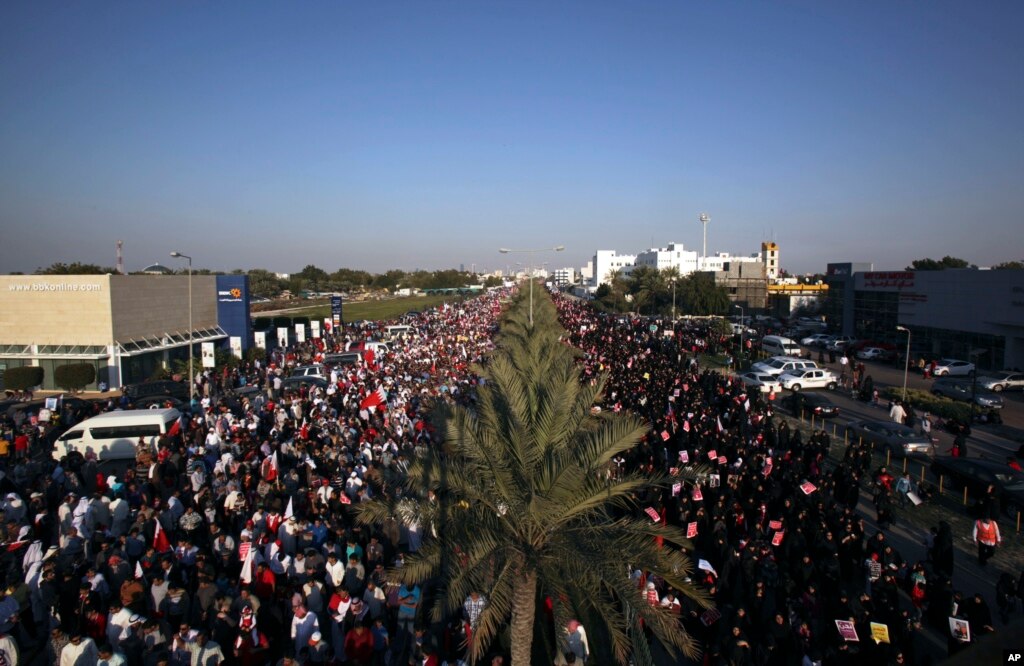
Bahrain Protest Attracts Tens of Thousands

VOA


Tens of thousands of Bahraini pro-democracy protesters wave signs and national flags during a march along a divided four-lane highway near Barbar, Bahrain, west of the capital of Manama, Feb. 15, 2014.

Reuters

The rally organized by the kingdom's main opposition al-Wefaq movement was one of the biggest staged since 2011.
Vast crowds of men, women and children took to the streets of the small Gulf Arab nation calling for democracy, political reform and the release of political prisoners, witnesses said.
"We will not stop until we achieve our demands," protesters shouted. "Shi'ites and Sunnis, we all love this country."
Police could not be seen at the rally on Budaiya Highway, which links Bahrain's southern Budaiya region with the capital Manama, witnesses said. No clashes were reported.
The Interior Ministry said a policeman had died after being wounded by a "terrorist" blast on Friday. Three other policemenwere wounded the same day, while 26 people had been arrested.
"Some villages saw rioting, vandalism and the targeting of policemen," the ministry said, referring to Friday's unrest.
Bahrain, with Saudi help, crushed the demonstrations that began on Feb. 14, 2011 inspired by Arab uprisings elsewhere, but has yet to resolve the conflict between majority Shi'ites and the Sunni-led monarchy they accuse of oppressing them.
The ruling family has launched a third round of dialogue with its opponents, but no political agreement is in sight.


Read More Here

Related Articles

.....
SFGate

Bahrainis protest, wounded police officer dies

Updated 11:41 am, Saturday, February 15, 2014
Police officers carry the body of fellow policeman Abdul Wahid Al Balouchi, who was killed in a bombing on Friday, during his funeral procession in Riffa, Bahrain, Saturday, Feb. 15, 2014. Thousands of Bahraini protesters clashed with security forces on Saturday, sending tear gas into a major shopping mall and bringing the capital's streets to a standstill on the same day that authorities said a police officer died of injuries sustained from an earlier bombing. Photo: Uncredited, AP / AP
Police officers carry the body of fellow policeman Abdul Wahid Al Balouchi, who was killed in a bombing on Friday, during his funeral procession in Riffa, Bahrain, Saturday, Feb. 15, 2014. Thousands of Bahraini protesters clashed with security forces on Saturday, sending tear gas into a major shopping mall and bringing the capital's streets to a standstill on the same day that authorities said a police officer died of injuries sustained from an earlier bombing. Photo: Uncredited, AP
MANAMA, Bahrain (AP) — Bahraini anti-government activists clashed with security forces as thousands of demonstrators took to the streets on Saturday, sending tear gas into a major shopping mall and bringing the capital's streets to a standstill on the same day that authorities said a police officer died of injuries sustained from an earlier bombing.
The Interior Ministry said that the officer was one of two injured in what it called a "terrorist blast" on Friday in the village of Dair, near the country's main airport. It did not identify the officer. In a second statement, the ministry characterized recent attacks against security forces as "urban guerrilla warfare."
Chaos in the small Gulf-island nation highlights deeper regional sectarian tensions that continue to roil Bahrain three years after the country's majority Shiites began an Arab Spring-inspired uprising to demand greater political rights from the Sunni-led monarchy.
Neighboring Sunni-ruled Gulf countries with smaller Shiite populations, led by Saudi Arabia, sent troops to Bahrain in an effort to stem the uprising in 2011. More than 65 people have died in the unrest, but rights groups and others put the death toll higher.


Read More Here
.....
Enhanced by Zemanta

Sunday, February 2, 2014

Syrian forces launch new Aleppo strikes


War burns in Syria 0:58

http://content5.video.news.com.au/NDM_CP_-_Reuters/274/606/2434365298_promo215554805_648x365_2434365418-hero.jpg
AP February 02, 2014
SYRIAN military helicopters have dropped barrels packed with explosives in the government's latest air raids on rebel-held areas of the northern city of Aleppo, killing at least 23 people including a family trapped in a burning car, activists said.
In neighbouring Lebanon, a car bomb blew up near a gas station in a Shiite town, killing at least three people, in the latest attack linked to the war in neighbouring Syria.
Footage on al-Manar television, associated with the Shiite group Hezbollah, showed a bright orange blaze as black silhouettes of people ran by the gas station in the north-eastern town of Hermel that lies near the Syrian border. Blasts could be heard in the background. The Lebanese Red Cross said another 18 people were wounded. The organisation initially reported that four people were killed, but later revised the number downwards.
The large blast occurred near a school for impoverished and orphaned children. None were injured, officials said.
It was the latest in a series of attacks targeting Lebanon's Shiite community, as Syria's violence causes neighbouring Lebanon's sectarian tensions to escalate into outright violence.
Sunni militant groups have claimed responsibility for a relentless series of attacks on Shiite parts of Lebanon, including a bomb that exploded in Hermel in late January. They say it is in retaliation for the Shiite Hezbollah group sending its fighters into Syria's civil war to support forces of President Bashar Assad.
Lebanon's Sunni community has also been hit, most notably by a deadly double car bombing outside Sunni mosques in the northern Lebanese city of Tripoli in August.
In Aleppo, the raids with barrel bombs, as the crude weapons are known, have flattened residential buildings, forcing defenders to flee and allowing government troops to advance.
The latest attacks killed 13 people in the al-Bab area of Aleppo, Hassoun Abu Faisal of the Aleppo Media Center said via Skype. The British-based Syrian Observatory for Human Rights corroborated the information.
The blasts badly damaged buildings and caused a fuel tanker to explode, setting nearby vehicles alight, including one carrying a family of eight who were trying to flee the area as they heard the approaching helicopters, said Abu Faisal.

Read More Here

.....

Aljazeera News

Fighting continues as Syria talks wind up

Regime forces accused of using barrel bombs on Aleppo's rebel-held areas, after Geneva summit ends without breakthrough.

Last updated: 02 Feb 2014 03:43
Syrian opposition activists say military helicopters have dropped barrels packed with explosives in the government's latest air raids on rebel-held areas of the northern city of Aleppo, killing at least 23 people including a family trapped in a burning car.
In Aleppo, the raids with barrel bombs, as the crude weapons are known, have flattened residential buildings, forcing defenders to flee and allowing government troops to advance, the activists say.
Saturday's attacks killed 13 people in the al-Bab area of Aleppo, Hassoun Abu Faisal of the Aleppo Media Centre said via Skype.
The British-based Syrian Observatory for Human Rights corroborated the information.
The blasts badly damaged buildings and caused a fuel tanker to explode, setting nearby vehicles alight, including one carrying a family of eight who were trying to flee the area as they heard the approaching helicopters, Abu Faisal said.
A video showed men dragging a charred victim out of a smashed building.
"You want a political solution? Here is a political solution!" shouted one man as he pointed at two charred bodies on the rubble-strewn ground.
The man was referring to last week's conference in Switzerland between government officials and opposition activists seeking to resolve Syria's war, which began as a peaceful uprising in March 2011 against the rule of President Bashar al-Assad.
The Geneva summit did not produce any tangible results, but is likely to lead to backdoor negotiations.
More bombings
Other barrel bombings in Aleppo killed three people near a mosque and another seven people in the Ansari quarter, activists said.
Ansari is frequently hit. On Friday, activists uploaded a video of what they said was a child being pulled alive from the rubble after shelling there.
Scenes of civilians and firefighters pulling out dusty, bloodied bodies from under the rubble have become more frequent as the bombing continues.
The footage appeared authentic and reflected Associated Press reporting of the event.
The barrel bombing in Aleppo comes as Syrian government forces try retake the city, which has been divided into government- and opposition-held areas since mid-2012.
Read More Here
.....
Enhanced by Zemanta

Sunday, September 1, 2013

Al-Qaeda claims responsibility for Iraq bombings


Iraqis inspect the aftermath of a car bomb attack, in the Shiite enclave of Sadr City, Baghdad, Iraq, Monday, July. 29, 2013. A wave of over a dozen car bombings hit central and southern Iraq during morning rush hour on Monday, officials said, killing scores in the latest coordinated attack by insurgents determined to undermine the government. (AP Photo/Karim Kadim)
.
Associated Press

BAGHDAD (AP) — The Iraqi branch of al-Qaeda claimed responsibility Friday for bombings earlier this week that killed at least 82 people, mostly in Shiite areas of the capital, calling them retaliation for the execution of Sunni prisoners by the Shiite-led government.
Wednesday's attacks involved car bombs and other explosives that mainly targeted parking lots, outdoor markets and restaurants in Shiite districts in Baghdad during the morning rush hour. Some Sunni areas were also hit later in the day.
A statement posted on a militant website by the Islamic State of Iraq and the Levant, the al-Qaeda affiliate in Iraq, took responsibility for the deadly attacks. The group claimed the attacks were a response to the Aug. 19 execution of 17 Sunni prisoners, all but one of them convicted on terrorism-related charges.
The authenticity of the statement could not be independently confirmed. It was posted on a website commonly used by jihadists and its style was consistent with earlier al-Qaeda statements.
It said tight security measures imposed by Iraqi forces failed to stop the attacks, and the group vowed to carry out more attacks against government targets.
"We will avenge the blood of our brothers," the group said.
The bombings were the latest in a wave of bloodshed that has swept Iraq since April, killing more than 4,000 people and worsening already strained ties between Iraq's Sunni minority and the Shiite-led government. More than 570 people have been killed so far in August.


Read More Here


********************************************************

Iraq Bombings, House Raid Kill at Least 80 People


Car bomb blasts and other explosions tore through mainly Shiite districts around Baghdad during morning rush hour Wednesday in a day of violence that killed at least 80, intensifying worries about Iraq's ability to tame the spiraling mayhem gripping the country.
It was the latest set of large-scale sectarian attacks to hit Iraq, even as the government went on "high alert" in case a possible Western strike in neighboring Syria increases Iraq's turmoil.
A relentless wave of killing has left thousands dead since April in the country's worst spate of bloodshed since 2008. The surge in violence raises fears that Iraq is hurtling back toward the widespread sectarian killing that peaked in 2006 and 2007, when the country was teetering on the edge of civil war.
Most of Wednesday's attacks happened in within minutes of each other as people headed to work or were out shopping early in the day. Insurgents unleashed explosives-laden cars, suicide bombers and other bombs that targeted parking lots, outdoor markets and restaurants in predominantly Shiite areas in and around Baghdad, officials said. A military convoy was hit south of the capital.
Security forces sealed off the blast scenes as ambulances raced to pick up the wounded. The twisted wreckage of cars littered the pavement while cleaners and shop owners brushed away debris. At one restaurant, the floor was stained with blood and dishes were scattered on plastic tables.
"What sin have those innocent people committed?" asked Ahmed Jassim, who witnessed one of the explosions in Baghdad's Hurriyah neighborhood. "We hold the government responsible."
The northern neighborhood of Kazimiyah, home to a prominent Shiite shrine, was among the worst hit. Two bombs went off in a parking lot, followed by a suicide car bomber who struck onlookers who had gathered at the scene. Police said the attack killed 10 people and wounded 27.
There was no immediate claim of responsibility for the attacks, but they bore the hallmarks of the Iraqi branch of al-Qaida, which operates in Iraq under the name the Islamic State of Iraq and the Levant. The group frequently targets Shiites, which it considers heretics, and carries out coordinated bombings in an attempt to incite sectarian strife.


Read More Here


********************************************************
Enhanced by Zemanta