This
film follows the story of programming prodigy and information activist
Aaron Swartz. From Swartz's help in the development of the basic
internet protocol RSS to his co-founding of Reddit, his fingerprints are
all over the internet. But it was Swartz's groundbreaking work in
social justice and political organizing combined with his aggressive
approach to information access that ensnared him in a two-year legal
nightmare. It was a battle that ended with the taking of his own life at
the age of 26. Aaron's story touched a nerve with people far beyond the
online communities in which he was a celebrity. This film is a personal
story about what we lose when we are tone deaf about technology and its
relationship to our civil liberties.
Film by Brian Knappenberger - Luminant Media http://www.takepart.com/internets-own... https://www.kickstarter.com/projects/...
- Watch some of our other videos -
Anonymous Documentary - How Anonymous Hackers Changed the World Full Documentary: https://www.youtube.com/watch?v=FAECy...
Anonymous Documentary - The Story of the Anonymous Hacktivists Full Documentary: https://www.youtube.com/watch?v=bC1ex...
Anonymous - Plan to defeat the Illuminati and New World Order 2015: https://www.youtube.com/watch?v=kobrw...
'Copyright
Disclaimer Under Section 107 of the Copyright Act 1976, allowance is
made for 'fair use' for purposes such as criticism, comment, news
reporting, teaching, scholarship, and research. Fair use is a use
permitted by copyright statute that might otherwise be infringing.
Non-profit, educational or personal use tips the balance in favor of
fair use'
LEGAL DISCLAIMER
The content within these recordings
are property of their respective Designers, Writers, Creators, Owners,
Organizations, Companies and Producers. I do not and will not profit
from making and uploading these recordings, they are for fun &
archival purposes only. This Disclaimer applies to all uploaded
recordings within my account unless stated otherwise in videos'
description. I will not give out Torrent links nor do I condone their
use.
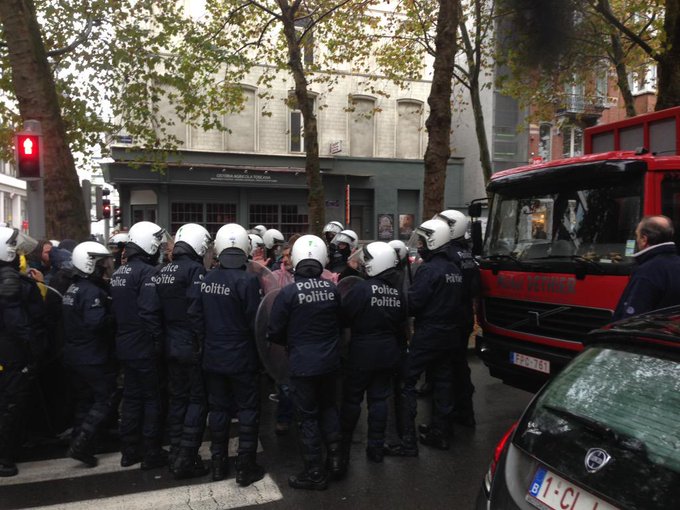
At least 100 people have been arrested in Brussels, where
hundreds more protested against TTIP, an impending free trade deal
between the US and the EU, as the next round of TTIP talks approaches.
Roads were paralyzed in
the Belgian capital as a force of more than 600 activists descended on
EU headquarters, blocking traffic and the venue of the EU leaders summit
in protest against the Transatlantic Trade and Investment Partnership
(TTIP).
People carried signs and chanted slogans such as “Stop TTIP, stop austerity” and "Sorry for the inconvenience. We're trying to save the world," at the march in Brussels on Thursday. "TTIP is death" another sign read. One group of protesters displayed a balloon ‘Trojan Horse’ as an allegory for the deal.
Last week, WikiLeaks released the final text of the TPP’s intellectual property rights chapter and it is absolutely terrifying.
These are just a few of its most dangerous pieces:
Compel ISPs to take down websites without any sort of court order, just like SOPA. (Appendix Section I)
Extend
the US’s copyright regime to require copyrights stand for life plus 70
years, preventing anyone from using works that belong in the public
domain. (Article QQ.G.6)
Criminalize
whistleblowing by extending trade secrets laws without any mandatory
exemptions for whistleblowers or investigative journalists. (QQ.H.8)
End anonymity online by forcing every domain name to be associated with a real name and address. (Article QQ.C.12)
Make it illegal to unlock, modify, or generally tinker with a device you own. (Article QQ.G.10)
Export
the US’s broken copyright policies to the rest of the world without
expanding any of the free speech protections, like fair use. (Article
QQ.G.17)
The worst part is that this is just one of the TPP’s 30 chapters.
For
years, governments have held critics of the massive Trans-Pacific
Partnership agreement in a perfect catch 22. Officials brushed off
public outcry and concern by claiming that the dissenters didn’t have
all the facts.
This was by design—the 12 country trade
deal was negotiated entirely behind closed doors by industry lobbyists
and government appointees, and even now the text of the agreement is
still classified.
But late last week, WikiLeaks released
the final text of the Intellectual Property chapter, meaning those
excuses won’t work anymore.
We’re planning to go
all out against the TPP, but the first step is to make sure Congress
knows just how many people oppose the TPP.
Taking
action today is just the beginning, because if all we do is send emails
and make phone calls, Congress is not going to reject the TPP. Too many
giant industries are seriously invested in making sure Congress
ratifies the TPP.
If we’re going to win, we need to go big. Which is exactly what we’re going to do.
Already
we have plans to work with hundreds of different groups as a massive
coalition to fight the TPP, coordinate gigantic on-the-ground protests
in key cities across the country, and produce compelling content to
spread the word to as many different audiences as possible just what is
at stake in the TPP.
P.S. Want to read the text of the chapter for yourself? Check it out on WikiLeaks here, or read their overview of it here. It’s long and complicated, so maybe you'll see something that we didn't. If you do, send us an email.
*KILL THE TPP!!!*
Excellent!:
— Noam Chomsky has joined the chorus decrying the TPP, which has very
little to do with free trade and is really about limiting regulation,
helping corporate interests and imposing fiercer standards of
intellectual property (to, again, largely benefit corporate interests). ...See More
The
Obama administration's Trans-Pacific Partnership trade deal is an
"assault," on working people intended to further corporate "domination,"
according to author…
Let me give you an example of what TPP could allow:
You
are an independent journalist or blogger. You need content. Suddenly,
all the pictures, videos, memes and articles become "private property."
You want to cite the video, where the now former NRC chairman turns
whistleblower and says he's adamantly anti-nuclear, after witnessing the
damage at Fukushima. You can't. A major news outlet owns the press
conference video footage. You place a stupid cat meme on your page,
withou... See More
A
chapter of the Trans-Pacific Partnership released by WikiLeaks reveals
potential violations of applicable U.S. environmental standards. By Joe
Wolverton, II, J.D.
Ed
Schultz led the coverage over the dangers of TPP. Finally, Congress and
the media begin to realize the importance of stopping this bill. Larry
Cohen joins.
#AceSecurityNews
says latest information and opinions from RT on the release of the
“TTPP Uncovered: WikiLeaks releases draft of highly-secretive
multi-national trade deal” documents together with download at this link
PDF Published time: November 13, 2013 17:36 Edited time: November 15, 2013 09:36
Get short URL
#AceSecurityNews
says latest information from RT on the release of the "TTPP Uncovered:
WikiLeaks releases draft of highly-secretive multi-national trade…
Digital
rights groups warn that TPP "will criminalize our online activities,
censor the Web, and cost everyday users money." (Photo: Getty)
The "disastrous" pro-corporate trade deal finalized
Monday could kill the Internet as we know it, campaigners are warning,
as they vow to keep up the fight against the Trans Pacific Partnership (TPP) agreement between the U.S. and 11 Pacific Rim nations.
"Internet users around the world should be very concerned about this ultra-secret pact," said
OpenMedia's digital rights specialist Meghan Sali. "What we’re talking
about here is global Internet censorship. It will criminalize our online
activities, censor the Web, and cost everyday users money. This deal
would never pass with the whole world watching—that’s why they’ve
negotiated it in total secrecy."
"The TPP will
criminalize our online activities, censor the Web, and cost everyday
users money. This deal would never pass with the whole world
watching—that’s why they’ve negotiated it in total secrecy." —Meghan
Sali, Open Media
TPP opponents have claimed
that under the agreement, "Internet Service Providers could be required
to 'police' user activity (i.e. police YOU), take down Internet
content, and cut people off from Internet access for common
user-generated content."
Among the deal's provisions are rules that could criminalize file-sharing, whistleblowing, and breaking digital locks,
even for legitimate purposes. Of course, because the contents of the
pact have been negotiated largely in secret, the exact implications of
the TPP on user rights is yet to be seen.
However, Electronic
Frontier Foundation's (EFF) Maira Sutton wrote on Monday, "We have no
reason to believe that the TPP has improved much at all from the last leaked version released in August, and we won't know until the U.S. Trade Representative releases the text. So as long as it contains a retroactive 20-year copyright term extension, bans on circumventing DRM, massively disproportionate punishments for copyright infringement, and rules that criminalize investigative journalists and whistleblowers, we have to do everything we can to stop this agreement from getting signed, ratified, and put into force."
Furthermore,
"The fact that close to 800 million Internet users' rights to free
expression, privacy, and access to knowledge online hinged upon the
outcome of squabbles over trade rules on cars and milk is precisely why
digital policy consideration[s] do not belong in trade agreements,"
Sutton added, referring to the auto and dairy tariff provisions that reportedly held up the talks.
"The
fact that close to 800 million Internet users' rights to free
expression, privacy, and access to knowledge online hinged upon the
outcome of squabbles over trade rules on cars and milk is precisely why
digital policy consideration[s] do not belong in trade agreements."
—Maira Sutton, EFF
With a major protest against the TPP and other secret trade deals planned for November
in Washington, D.C., EFF is crowdsourcing slogans related to how the
TPP threatens digital rights and freedoms around the world.
"Successive
leaks of the TPP have demonstrated that unless you are a big business
sector, the [U.S. Trade Representative, or USTR] simply doesn't care
what you have to say," wrote EFF's Jeremy Malcolm.
"Enough's enough," reads the group's call-to-action.
"The time for whitepapers and presentations is past. The USTR has
failed us, so now it's time for the public to rise up and take their
message about the TPP's threats to user rights to Congress, which has
the ultimate authority to approve or reject the deal for the United
States."
This work is licensed under a Creative Commons Attribution-Share Alike 3.0 License
Fresh
off the scene from those two epic embarrassments, the UN now wants to
tell governments of the world how to censor the internet. I wish I was
kidding.
From the Washington Post:
On
Thursday, the organization’s Broadband Commission for Digital
Development released a damning “world-wide wake-up call” on what it
calls “cyber VAWG,” or violence against women and girls. The report
concludes that online harassment is “a problem of pandemic proportion” —
which, nbd, we’ve all heard before. But the
United Nations then goes on to propose radical, proactive policy changes
for both governments and social networks, effectively projecting a
whole new vision for how the Internet could work.
Under
U.S. law — the law that, not coincidentally, governs most of the
world’s largest online platforms — intermediaries such as Twitter and
Facebook generally can’t be held responsible for what people do on them.
But the United Nations proposes both that social networks
proactively police every profile and post, and that government agencies
only “license” those who agree to do so.
People are being harassed online, and the solution is to censor everything and license speech? Remarkable.
So
many politicians blatantly push for policies that harm all of us, just
because the special interests that fund their campaigns want them to.
Because
of this, Congress tries to hide -- taking vague positions, pushing for
watered down legislation, or remaining silent at critical moments.
This
week, they’re expected to renew debate on CISA, the Cybersecurity
Information Sharing Act, a bill that would give corporations sweeping
legal immunity when they share your data with the government.
Now more than ever, it’s so important that we don’t let our lawmakers hide in the shadows.
P.S.
As much as we’ve talked about how bad CISA is for expanding mass
surveillance, there’s another side to the law that just made it even
worse. Late last week, Senator Sheldon Whitehouse of Rhode Island
introduced an amendment to expand the Computer Fraud and Abuse Act, the
law that has been used time and again to persecute digital activists,
including our friend Aaron Swartz. That’s despicable, and needs to be quashed immediately — so take action now to help kill CISA.
In
2007, at a public forum at Coe College, in Iowa, Presidential candidate
Barack Obama was asked about net neutrality. Specifically, “Would you
make it a priority in your first year of office to reinstate net
neutrality as the law of the land? And would you pledge to only appoint
F.C.C. commissioners that support open Internet principles like net
neutrality?”
“The answer is yes,” Obama replied. “I am a strong
supporter of net neutrality.” Explaining, he said, “What you’ve been
seeing is some lobbying that says that the servers and the various
portals through which you’re getting information over the Internet
should be able to be gatekeepers and to charge different rates to
different Web sites…. And that I think destroys one of the best things
about the Internet—which is that there is this incredible equality
there.”
If reports in the Wall Street Journal are correct, Obama’s chairman of the Federal Communications Commission, Thomas Wheeler,
has proposed a new rule that is an explicit and blatant violation of
this promise. In fact, it permits and encourages exactly what Obama
warned against: broadband carriers acting as gatekeepers and charging
Web sites a payola payment to reach customers through a “fast lane.”
Federal
regulators are expected to release draft net neutrality rules in
mid-May as part of an ongoing effort to craft rules for Internet traffic
that might actually hold up in court.
Federal Communications
Commission Chairman Tom Wheeler said Wednesday that the agency would
consider draft “Open Internet,” or net neutrality, rules at an agency
meeting May 15. As we reported
in February, Wheeler will propose basically the same rules that the
agency had tried before, but justify them under a different part of the
law.
Consumer groups have complained about that plan because
they’re worried that Wheeler’s rules may not hold up in court either. A
federal appeals court rejected two previous versions of net neutrality
rules after finding fault in the FCC’s legal reasoning. During the
latest smackdown, however, the court suggested that the FCC had some
authority to impose net neutrality rules under a section of the law that
gives the agency the ability to regulate the deployment of broadband
lines.
Internet activists would prefer that the FCC just re-regulate Internet
lines under old rules designed for telephone networks, which they say
would give the agency clear authority to police Internet lines. Wheeler
has rejected that approach for now. Phone and cable companies, including
Comcast, AT&T and Verizon, have vociferously fought that idea over
the past few years.
What if you had only three weeks before the Internet you know and love was about to disappear?
Would you spend your time binging on listicles or the final season of Breaking Bad? Or would you do something about it?
Would
you email all your friends with the news? Blast your social media
networks? Demand that Congress and the president keep this amazing
invention from going away?
If the Internet had only three weeks left, would you take to the streets and raise hell?
I bet you would.
And
here's your chance to prove it: Because three weeks from today the
Internet as we know it may not disappear, but it could be a lot closer
to the precipice.
On May 15, the Federal Communications Commission
will propose a new set of rules that are supposed to stop big phone and
cable companies from blocking websites or discriminating against apps
and services they don't like. Only as written the rules would do pretty
much the opposite.
According to numeroussources,
FCC Chairman Tom Wheeler's proposal would allow Internet service
providers like Verizon or Time Warner Cable to charge extra fees to
content companies like Google and Netflix for preferential treatment,
guaranteeing their content reaches end-users ahead of those that don't
pay.
In other words: Goodbye, open Internet. Hello, payola Schminternet.
By Chris Strohm - Nov 15, 2013 10:42 AM CT Google Inc., Facebook Inc. and Yahoo! Inc. are fighting back against the National Security Agency by using harder-to-crack code to shield their networks and online customer data from unauthorized U.S. spying.
The
companies, burned by disclosures they’ve cooperated with U.S.
surveillance programs, are protecting user e-mail and social-media posts
with strengthened encryption that the U.S. government says won’t be
easily broken until 2030. Enlarge image
The National Security Agency headquarters in Fort Meade, Maryland. Photographer: NSA via Getty Images
The
NSA has tapped fiber-optic cables abroad in order to siphon off data
from Google and Yahoo, circumvented or cracked encryption, and covertly
introduced weaknesses and back doors into digital coding, according to
reports in the Washington Post, the New York Times and the U.K.’s
Guardian newspaper based on documents leaked by former NSA contractor
Edward Snowden. Photographer: Krisztian Bocsi/Bloomberg
While
the NSA may find ways around the barriers, the companies say they have
to assure users their online connections are secure and data can’t be
grabbed when transmitted over fiber-optic networks or digitally stored. Microsoft Corp.
is convinced it must “invest in protecting customers’ information from a
wide range of threats, which if the allegations are true, include
governments,” Matt Thomlinson, general manager of trustworthy computing,
said in an e-mail. He didn’t provide details.
Internet companies
including Google, Yahoo, Facebook, Microsoft and Apple Inc. are trying
to distance themselves from news reports that they gave the agency data
on electronic communications of Americans and foreigners or have lax
security.
While the companies are trying to prevent the NSA from
gaining unauthorized access to their data, they say they comply with
legal court orders compelling them to provide the government
information.
The NSA has tapped fiber-optic cables abroad in order
to siphon off data from Google and Yahoo, circumvented or cracked
encryption, and covertly introduced weaknesses and back doors into
coding, according to reports in the Washington Post, the New York Times
and the U.K.’s Guardian newspaper based on documents leaked by former
NSA contractor Edward Snowden.
Game On
Companies
are fighting back primarily by using increasingly complex encryption,
which scrambles data using a mathematical formula that can be decoded
only with a special digital key. The idea is to protect sensitive
information like e-mails, Internet searches and digital calls.
Google
has accelerated efforts to encrypt information flowing between its data
centers, doubled the length of its digital keys and implemented
measures to detect fraudulent certificates for verifying the
authenticity of websites, according to a statement from the Mountain
View, California-based company.
NSA spy programs have “the great
potential for doing serious damage to the competitiveness” of U.S.
companies, Richard Salgado, Google’s director of law enforcement and
information security, told a Senate subcommittee Nov. 13.
“It’s
very important that the users of our services understand that we are
stewards of their data, we hold it responsibly, we treat it with
respect,” Salgado said. “We’ve already seen impacts on the businesses.”
Government Threat
Google,
Yahoo and Facebook generated $44.4 billion in advertising revenue so
far in 2013 in part by mining users’ private data, according to
Bloomberg Industries.
An Aug. 14 analysis by Forrester Research Inc. analyst James Staten found the U.S. cloud computing industry could lose as much as $180 billion by 2016 due to the spying disclosures.
Yahoo
will make encrypted connections standard by January for all its Mail
users with 2048-bit digital keys, Sarah Meron, a spokeswoman for the
Sunnyvale, California-based company, said in an e-mail.
Facebook,
in addition to moving toward 2048-bit encryption keys, is accelerating a
tactic known as “perfect forward secrecy” that prevents the NSA from
deciphering the communications of users if it obtains a security code, Jodi Seth, a company spokeswoman, said in an e-mail. Read More Here
...........
Battle brews as tech companies attempt to fend off NSA hacking
Google,
Facebook, Yahoo, and others are all improving their data encryption to
discourage the NSA from accessing user information.
The NSA allegedly gathered millions of records from Google and Yahoo data centers around the world, but soon, the agency might have a much harder time trying to collect this type of data.
Google,
Yahoo, Microsoft, Apple, and other prominent technology companies are
investing heavily in stronger, 2048-bit encryption. Due to computing
power constraints, it's expected to be more than a decade before this
type of encryption can be easily overcome.
Google, one of the leaders in the effort, announced in May that it would switch over to 2,048-bit encryption keys by the end of 2013. Yahoo recently confirmed to Bloomberg,
which spoke with several tech companies that are investing in new
encryption, that it will make 2048-bit encryption standard by January
2014 for all its Mail users. Facebook also plans to move to 2048-bit
encryption, a spokeswoman told Bloomberg, and will roll out "perfect
forward secrecy," a feature that prevents snoopers from accessing user
data even if they can access the company's security codes.
...........







 Re/code


